

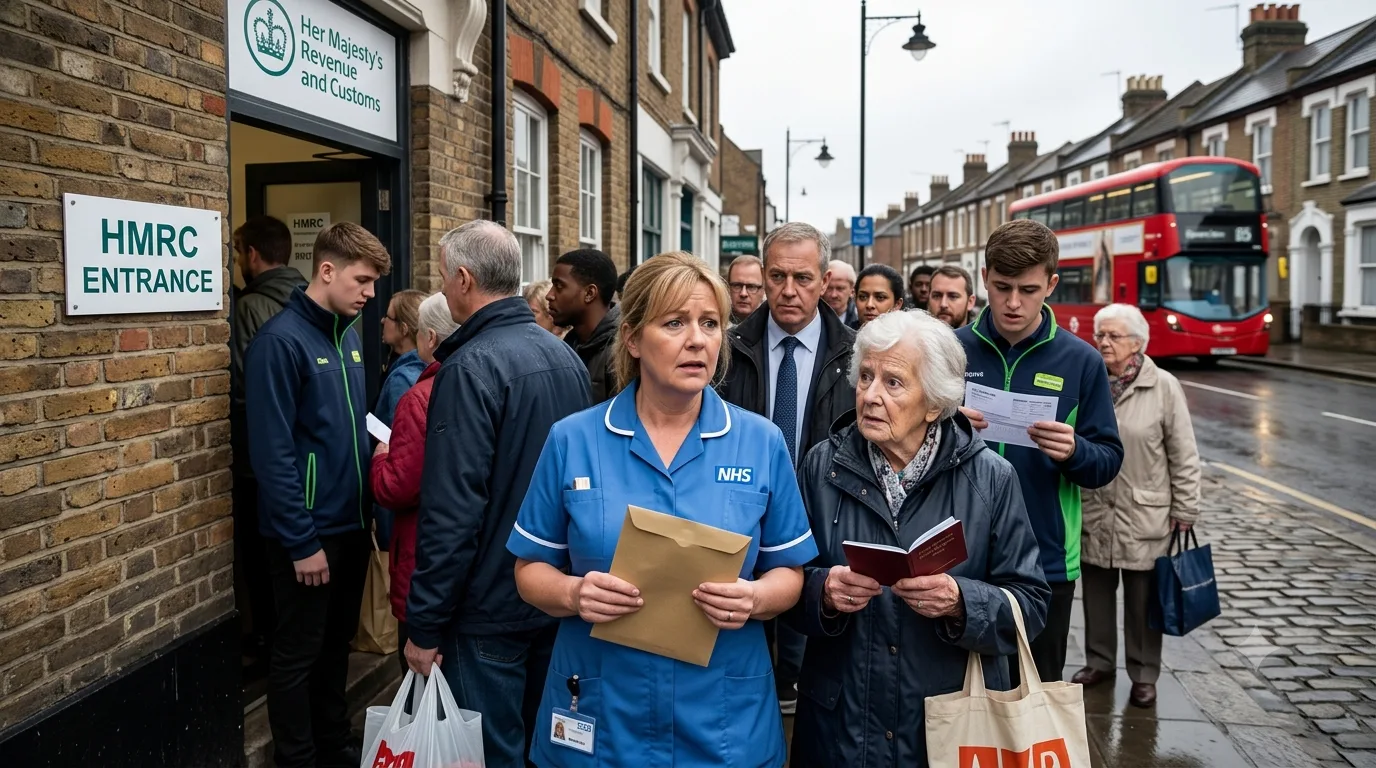
The latest tax threshold freeze HMRC data shows the number of people paying Income Tax continuing to rise as wages, pensions and other taxable incomes increase against allowances that remain fixed.
HMRC projects the UK Income Tax population will grow from 36.7 million in 2023/24 to 40.8 million in 2026/27. Higher-rate taxpayers are projected to reach 7.7 million, while around 9.58 million taxpayers will be above State Pension age.
The freeze is also showing up in actual tax receipts. Between April and July 2026, HMRC collected £117.6 billion in Income Tax, compared with £109.8 billion during the same four months of 2025.
What Does The Latest Tax Threshold Freeze HMRC Data Show?
HMRC’s July 2026 Income Tax Liabilities Statistics contain finalised 2023/24 data alongside projections for 2024/25, 2025/26 and 2026/27.
The figures are based on the Survey of Personal Incomes and economic assumptions consistent with the March 2026 fiscal forecast. Figures after 2023/24 are therefore projections rather than final taxpayer counts.
| Taxpayer Category | 2023/24 | 2026/27 Projection |
| All Income Taxpayers | 36.7 million | 40.8 million |
| Savers Rate | 652,000 | 415,000 |
| Basic Rate | 29.4 million | 31.4 million |
| Higher Rate | 5.76 million | 7.70 million |
| Additional Rate | 893,000 | 1.29 million |
| Above State Pension Age | 8.16 million | 9.58 million |
Higher-rate taxpayers are expected to increase from 15.7% of taxpayers in 2023/24 to 18.9% in 2026/27. Additional-rate taxpayer numbers are projected to rise 44% over the same period.
The savers-rate category is also worth noting. It covers people with no taxable earnings but taxable savings or dividend income. HMRC expects this group to fall from 652,000 to 415,000 between 2023/24 and 2026/27.
Is The Freeze Already Showing Up In HMRC Tax Receipts?
Yes. The latest cash data provides a useful comparison with HMRC’s longer-term liability projections.
Between April and July 2026, Income Tax receipts reached £117.6 billion, up £7.8 billion from £109.8 billion during the equivalent period in 2025. PAYE Income Tax receipts increased from £97.0 billion to £103.8 billion.
Liabilities and receipts should not be treated as the same measure. Liabilities show tax due on income arising within a tax year, while receipts show when HMRC actually collects the money. Self Assessment payment timings are one reason the totals differ.
For wider context, Income Tax raised £306 billion in 2024/25, compared with £171 billion from National Insurance contributions and £173 billion from VAT. Together, Income Tax, NICs and VAT accounted for just under 60% of government receipts.
How Has The Tax Threshold Freeze Expanded Since 2021?
The current freeze developed through several separate fiscal decisions.
The original measure fixed the Personal Allowance at £12,570 and the basic-rate limit at £37,700. The freeze was extended to 2027/28 in 2022 and later extended again through 2030/31.
The extension is now contained in Section 10 of the Finance Act 2026, which keeps the Personal Allowance and basic-rate limit unchanged for 2028/29, 2029/30 and 2030/31.
For most taxpayers in England, Wales and Northern Ireland, this keeps the higher-rate threshold at £50,270.
The earlier freeze was legislated through Section 5 of the Finance Act 2021, with the previous extension made through Section 5 of the Finance Act 2023.
How Much Has The Personal Allowance Lost In Real Terms?

A cash freeze does not mean the economic value of an allowance stays unchanged.
OBR analysis found that the six-year freeze originally running to 2027/28 would take the real value of the Personal Allowance back to approximately its 2013/14 level.
The OBR also calculated that the personal tax threshold measures then in place had a revenue effect comparable to a 4p increase in the basic rate of Income Tax by 2027/28.
The freeze has since been extended further. The OBR’s November 2025 forecast estimated that, had the Personal Allowance and higher-rate threshold instead risen with inflation, they would be approximately £4,900 and £20,100 higher respectively by 2030/31.
That explains why calls to increase the Personal Allowance have attracted attention. The current Personal Allowance increase campaign focuses on how wage growth against a fixed £12,570 allowance gradually brings more earnings into tax.
How Far Is Higher-Rate Tax Moving Down The Earnings Distribution?
Fiscal drag affects both people entering Income Tax for the first time and existing taxpayers moving into higher bands.
IFS modelling published before the final 2025 Budget examined a freeze extension through 2029/30. It estimated that the higher-rate threshold, which had stood just below the 90th percentile of employee earnings in 2019/20, could reach around the 75th percentile.
That would mean roughly one in four employees earning more than the higher-rate threshold applying outside Scotland.
The exact figure should be treated as modelling rather than a current HMRC taxpayer projection, particularly because the eventual freeze now runs through 2030/31.
The same IFS analysis illustrates the effect at the other end of the earnings scale. A minimum-wage worker needed to work about 31 hours a week before becoming liable for Income Tax in 2015/16. Under its freeze scenario, that could fall to around 18 hours by 2029/30.
At the current 2026 National Living Wage of £12.71 an hour, annual earnings reach the £12,570 Personal Allowance at roughly 19 hours a week when working throughout the year.
It Is Not Just Income Tax: National Insurance Thresholds Matter Too
The wider fiscal-drag picture includes National Insurance.
For 2026/27, the employee National Insurance primary threshold is £12,570 and the upper earnings limit is £50,270. The employer secondary threshold is £5,000.
Budget 2025 extended equivalent employee and self-employed NI thresholds and the employer secondary threshold through April 2031.
OBR modelling puts the combined impact of the various Income Tax and NIC threshold measures at about £66.6 billion in additional annual receipts by 2030/31 compared with thresholds otherwise being uprated.
Around £55.5 billion of that total relates to Income Tax threshold measures.
For employers, this means rising gross wages can increase both employee tax exposure and payroll costs even when headline rates remain unchanged.
How Does The Freeze Affect Universal Credit Claimants?
Tax thresholds also interact with means-tested benefits.
IFS modelling estimated that, under its earlier freeze-extension scenario, around 3.1 million taxpayers could be in families entitled to Universal Credit.
Universal Credit normally falls by 55p for each additional £1 of earnings above the applicable work allowance after tax.
IFS calculated that a UC claimant paying both Income Tax and National Insurance may typically keep no more than around 32p from an additional £1 of gross earnings after these interactions.
This does not mean every UC claimant faces the same effective deduction. Work allowances, household circumstances, earnings levels and other deductions can materially change the calculation.
Which Regions Have The Most Higher-Rate Taxpayers?
HMRC’s regional data shows that fiscal drag does not start from the same position across the country.
In 2023/24, higher and additional-rate taxpayers represented 28.9% of Income Taxpayers in London, followed by 22.8% in the South East, 20.8% in Scotland and 20.1% in the East of England.
Northern Ireland had the lowest proportion at 10.7%, followed by Wales at 11.9% and the North East at 12.0%.
Scotland also operates separate bands for non-savings, non-dividend income. Its higher-rate threshold has remained at £43,662 since 2021/22, although Scottish tax bands and rates differ more widely from those elsewhere in the UK.
HMRC’s gender data shows men represented 54.4% of Income Taxpayers in 2023/24 compared with 48.5% of the UK population aged 16 and over. Women accounted for 45.6% of Income Taxpayers.
Who Actually Pays The Most Income Tax?
HMRC estimates total Income Tax liabilities increased from £274 billion in 2023/24 and will reach approximately £347 billion in 2026/27.
The tax burden remains concentrated among higher-income taxpayers.
| Taxpayer Group | Share Of 2023/24 Income Tax |
| Top 1% | 27.2% |
| Top 10% | 59.1% |
| Top 50% | 90.1% |
| Bottom 50% | 9.9% |
HMRC also projects average Income Tax liability across all income ranges to rise by around £1,030, from £7,470 in 2023/24 to £8,510 in 2026/27.
These figures do not mean each taxpayer’s bill will rise by £1,030. They reflect changes in taxpayer numbers, incomes and the proportion of people moving into higher bands.
Why Are More Pensioners Being Drawn Into Income Tax?
Pensioners are particularly exposed because the State Pension rises while the Personal Allowance remains at £12,570.
The full new State Pension is £241.30 a week in 2026/27.
Using the headline 52-week rate gives £12,547.60, although HMRC’s taxable State Pension calculation generally uses one week at the previous rate and 51 weeks at the new rate where the April increase applies.
HMRC projects 9.58 million Income Taxpayers above its modelled State Pension age in 2026/27.
Tax becomes more likely where someone also receives a workplace pension, private pension, employment income or taxable savings.
Pensioners concerned about PAYE calculations may also want to check how State Pension income can affect HMRC tax calculations.
IFS previously projected the full new State Pension would exceed the Personal Allowance from 2027/28. However, there is an important qualification.
The Government has said people whose only income is the basic or new State Pension without increments will not have to pay small amounts of Income Tax through Simple Assessment over this Parliament.
As of September 2026, the detailed mechanism has still not been published.
Pensioners with other taxable income may still face tax. Savings income can also affect PAYE coding, making it useful to check any unexpected HMRC savings tax and tax-code adjustments.
What Does The Threshold Freeze Mean For Take-Home Pay?

For England, Wales and Northern Ireland in 2026/27, the standard Personal Allowance remains £12,570 and the higher-rate threshold remains £50,270.
| Illustrative Income | Approximate Income Tax |
| £13,500 | £186 |
| £55,000 | £9,432 |
| £110,000 | £33,432 |
At £55,000, the 40% rate does not apply to the entire salary. It applies to the portion above the relevant higher-rate threshold.
At £110,000, the Personal Allowance is reduced because it falls by £1 for every £2 of adjusted net income above £100,000.
Actual take-home pay can differ because of National Insurance, pensions, salary sacrifice, tax codes, student loans, benefits and Scottish Income Tax rules.
Conclusion
The latest tax threshold freeze HMRC data shows that fiscal drag is affecting an increasingly broad section of the UK population.
HMRC expects the taxpayer population to reach 40.8 million in 2026/27, while August receipts data shows Income Tax collections already rising strongly.
Longer-term OBR forecasts indicate that keeping Income Tax and National Insurance thresholds fixed through 2030/31 will continue bringing more income into tax even without increases to headline rates.
Workers, businesses, pensioners, savers and benefit claimants can all be affected differently.
The key issue is therefore not simply whether tax rates rise, but how rapidly earnings and other taxable income grow while the thresholds remain fixed.
FAQs
What Is The Tax Threshold Freeze?
It means important tax allowances and band limits remain fixed in cash terms rather than rising with inflation, allowing more income to become taxable as earnings increase.
How Long Is The Personal Allowance Frozen?
The £12,570 Personal Allowance is currently fixed through the 2030/31 tax year, meaning the present freeze runs until 5 April 2031.
How Many People Will Pay Income Tax In 2026/27?
HMRC projects approximately 40.8 million Income Taxpayers, compared with 36.7 million in the 2023/24 outturn data.
Will Everyone Pay More Tax Because Of The Freeze?
No. The effect depends on income growth and individual circumstances. Someone whose taxable income remains below their available allowances may still pay no Income Tax.
Does Crossing £50,270 Mean Your Whole Salary Is Taxed At 40%?
No. For most taxpayers outside Scotland, only the relevant portion above the higher-rate threshold is taxed at 40%.
Are National Insurance Thresholds Frozen Too?
Yes. Important employee, self-employed and employer National Insurance thresholds are also affected by freezes extending into the end of the decade.
Will State Pensioners Pay Income Tax From 2027/28?
Some pensioners already pay Income Tax because they have State Pension plus other taxable income.
The Government has said people relying solely on the basic or new State Pension without increments will not have to pay small amounts through Simple Assessment over this Parliament, but detailed arrangements have not yet been published.