


HMRC can normally assess unpaid tax going back four years from the end of the relevant tax period.
This can increase to six years when a tax loss results from careless behaviour, 12 years for certain offshore matters and 20 years for deliberate behaviour or specified failures to notify HMRC.
The 20-year rule does not mean HMRC automatically has permission to investigate every taxpayer for two decades. How far back HMRC can go depends on the type of tax, what caused the underpayment, when it happened and which statutory power HMRC is using.
| Circumstance | General Assessment Period |
| Normal Assessment | 4 Years |
| Careless Behaviour | 6 Years |
| Certain Offshore Matters | 12 Years |
| Deliberate Behaviour | 20 Years |
| Certain Failures To Notify | Up To 20 Years |
Last Updated: 11.09.2026
How Far Back Can HMRC Go Under Current UK Rules?
The normal HMRC assessment period is four years from the end of the relevant tax period.
This broadly applies where additional tax is due but the conditions allowing HMRC to use one of the extended assessment periods have not been established.
HMRC’s assessment rules distinguish between the ordinary four-year period and longer periods applying in particular circumstances.
The extended limits are not simply based on how much tax is involved.
When Does the Four-Year Rule Apply?
Four years is the normal assessment period for recovering tax that has been under-assessed, under-declared, over-repaid or incorrectly credited.
It is sometimes described as the period applying to an innocent mistake, but that is an oversimplification.
The more important question is whether HMRC has grounds to apply a longer statutory limit.
If there is no careless or deliberate behaviour and no other extended assessment rule applies, HMRC will generally need to act within the normal four-year period.
When Careless Errors Extend It To Six Years?
HMRC can potentially go back six years where a loss of tax was brought about by careless behaviour.
Carelessness generally means failing to take reasonable care in the circumstances. It does not require HMRC to prove fraud or deliberate dishonesty.
Examples could include failing to check obvious discrepancies against accounting records, submitting figures that cannot be supported by available records or providing an accountant with incomplete information.
However, an inaccurate return does not automatically mean the taxpayer was careless.
HMRC must consider the behaviour that caused the tax loss. Your existing content correctly distinguishes carelessness from deliberate behaviour.
When Offshore Tax Issues Can Reach 12 Years?
A 12-year assessment period can apply to certain losses of Income Tax, Capital Gains Tax and qualifying Inheritance Tax involving offshore matters or offshore transfers.
The rule does not mean every overseas account, foreign investment or international transaction automatically allows HMRC to go back 12 years.
Whether it applies depends on the nature of the offshore matter and the relevant statutory conditions.
There are also restrictions where HMRC received sufficient overseas information early enough to make an assessment within the normal four or six-year period.
Deliberate offshore behaviour can instead fall within the 20-year assessment framework.
When Can HMRC Investigate Up To 20 Years?
Twenty years is the longest commonly discussed HMRC assessment period.
It can apply where tax has been lost because of deliberate behaviour.
Examples could include knowingly omitting taxable income, deliberately understating sales or intentionally claiming expenditure that the taxpayer knows is not deductible.
The size of an adjustment alone does not prove deliberate behaviour. HMRC needs evidence supporting the behaviour classification.
The 20-year period can also apply in certain failure-to-notify cases. A person may have failed to tell HMRC that they became liable to tax or failed to register when legally required.
HMRC’s guidance confirms that the failure-to-notify time limit can be 20 years even where the original failure itself was not deliberate, although exceptions and tax-specific rules can apply.
HMRC Look-Back Rules Timeline
HMRC’s assessment time limits have developed over time, with the current framework allowing different look-back periods depending on the type of tax issue and taxpayer behaviour.
| Period | Position |
| Earlier Rules | HMRC assessment periods were gradually aligned across several taxes, creating the main four, six and 20-year framework. |
| 2019 Change | A 12-year assessment period was introduced for certain offshore Income Tax, Capital Gains Tax and Inheritance Tax cases. |
| Ongoing Position In 2026 | HMRC continues to use four years for ordinary cases, six years for careless behaviour, 12 years for qualifying offshore matters and 20 years for deliberate behaviour or certain failures to notify. |
| Future Outlook | The current limits remain in place, although future Finance Acts could change assessment periods or related compliance rules. |
What This Means For Taxpayers?
The relevant time limit depends on the tax year, type of tax and circumstances of the underpayment.
Older transitional rules can also affect offshore cases, so HMRC cannot automatically apply the longest period to every investigation.
What Do The HMRC Time Limits Look Like In Practice?
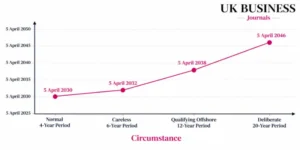
A calendar example makes the rules easier to understand.
Consider the 2025/26 tax year, which ended on 5 April 2026. In a simplified case where the relevant assessment period runs from the end of that tax year, the potential deadlines could look like this:
| Circumstance | Illustrative Deadline |
| Normal 4-Year Period | 5 April 2030 |
| Careless 6-Year Period | 5 April 2032 |
| Qualifying Offshore 12-Year Period | 5 April 2038 |
| Deliberate 20-Year Period | 5 April 2046 |
These dates are illustrations rather than universal deadlines. Different taxes, accounting periods, transactions and transitional rules can change how the relevant period is calculated.
This is why the answer to how far back HMRC can go should always be considered alongside the particular tax and circumstances rather than applying 4, 6, 12 or 20 years mechanically.
HMRC Enquiry Vs Discovery Assessment
One of the most important distinctions is between the deadline for opening a routine enquiry and the longer deadline HMRC may have for making an assessment.
They are not the same thing.
For an on-time Self Assessment return, HMRC’s normal enquiry window generally runs for 12 months from the date the return was received.
When a return is submitted after the normal filing date, the enquiry window can continue to the quarter date following the first anniversary of receipt. The relevant quarter dates are 31 January, 30 April, 31 July and 31 October.
The end of the enquiry window does not necessarily mean HMRC can never address that tax year again.
Can HMRC Make A Discovery Assessment Later?
A discovery assessment may be possible after the ordinary enquiry window has closed if the required legal conditions are satisfied and HMRC remains within the relevant assessment deadline.
A discovery exists where an HMRC officer reaches a reasonable conclusion that tax that should have been assessed has not been assessed, an existing assessment is insufficient or excessive relief has been given.
It must amount to more than simple suspicion.
A discovery assessment could therefore potentially involve the four, six, 12 or 20-year rules depending on the tax and circumstances.
This distinction matters because a taxpayer should not assume that the expiry of the normal Self Assessment enquiry window automatically closes every possible route for HMRC to address an older liability.
Equally, HMRC cannot simply describe something as a discovery and disregard the statutory conditions or relevant time limit.
What Records And Information Can HMRC Request?
During a compliance check, HMRC can request information and documents that are reasonably required to check a person’s tax position.
This can include accounts, invoices, receipts, tax calculations, contracts, correspondence and relevant bank records.
HMRC also has formal information powers under Schedule 36 of the Finance Act 2008.
There are safeguards surrounding these powers.
For example, an information notice should describe the requested documents or information clearly enough for the recipient to understand what must be provided.
Special restrictions also apply to documents created entirely more than six years before an information notice.
HMRC generally requires prior agreement from an authorised officer before such an old document can be formally required.
That does not mean HMRC can never ask about something more than six years old.
An older document may still be relevant to a later tax period. For example, an old purchase agreement may be required to establish the original cost of an asset when calculating a later capital gain.
Older documents may also become relevant where HMRC has reasonable grounds to suspect deliberate behaviour.
If records no longer exist, the taxpayer should not simply invent figures. Available bank records, invoices, statements, third-party documents and other reliable evidence may help reconstruct the position.
Does The HMRC Time Limit Depend On The Type Of Tax?
Yes. Although the four-year framework has broad application, the extended rules do not operate identically across every tax.
| Tax | Potential Position |
| Income Tax | 4, 6, 12 or 20 years depending on circumstances |
| Capital Gains Tax | 4, 6, 12 or 20 years depending on circumstances |
| Corporation Tax | Commonly 4, 6 or 20 years |
| Inheritance Tax | Can involve 4, 6, 12 or 20-year provisions |
| VAT | Four-year framework with VAT-specific restrictions |
| National Insurance | Separate assessment and recovery rules can apply |
The 12-year offshore assessment period is particularly important because it does not simply apply across every UK tax.
HMRC’s current guidance restricts that extended offshore period to Income Tax, Capital Gains Tax and qualifying Inheritance Tax cases.
Self Assessment Vs Corporation Tax Enquiry Deadlines
Companies also have enquiry windows.
For a company that is not part of a group that is not small, an on-time Company Tax Return can generally be enquired into within 12 months of the date HMRC receives it.
For companies belonging to groups that are not small, the normal period for an on-time return generally runs for 12 months from the statutory filing date instead.
Late and amended company returns have separate rules.
The company enquiry window should again be distinguished from HMRC’s separate ability to make an assessment where the statutory conditions for doing so are met.
Can An HMRC Investigation Expand Into Earlier Tax Years?
An HMRC check may start with one return, transaction or accounting period and later expand.
For example, HMRC might identify an expense that was treated incorrectly in one year.
If records indicate that the same treatment was used repeatedly, HMRC may investigate whether similar inaccuracies occurred in earlier periods.
How far it can ultimately go depends on the evidence.
Finding another mistake does not automatically establish carelessness or deliberate conduct. HMRC still needs to determine what caused the loss of tax and which assessment period legally applies.
An investigation may become more serious where evidence suggests income was knowingly concealed, records were deliberately altered or HMRC was intentionally given false information.
Specialist investigation procedures may then become relevant, but a lengthy look-back period by itself does not prove tax fraud.
What Can You Do If You Think HMRC Has Gone Back Too Far?
Someone receiving a request concerning older tax years should first identify exactly what HMRC is doing.
An information request, routine enquiry, discovery assessment and demand for payment of an already established debt are different processes.
Useful steps include:
- Identify The Tax And Periods stated in HMRC’s correspondence
- Check The Legal Deadline that appears to apply to each period
- Ask Why A Longer Period Applies if HMRC alleges carelessness or deliberate behaviour
- Review Previous Returns And Disclosures to establish what information HMRC already received
- Preserve Available Records including accounts, invoices and correspondence
- Check Appeal Deadlines before responding to an assessment
- Consider Professional Advice where substantial liabilities, offshore matters or deliberate-behaviour allegations are involved
A taxpayer who believes a compliance check should stop can raise the issue with HMRC. Alternative Dispute Resolution may also be available in suitable disputes, and certain HMRC decisions carry appeal rights.
The key is to challenge the legal basis or factual evidence where appropriate rather than simply refusing to cooperate.
What Can You Owe After An HMRC Investigation?
An HMRC investigation can produce more than one financial consequence.
Additional tax represents the underlying amount that should originally have been paid.
Interest may be charged because that tax was paid late. Interest is normally calculated separately from any behavioural penalty.
Penalties depend on factors such as why the error occurred, whether disclosure was prompted or unprompted and how effectively the taxpayer cooperated with HMRC.
HMRC therefore does not simply choose a percentage based on how long ago the tax relates.
Someone facing a £10,000 tax adjustment, for example, should not assume £10,000 represents the final total liability. Interest and any applicable penalties need to be considered separately.
Should You Make A Voluntary Disclosure To HMRC?
Anyone who discovers historic undeclared income or an incorrect return should consider correcting the position rather than waiting for HMRC to identify it.
The correct disclosure route can depend on the type of tax and whether the conduct was careless or deliberate.
An unprompted disclosure made before HMRC starts investigating the relevant issue can generally result in a more favourable penalty position than waiting until HMRC has already made contact.
A complete disclosure normally requires the taxpayer to identify the affected periods, calculate the additional tax, consider interest and penalties and provide HMRC with accurate supporting information.
Cooperation can reduce penalties, but it does not normally remove the underlying tax or interest.
Conclusion
So, how far back can HMRC go?
The starting point is normally four years, increasing to six years where careless behaviour caused a tax loss, 12 years for certain qualifying offshore matters and up to 20 years for deliberate behaviour and specified failures to notify.
The 20-year period is not a general investigation window available in every case.
HMRC must consider the relevant tax, tax period, taxpayer behaviour and statutory conditions.
The deadline for opening an ordinary tax-return enquiry is also different from the deadline for issuing a valid later assessment.
Anyone contacted about substantially older periods should establish precisely which HMRC power is being used, preserve available evidence and check both the factual and legal basis for the period being examined.
Frequently Asked Questions
Can HMRC Go Back More Than 20 Years?
Twenty years is the longest commonly applicable assessment period under the aligned HMRC rules, but specialised tax provisions and recovery of already established debts can involve different rules.
An old tax debt should not be confused with HMRC making a new assessment for an old period.
Can HMRC Investigate A Tax Return After Four Years?
Potentially. HMRC may be able to assess an older period where conditions for the six, 12 or 20-year limits are satisfied.
A discovery assessment may also be possible after the normal enquiry window has closed.
How Far Back Can HMRC Go For A Limited Company?
Corporation Tax can generally involve four, six or 20-year assessment periods depending on the circumstances.The 12-year offshore assessment rule does not generally apply to Corporation Tax.
How Far Back Can HMRC Check Self-Employed Tax Records?
The assessment period can range from four to 20 years depending on the circumstances.
Self-employed business records normally need to be retained for at least five years after the 31 January submission deadline for the relevant tax year.
Can HMRC Investigate Someone After They Move Abroad?
Moving abroad does not automatically prevent HMRC from investigating UK tax liabilities relating to periods when UK tax was due.
Whether HMRC can make an assessment still depends on the applicable UK tax rules and statutory deadline.
Can HMRC Investigate A Dissolved Company?
HMRC may take action before a company is dissolved and may seek restoration of a dissolved company in appropriate circumstances.
Dissolution also does not automatically make directors personally responsible for a company’s tax liabilities.
How Long Should Tax Records Be Kept?
The required period depends on the taxpayer and type of records.
Self-employed taxpayers generally retain business records for at least five years after the relevant 31 January filing deadline, while company accounting records are normally retained for six years.
Records may need to be kept longer when a compliance check remains open or another rule requires extended retention.