

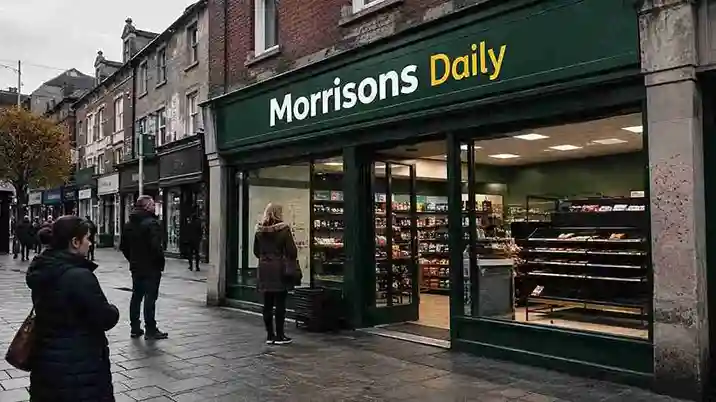
Morrisons has confirmed plans to close 100 loss-making convenience stores across the UK. Many of the affected sites came from the McColl’s acquisition, with rising operating costs cited as a key reason.
The closures could affect hundreds of jobs, with staff expected to go through consultation. While Morrisons is reducing company-owned convenience stores, it still plans to grow through franchise-led expansion.
Key highlights:
- Morrisons plans to close 100 loss-making convenience stores
- Hundreds of jobs could be affected during consultation
- Most impacted sites originated from the McColl’s acquisition
- Rising operating costs were cited as a major factor
- Morrisons remains committed to expanding franchise stores
Why Is Morrisons Closing 100 Convenience Stores Across the UK?

The announcement of the Morrisons convenience store closures represents another major restructuring step for the Bradford-based supermarket.
According to the company, the decision follows an extensive review of company-owned convenience locations that have remained unprofitable despite investment and operational changes.
Morrisons stated that these stores had struggled financially for several years and were unable to return to sustainable performance levels.
“Having completed the review, we are now proposing to take the tough but necessary decision to close a number of these stores over the next few months.” – A Morrisons spokesperson
The closures also arrive during a period of wider cost reduction measures across the business. In recent years, Morrisons has already scaled back several in-store services including pharmacies, cafés, florists and meat counters.
Which Morrisons Daily Stores Are Affected By The Closures?
The planned closures do not affect the entire Morrisons convenience estate. Instead, the company identified specific stores that had underperformed over a prolonged period.
The Role of Former McColl’s Locations in the Closure Plan
A large proportion of the affected stores originated from Morrisons’ acquisition of McColl’s in 2022. At the time, Morrisons purchased 1,164 stores out of administration and invested heavily to convert many of them into Morrisons Daily locations.
The acquisition was positioned as an opportunity to accelerate growth in convenience retail and strengthen local market presence.
However, not every converted location achieved the expected commercial outcomes. Some stores continued to experience weak customer demand, challenging operating conditions and profitability concerns despite remedial action.
How Were Loss-Making Stores Identified?
Morrisons explained that store performance remains under constant review and that the selected locations had continued to generate losses despite corrective actions.
Store review factors included:
- Long-term financial performance
- Local customer demand
- Operating and staffing costs
- Commercial viability
- Future growth potential
Overview Of the Closure Programme:
| Category | Details |
| Stores Closing | 100 convenience stores |
| Store Type | Company-owned Morrisons Daily |
| Origin | Former McColl’s locations |
| Timeline | Closures expected over coming months |
| Staff Impact | Consultation and redeployment support |
The company maintains that this review is designed to strengthen the wider convenience network rather than reduce its presence in the sector altogether.
What Factors Have Made Morrisons Convenience Stores Unprofitable?
The reasons behind the Morrisons convenience store closures go beyond store-level performance and reflect broader pressures facing UK retail. Morrisons directly linked the decision to rising operating expenses and increasing regulatory costs.
A company statement explained:
“This situation has been exacerbated in more recent years by significant cost increases resulting from government policy choices, which have made returning these stores to profitability even more difficult.”
Several factors have increased pressure across supermarket operations.
Cost pressures highlighted by Morrisons:
- Employer National Insurance contribution increases
- National Living Wage increases
- Higher operational expenditure
- Packaging and compliance obligations
- Increased supply chain costs
Chief executive Rami Baitiéh previously described the environment as an:
“Avalanche of costs”
Alongside these challenges, Morrisons continues managing debt obligations linked to its private equity ownership structure while competing with both traditional supermarkets and discount retailers.
These combined factors have created a more difficult operating environment for lower-performing convenience sites.
How Will Morrisons Convenience Store Closures Affect Employees and Customers?
The proposed closures create uncertainty for both workers and local shoppers, particularly in communities where convenience stores play an important role in day-to-day shopping.
Morrisons has acknowledged that the changes will be difficult for some employees and customers but says measures are being introduced to reduce disruption wherever possible.
Employee Consultation and Redeployment Options
Morrisons confirmed that consultation processes would begin with employees and unions. Although redundancies remain a possibility, the retailer says it intends to support staff and explore redeployment opportunities across the wider business.
The business employs approximately 95,000 people across supermarkets, manufacturing and logistics operations, which may provide alternative employment routes for affected colleagues.
The company stated that it has historically achieved successful internal redeployment during previous restructuring programmes and plans to continue that approach where suitable positions exist.
What Could Customers Expect from Nearby Stores and Online Services?
For customers, Morrisons says it will attempt to minimise disruption by encouraging shoppers to use nearby branches and online services where available.
The retailer indicated that customer continuity remains a priority and that alternative access points will help maintain convenience for affected communities.
Customer Impact Across Local Communities
The impact on communities may vary depending on local retail availability. In areas with fewer alternatives, store closures could affect shopping habits, travel convenience and local footfall.
Customers who rely on nearby convenience access may need to adapt purchasing patterns or shift towards larger stores and digital ordering options.
Potential Impact of Morrisons Store Closures:
| Area | Possible Impact |
| Employees | Consultation and redeployment |
| Customers | Shift to nearby stores or online |
| Communities | Reduced local convenience options |
| Morrisons | More focused store portfolio |
| Franchise Network | Potential future expansion |
While disruption may occur in some locations, Morrisons argues that concentrating investment into stronger-performing stores will improve operational quality and strengthen the overall customer experience.
Is Morrisons Changing Its Convenience Store Growth Strategy?

Despite the closure programme, Morrisons insists convenience retail remains central to future growth and continues to view the segment as an important long-term opportunity.
The difference is that future expansion increasingly appears to be franchise-led rather than company-operated.
The supermarket currently operates around 1,700 convenience stores across the UK, with roughly 700 operating under franchise arrangements. This model allows Morrisons to expand its reach while reducing direct operating exposure.
Last year alone, Morrisons opened more than 120 franchise stores and continues to outline expansion plans for future years.
“Expansion of our Convenience business is a core part of Morrisons growth strategy.” – A Morrisons spokesperson
The company also highlighted opportunities to open hundreds more franchise convenience stores over time, reinforcing that closures do not signal a retreat from the sector.
This approach may provide stronger scalability, more flexible investment and lower financial pressure compared with maintaining larger numbers of company-owned convenience locations.
What Do These Store Closures Reveal About Morrisons’ Wider Business Challenges?
The Morrisons convenience store closures show that the retailer is still dealing with wider business challenges, not just store-level losses.
The move appears to be part of a broader plan to improve efficiency, reduce costs and strengthen long-term performance.
Key business pressures include:
- Debt servicing obligations linked to its ownership structure
- Competitive pricing pressure from major UK supermarket rivals
- Consumer spending changes caused by tighter household budgets
- Retail operating inflation affecting wages, energy and supply costs
- Changing shopping behaviours, including more frequent local purchases
- Store estate performance issues across underperforming convenience sites
Morrisons has also used property deals, estate management and restructuring measures to support financial recovery. Overall, the closures look more like a strategic reset than a full retreat from convenience retail.
What Could Be Next for Morrisons Convenience Stores and UK Retail?
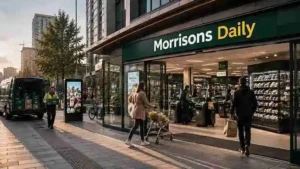
Morrisons’ next phase appears to focus on quality over scale. By closing underperforming convenience stores and expanding franchise operations, the supermarket may build a more flexible network that better responds to changing customer habits.
The wider convenience sector is also shifting. Many shoppers now combine online orders with smaller, more frequent local purchases instead of relying only on one large weekly shop.
For Morrisons, success will depend on balancing growth with financial discipline, keeping customers loyal, and improving store performance.
For the wider UK retail market, these closures show how even major supermarket brands must keep adapting to rising costs and changing shopping behaviour.
Conclusion
The Morrisons convenience store closures mark a significant shift in the supermarket’s approach to convenience retail rather than a withdrawal from the sector.
By shutting 100 underperforming stores, many linked to the McColl’s acquisition, Morrisons aims to improve efficiency and focus investment where performance is stronger.
While the move creates uncertainty for employees and customers, the retailer continues to back franchise growth and position its convenience business for long-term sustainability in a challenging UK retail market.
Frequently Asked Questions
Why is Morrisons closing convenience stores?
Morrisons said the affected stores had remained loss-making for years and faced additional pressure from rising operating costs and government-related cost increases.
Are all Morrisons Daily stores shutting?
No. The closures affect selected company-owned convenience stores rather than the entire Morrisons Daily network.
How many convenience stores does Morrisons operate?
Morrisons operates around 1,700 convenience stores across the UK, including franchise-operated locations.
Were the affected stores previously McColl’s branches?
Yes. The closures mainly involve former McColl’s stores acquired by Morrisons in 2022.
Will employees lose their jobs?
Consultations are underway and Morrisons says it will attempt to redeploy affected employees where possible.
Is Morrisons still expanding its convenience business?
Yes. Morrisons says convenience remains part of its growth plans, with future expansion expected to focus on franchise stores.
Could more supermarket closures happen in the UK?
Retail conditions remain challenging across the sector, although closure decisions vary by company performance and strategy.