

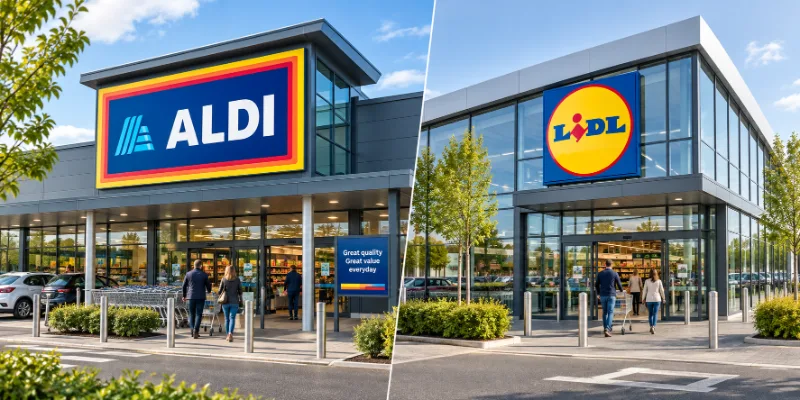
The Aldi and Lidl CMA planning rules are not changes to the normal UK planning permission system.
The CMA has provisionally decided that Aldi, Lidl Great Britain and Lidl Northern Ireland should be brought under the Controlled Land Order 2010, which limits how major supermarkets can use certain property agreements to restrict grocery competitors from accessing sites.
The consultation on the proposal closed on 7 September 2026, and the CMA is currently expected to make its final decisions in October 2026. Until then, Aldi and Lidl have not been finally designated under the rules.
At a Glance:
| Area | What It Means |
| Main Change | Aldi and Lidl could face the same supermarket land restrictions as major rivals |
| Rules Affected | Restrictive covenants and certain grocery exclusivity agreements |
| Planning Permission | Normal local planning rules remain unchanged |
| Current Status | CMA decision is still provisional |
| Consultation | Closed on 7 September 2026 |
| Next Step | Final CMA decisions expected in October 2026 |
| New Store Expansion | Aldi and Lidl can continue acquiring sites and opening stores |
Last Updated: 11.09.2026
Latest Update on the Aldi and Lidl CMA Planning Rules
The CMA published its provisional decisions on 7 August 2026, concluding that Aldi, Lidl GB and Lidl NI now meet the criteria to be treated as Large Grocery Retailers.
A further period for representations ended at 5pm on 7 September 2026. The CMA must now consider the submissions and any additional evidence before making its final decisions.
That means Aldi and Lidl have not yet been permanently brought within the Controlled Land Order. The process remains active, with final decisions scheduled for October 2026.
This distinction is important because headlines referring to new Aldi and Lidl planning rules can give the impression that the changes have already taken effect.
What Has the CMA Proposed for Aldi and Lidl?
The CMA proposes designating Aldi Stores Limited, Lidl Great Britain Limited and Lidl Northern Ireland Limited as Large Grocery Retailers under the Controlled Land Order.
Seven supermarket groups are already covered:
- Asda
- Co-op
- Marks & Spencer
- Morrisons
- Sainsbury’s
- Tesco
- Waitrose
The Order is designed to prevent large supermarket businesses from using certain land agreements to make it unnecessarily difficult for competing grocery retailers to establish stores nearby.
Aldi and Lidl were excluded when the regime was introduced in 2010. The CMA now believes their businesses have evolved sufficiently to justify treating them in the same way as established supermarket groups.
Are These Really New Planning Rules for Aldi and Lidl?
Not in the normal meaning of planning rules.
Planning permission deals with whether land can be developed or used for a particular purpose. Local planning authorities continue to decide applications using the ordinary planning system.
The Controlled Land Order instead deals with contractual arrangements connected with land.
For example, a supermarket selling a site might attempt to include a restriction preventing a competing supermarket from using that land in the future.
A grocery retailer occupying a retail development could also negotiate an exclusivity agreement that prevents the landlord from leasing another unit to a competing grocery business.
The CMA rules are concerned with those types of competitive restrictions.
Final designation would therefore not give competitors automatic permission to open stores beside Aldi or Lidl. Planning approval, site availability, development costs, leases and commercial viability would still need to be considered.
What Is the Controlled Land Order 2010?
The Groceries Market Investigation (Controlled Land) Order 2010 followed an investigation into competition in the UK grocery sector.
Regulators were concerned that control over land could make it difficult for new grocery businesses to enter certain local markets.
Two types of arrangements are particularly relevant.
Restrictive Covenants
A restrictive covenant places limits on how land may subsequently be used.
In the supermarket sector, a retailer selling land could potentially seek a covenant preventing the site from later being used for competing grocery retail.
The Order restricts designated Large Grocery Retailers from imposing certain new covenants that restrict grocery retailing.
Supermarket Exclusivity Arrangements
An exclusivity agreement can prevent a property owner or developer from allowing competing grocery retailers to operate within the same development.
The Controlled Land Order places limits on relevant grocery exclusivity arrangements, including restrictions on certain arrangements extending beyond five years.
Exactly how the rules apply can depend on when an agreement was made and its contractual terms.
Why Were Aldi and Lidl Originally Excluded From the Rules?
Aldi and Lidl looked considerably different when the Order was introduced.
They were treated as Limited Assortment Discounters, reflecting their smaller product ranges and discount-led retail model.
At the time, they generally carried far fewer product lines than traditional full-range supermarkets.
Regulators did not consider them close enough substitutes for established Large Grocery Retailers to justify including them within the same land restrictions.
More than 15 years later, the grocery market has changed substantially.
Aldi and Lidl have expanded their store estates, increased the breadth of their grocery ranges and become major destinations for household shopping. Their growth has led the CMA to reconsider whether the original distinction remains appropriate.
Why Does the CMA Now Consider Aldi and Lidl Major Grocery Retailers?
The CMA’s provisional assessment focuses on three main requirements.
The first is store scale and geographic coverage. Aldi and Lidl GB each operate more than 1,000 stores across Great Britain, while Lidl NI operates more than 40 stores in Northern Ireland.
A substantial proportion of those shops exceed the 1,000-square-metre threshold relevant to the assessment.
The second is whether they provide a full range of groceries. The CMA believes their stores now cover the principal categories necessary for shoppers to complete a broad grocery shop.
The third concerns grocery procurement. Aldi and Lidl operate integrated purchasing functions that obtain products directly from suppliers.
Taken together, the CMA provisionally considers the discounters substantial enough to satisfy the Large Grocery Retailer definition.
How Much Have Aldi and Lidl’s Product Ranges Grown?
Product range has become one of the most disputed parts of the case.
Aldi argued that its core range remained relatively small compared with established supermarkets. It reported a core range of around 2,005 products, rising to approximately 2,703 grocery SKUs when additional ranges were included.
However, the CMA considered how product variants were counted.
For example, several flavours contained within one product case could be recorded as a single SKU within a retailer’s internal system even though consumers effectively see several different choices.
When individual variants are considered separately, the CMA’s assessment puts typical Aldi and Lidl grocery ranges at around 4,000 to 5,000 lines in most stores.
That remains below the range offered by some traditional supermarkets, but the CMA’s position is that the important question is not simply the total number of products.
It is whether shoppers can find products across the principal grocery categories required for a full shop.
Aldi and Lidl Store Numbers and UK Grocery Market Share
The scale of the discounters is also evident in their position within the wider UK grocery market.
Recent 2026 grocery market data has placed Aldi among Britain’s four largest grocery retailers by market share, while Lidl has moved into the top five.
By July 2026, Worldpanel data put Aldi’s market share at approximately 10.8%, while Lidl had reached around 8.8%.
Their current position is very different from the market that existed when the Controlled Land Order was introduced.
The CMA’s decision is therefore not simply about how many products sit on an Aldi or Lidl shelf.
It also reflects how significant the two companies have become as competitive forces within the grocery sector.
Are Aldi and Lidl Now Used for the Main Weekly Shop?
One argument historically separating discount supermarkets from traditional chains was that customers might visit them for limited purchases rather than their entire weekly shop.
That distinction has weakened considerably.
The CMA considered consumer behaviour alongside retailer evidence and concluded provisionally that Aldi and Lidl now compete meaningfully for customers completing their main grocery shops.
Their stores cover fresh food, chilled and frozen products, bakery goods, household items, drinks, toiletries and other everyday grocery categories.
This matters because a retailer capable of satisfying a substantial proportion of a household’s weekly requirements can place direct competitive pressure on established supermarkets.
How Aldi and Lidl Influence Supermarket Pricing?
The competitive influence of the two discounters can also be seen in supermarket pricing strategies.
Several major supermarket businesses operate price-matching schemes that compare selected products directly with Aldi, while some have also used Lidl as a comparison.
Such programmes demonstrate how strongly mainstream supermarkets monitor discount competitors when deciding how to position prices.
That competitive relationship supports the CMA’s view that Aldi and Lidl can no longer easily be separated from the major grocery retailers covered by the Controlled Land Order.
What Would Change If Aldi and Lidl Are Finally Designated?
Final designation would change how certain land agreements can be structured, but it would not restrict ordinary store expansion.
| Issue | Current Position | If Designation Is Confirmed |
| Large Grocery Retailer status | Aldi and Lidl are not designated | They would become designated retailers |
| Planning permission | Normal planning laws apply | Normal planning laws would still apply |
| New restrictive covenants | Not subject to the Order as designated retailers | Relevant restrictions would become subject to the Order |
| Grocery exclusivity arrangements | Different regulatory position | Same controlled-land regime as other designated supermarkets |
| Buying development sites | Permitted | Still permitted |
| Opening new supermarkets | Permitted | Still permitted |
| Expansion programmes | Can continue | Can continue |
The main difference would therefore concern how land can be controlled, not whether Aldi or Lidl can keep growing.
What Could the Rules Mean for Landlords and Property Developers?
The commercial property impact deserves particular attention.
Landlords negotiating supermarket leases may need to scrutinise requests for exclusivity more carefully if Aldi and Lidl become designated retailers.
Retail developers could also find that arrangements restricting competing grocery tenants are subject to tighter controls.
For property owners selling former supermarket sites, restrictive covenants affecting future grocery use may require additional legal consideration.
Developers planning retail parks and mixed-use schemes may similarly need to consider whether proposed restrictions comply with the Controlled Land Order.
The rules do not make every exclusivity provision unlawful. Their application depends on the type of agreement, its duration and when it was entered into.
Businesses dealing with affected sites may therefore require specific legal advice.
Could the Changes Make It Easier for Rival Supermarkets to Open?
Potentially.
If a site is currently affected by a restriction that would become prohibited or unenforceable under the relevant rules, removing that barrier could give competing retailers greater access to property.
However, this should not be interpreted as meaning new supermarkets will automatically appear beside existing Aldi or Lidl stores.
A rival still needs an available site, suitable lease terms, planning approval, sufficient customer demand and a commercially viable development.
The CMA measure is better understood as removing certain artificial barriers to grocery competition rather than actively creating new stores.
What Could the Decision Mean for Smaller Grocery Retailers?
Smaller grocery businesses could also have an interest in how supermarket land restrictions operate.
Competition for suitable retail property can be particularly important in areas where only a limited number of large sites are available.
Reducing restrictions that prevent grocery use could potentially increase opportunities for other operators, although the practical benefit would vary significantly by location.
The rules are not designed specifically to favour independent retailers. Their wider purpose is to prevent designated supermarket groups from using control over land in ways that unnecessarily reduce grocery competition.

What Have Aldi and Rival Supermarkets Said?
Aldi has disputed the CMA’s reasoning and argued that its limited assortment remains an important part of its business model.
It has maintained that the size of its range remains substantially below that of traditional large supermarkets and argued that its previous exclusion from the Order has not damaged competition.
Several established supermarket groups have supported designation.
Sainsbury’s, Morrisons and Iceland have argued in different ways that Aldi and Lidl have grown sufficiently to compete directly with major supermarket chains and should therefore operate under the same land restrictions.
Those companies have their own commercial interests in the outcome, so their submissions should be viewed as stakeholder positions rather than independent regulatory findings.
Does the CMA Have Evidence of Restricted Aldi and Lidl Land Agreements?
Evidence provided during the CMA investigation indicated that some Aldi, Lidl GB and Lidl NI land agreements contained types of restrictions that could fall within the Controlled Land Order if the companies were designated.
However, this does not mean every Aldi or Lidl property agreement contains an anti-competitive provision.
Nor does it mean the businesses breached rules that did not previously apply to them.
Some commercially sensitive information has also been withheld from the public material, meaning the complete scale and potential effect of affected agreements cannot currently be quantified publicly.
What Could the Decision Mean for Shoppers?
The intended long-term benefit is greater competition.
Where several grocery businesses can realistically compete for customers, retailers may face stronger pressure over pricing, product quality, choice and customer service.
The effect should not be exaggerated, though.
Designation would not guarantee lower supermarket prices or cause a new competitor to open in every local area.
Food prices are affected by many other factors, including supplier costs, wages, energy, logistics and wider economic conditions.
The proposed rules address one specific part of supermarket competition by reducing the ability of large retailers to use land agreements as barriers to rivals.
Will the CMA Rules Stop Aldi or Lidl Expanding?
No. Neither the Controlled Land Order nor the provisional CMA decision prevents Aldi or Lidl from acquiring new sites, applying for planning permission or opening additional stores.
Both businesses have substantial UK expansion programmes.
Designation would instead affect certain contractual methods that could restrict how other grocery retailers use nearby land.
For developers, investors and landlords, that distinction is important. The decision regulates competitive conduct associated with property rather than imposing a cap on supermarket growth.
What Happens If a Supermarket Breaches the Controlled Land Order?
The CMA monitors compliance with the Order and has previously required designated supermarkets to address problematic land arrangements.
However, the enforcement position differs from some newer competition remedies.
Although the Digital Markets, Competition and Consumers Act 2024 strengthened the CMA’s ability to impose financial penalties in various areas, the enhanced penalty regime does not automatically apply to this particular 2010 Order.
That does not make compliance voluntary. Designated supermarkets remain legally required to follow the Order and may be required to correct arrangements that do not comply.
What Happens Next With the Aldi and Lidl CMA Decision?
The latest consultation period ended on 7 September 2026.
The CMA is now considering representations and other relevant evidence before reaching its final decisions.
Those decisions are currently scheduled for October 2026.
Until then, Aldi, Lidl GB and Lidl NI should still be described as provisionally designated, rather than already subject to the Controlled Land Order as Large Grocery Retailers.
The final outcome will determine whether a regulatory distinction dating back to 2010 remains justified or whether the growth of the discount supermarkets means they should now operate under the same controlled-land rules as Britain’s established major supermarket groups.
Conclusion
The Aldi and Lidl CMA planning rules are primarily about competition and control of supermarket land, not traditional planning permission.
The CMA believes the growth of Aldi and Lidl in store numbers, product range and competitive importance means the distinction made when the Controlled Land Order was introduced is no longer appropriate.
If the provisional decision is confirmed, Aldi, Lidl GB and Lidl NI will face the same restrictions on relevant restrictive covenants and grocery exclusivity agreements as other designated supermarket groups.
For shoppers, the objective is greater choice and competition. For landlords, property developers, investors and grocery businesses, the more immediate effect could be greater scrutiny of supermarket leases, site disposals and other property agreements.
The consultation has now closed, making the CMA’s expected October 2026 final decisions the next major development to watch.
FAQs
Are Aldi and Lidl Subject to New Planning Rules?
Not yet, and the proposals are not conventional planning rules. The CMA has provisionally decided to bring Aldi and Lidl within competition rules covering certain supermarket land agreements.
Have Aldi and Lidl Already Been Added to the Controlled Land Order?
No. The CMA’s August 2026 decisions are provisional. Final decisions are currently expected in October 2026.
Why Is the CMA Changing the Rules for Aldi and Lidl?
The CMA believes Aldi and Lidl have grown significantly since 2010 and now have the store scale, grocery ranges and procurement operations required to qualify as Large Grocery Retailers.
When Will the CMA Make Its Final Decision?
The current timetable states that final decisions are expected in October 2026 following the closure of the latest consultation on 7 September.
Could the Rules Affect Aldi and Lidl New Store Openings?
The rules would not stop either retailer opening stores. They would mainly regulate certain property agreements capable of restricting competing grocery businesses.
What Is a Restrictive Covenant in a Supermarket Property Agreement?
It is a contractual restriction controlling how land can be used. In grocery retail, a covenant could potentially prevent a site from subsequently being used by a competing supermarket.
What Is a Supermarket Exclusivity Agreement?
It is an agreement that can limit a landlord or developer from allowing another grocery retailer to operate from the same site or development. Certain long-term arrangements are restricted under the Controlled Land Order.