

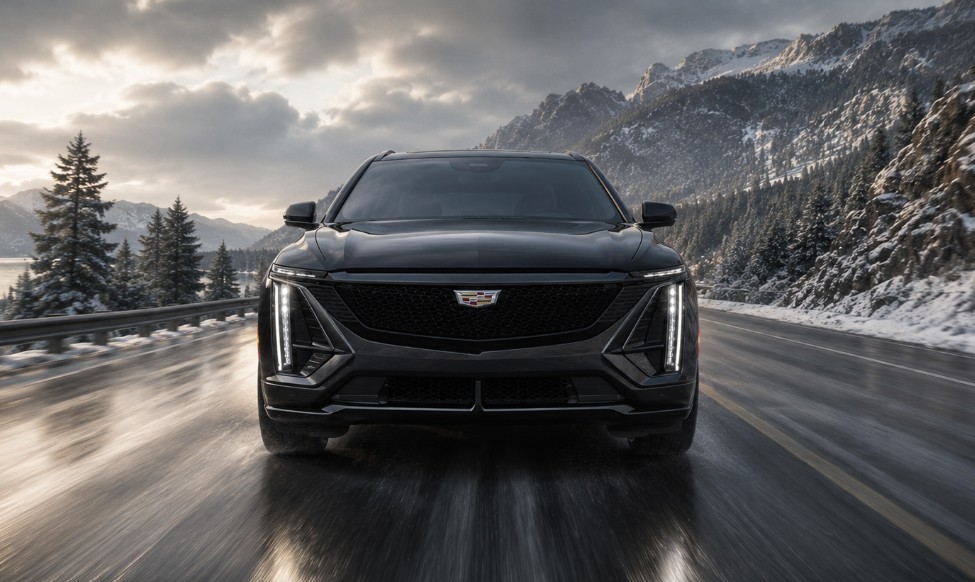
The Cadillac LYRIQ combines luxury electric vehicle technology with multiple driving modes designed to provide different levels of performance, comfort and traction.
However, one question continues to attract attention among electric vehicle buyers: Do the driving modes in Cadillac Lyriq offer different ranges of battery usages?
Yes, the driving modes can influence battery consumption and real-world driving range, but they do not change the battery’s physical capacity or provide separate official range ratings for every mode.
Tour, Sport, Snow/Ice and My Mode change how the LYRIQ responds to driver inputs. These differences can affect acceleration behaviour, energy consumption and ultimately the distance the vehicle covers between charges.
Our analysis of Cadillac’s technical specifications, driving-mode documentation and published automotive assessments highlights an important distinction: the selected mode does not determine efficiency on its own.
Driving speed, acceleration, temperature, road conditions and regenerative braking also influence energy consumption.
For business owners, professionals and everyday drivers considering a premium electric SUV, understanding these differences is particularly valuable. Battery efficiency directly affects charging expenses, journey planning and the wider cost of operating an electric vehicle.
Do Cadillac Lyriq Driving Modes Actually Affect Battery Range?
The Cadillac LYRIQ’s driving modes affect the way the vehicle performs, which can indirectly change its battery consumption.
However, choosing Sport Mode does not automatically remove a fixed percentage of available range, just as selecting Tour Mode does not increase the battery’s physical energy capacity.
The difference comes from how power is requested and how the vehicle responds.
For example, Sport Mode provides a more immediate accelerator response. A driver who regularly takes advantage of that responsiveness may consume more energy than someone driving smoothly in Tour Mode.
But if two drivers maintain similar speeds, acceleration patterns and road conditions, the difference between modes may be relatively small.
Cadillac Lyriq Driving Modes and Battery Consumption Comparison
| Driving mode | Main purpose | Potential battery impact | Recommended conditions |
| Tour | Smooth everyday driving | Supports predictable, economical driving | Daily commuting and motorways |
| Sport | More responsive acceleration and handling | May increase consumption during aggressive driving | Dry roads and performance driving |
| Snow/Ice | Improve control on slippery surfaces | Depends heavily on road conditions and traction | Snow, ice and slippery roads |
| My Mode | Personalise vehicle responses | Depends on selected settings and driving style | Customised everyday driving |
| V-Mode | Enhanced performance on LYRIQ-V models | Performance-focused operation can increase energy demand | Appropriate performance-driving conditions |
V-Mode is specific to the high-performance LYRIQ-V. It is not a standard driving mode on every LYRIQ.
Our assessment suggests that Tour remains the most practical default for drivers focused on consistent energy consumption, while Sport and My Mode provide additional flexibility without necessarily causing substantial range losses during gentle driving.
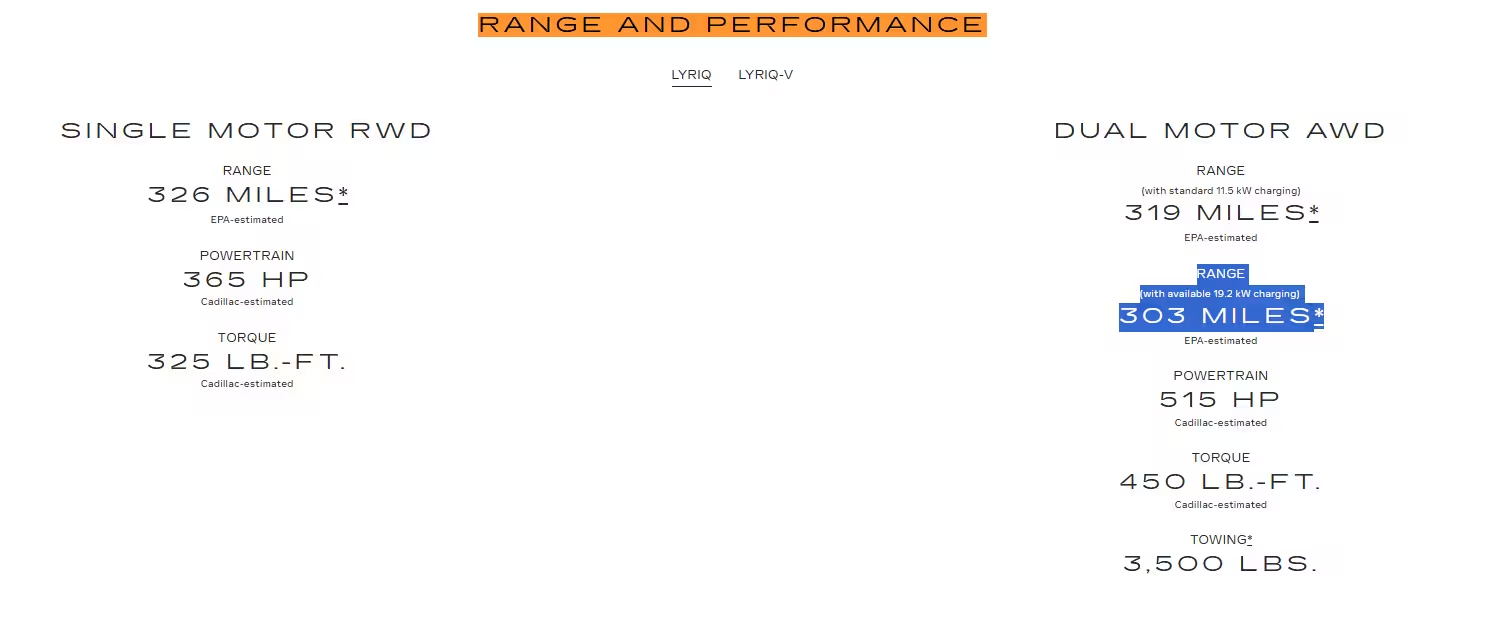
Cadillac’s official LYRIQ Driver Mode Control documentation identifying Tour, Sport, Snow/Ice and My Mode.
What Is the Official Cadillac Lyriq Battery Range in 2026 and 2027?
Before comparing driving modes, it is important to establish the LYRIQ’s manufacturer-published range.
Cadillac lists a rated battery energy capacity of approximately 102 kWh for the 2026 LYRIQ.
However, the available driving range differs according to the powertrain, vehicle configuration and equipment.
Cadillac Lyriq Official Range Comparison
| 2026 Cadillac LYRIQ configuration | EPA-estimated range | Approximate kilometres |
| Single-motor RWD | 326 miles | 525 km |
| Dual-motor AWD, standard 11.5 kW charging configuration | 319 miles | 513 km |
| Dual-motor AWD, available 19.2 kW charging configuration | 303 miles | 488 km |
| LYRIQ-V AWD | 285 miles | 459 km |
Cadillac also advertises up to 326 miles of EPA-estimated range for the 2027 LYRIQ RWD.
These figures are manufacturer-published US EPA estimates. They should not be confused with UK WLTP figures or guaranteed real-world driving distances.
The differences between RWD, AWD and LYRIQ-V ratings are associated with the vehicle configurations themselves, not simply switching between Tour and Sport.
For example, the 326-mile RWD estimate is approximately 2.2% higher than the 319-mile AWD estimate. The 285-mile LYRIQ-V rating is approximately 12.6% lower than the 326-mile RWD figure.
Those percentages describe differences between vehicle specifications, not measured driving-mode efficiency penalties.
This distinction is essential when comparing vehicles before purchase.
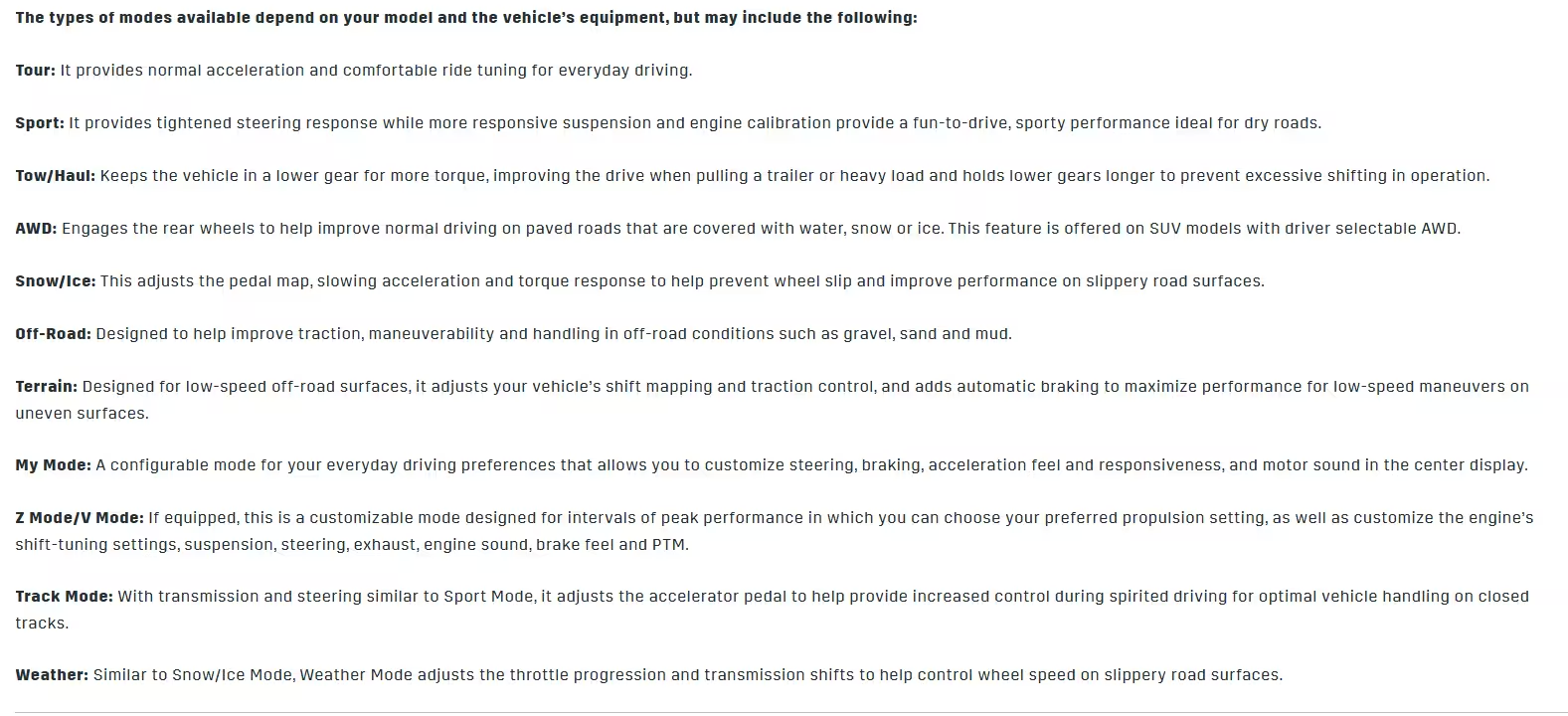
Official Cadillac LYRIQ 2026 battery-range specifications showing the EPA-estimated range for RWD, AWD and LYRIQ-V configurations.
Which Cadillac Lyriq Driving Mode Uses the Least Battery?
For most ordinary driving situations, Tour Mode is a sensible starting point for drivers prioritising efficiency.
Cadillac describes Tour as the setting intended for smooth everyday driving, providing balanced acceleration and comfortable handling.
The advantage comes primarily from encouraging controlled driving inputs rather than activating a separate battery-saving system.
Tour Mode: Best for Everyday Driving
Tour Mode is suitable for city commuting, motorway journeys and longer trips where predictable vehicle behaviour is preferred.
Its balanced accelerator response makes it easier to drive smoothly without continuously requesting high motor output.
The benefits include:
- Comfortable acceleration during daily journeys.
- Predictable accelerator behaviour.
- Balanced steering and ride characteristics.
- Suitability for sustained motorway driving.
- A practical default for monitoring energy consumption.
Our assessment is that Tour Mode provides the strongest combination of everyday usability and efficiency-oriented driving.
However, drivers should not assume that Tour automatically applies stronger regenerative braking than Sport. The LYRIQ’s regenerative braking features have their own controls, and exact behaviour depends on the vehicle configuration.
Sport Mode: Can It Increase Battery Consumption?
Sport Mode changes the LYRIQ’s driving character by making acceleration and handling responses more immediate.
Cadillac identifies changes to accelerator calibration, steering and other equipped vehicle systems when Sport is selected.
The important financial consideration is not that Sport automatically consumes a particular amount of additional energy, but that its responsiveness can encourage more demanding driving.
For example, repeated strong acceleration can increase energy consumption because the vehicle must rapidly convert battery energy into kinetic energy.
When the vehicle subsequently slows, some energy can be recovered through regenerative braking, but energy conversion is not perfectly efficient.
Consequently, repeated acceleration and deceleration can increase consumption.
A smoothly driven LYRIQ in Sport Mode may still outperform an aggressively driven LYRIQ in Tour Mode.
Our review finding: There is no verified universal figure establishing that Sport Mode reduces LYRIQ range by 10%, 15% or any other fixed percentage. Such figures should not be presented as manufacturer-confirmed results.
Snow/Ice Mode: Is It More Efficient?
Snow/Ice Mode is designed to improve controllability on slippery surfaces.
Cadillac explains that it adjusts accelerator response and relevant vehicle systems to manage traction.
The gentler response may help prevent sudden wheel spin, but the purpose is improved driving control rather than maximum battery efficiency.
Snowy conditions can increase energy consumption because of:
- Low outside temperatures.
- Greater resistance from snow-covered roads.
- Cabin and battery heating requirements.
- Reduced traction.
- Additional energy demands during difficult driving conditions.
A driver may therefore experience lower range in Snow/Ice Mode even when using the accelerator gently.
However, the surrounding weather and road conditions may be responsible for much of that reduction.
Safety should always take priority over marginal efficiency gains.
My Mode: Can Drivers Customise the LYRIQ for Better Efficiency?
My Mode allows drivers to personalise supported vehicle responses.
Depending on equipment and model year, adjustable features can include acceleration feel, steering, brake feel, suspension and motor sound.
Cadillac documentation identifies acceleration-feel options that may include Relaxed, Tour and Sport.
A driver interested in reducing unnecessary energy use might prefer a relaxed acceleration feel while retaining comfortable steering and braking characteristics.
However, there is no official guarantee that a particular My Mode configuration produces a specific additional number of miles.
Our assessment is that My Mode offers useful flexibility for drivers who want a personalised balance of comfort and responsiveness.
It should be treated as a customisation feature rather than an automatically superior efficiency mode.
How Does Cadillac Lyriq V-Mode Affect Battery Usage?
The LYRIQ-V is a separate high-performance version of Cadillac’s electric SUV.
For the 2026 model, Cadillac publishes up to 615 horsepower in Velocity Max and an EPA-estimated range of 285 miles.
The LYRIQ-V also includes performance-specific driving features, including V-Mode.
These settings are designed to provide more engaging performance and additional driver control.
Demanding acceleration and repeated high-power operation can result in greater energy consumption.
However, it would be inaccurate to compare the LYRIQ-V’s 285-mile rating directly with the standard LYRIQ’s 326-mile rating and attribute the entire difference to V-Mode.
The two vehicles have different performance configurations, and their published range figures account for the broader vehicle specifications.
For buyers, the distinction is straightforward: the standard LYRIQ prioritises refined everyday electric motoring, while the LYRIQ-V adds more substantial performance capability.
How Much Battery Range Can Be Lost Through Higher Energy Consumption?
Understanding how battery consumption affects range requires a comparison based on electricity usage per distance travelled.
EV efficiency is commonly expressed as kWh per 100 miles, miles per kWh or kWh per 100 kilometres.
A vehicle requiring more electricity to travel the same distance will generally have a shorter driving range.
Illustrative Battery Consumption Comparison
The following example uses a hypothetical vehicle with 100 kWh of usable energy. This is a calculation example, not a measurement of the LYRIQ’s usable battery capacity or actual efficiency in each driving mode.
| Driving scenario | Consumption per 100 miles | Calculated range | Range change |
| Baseline efficiency | 30 kWh | 333 miles | Baseline |
| 5% higher consumption | 31.5 kWh | 317 miles | About 4.8% lower |
| 10% higher consumption | 33 kWh | 303 miles | About 9.1% lower |
| 20% higher consumption | 36 kWh | 278 miles | About 16.7% lower |
These figures illustrate why even moderate increases in consumption can have a noticeable effect on driving range.
Importantly, a 10% increase in energy consumption does not translate into exactly a 10% reduction in range.
The correct relationship is:
Calculated range = usable battery energy ÷ energy consumption per mile.
The percentage changes in this table are mathematical examples and should not be interpreted as measured Tour-versus-Sport results.
For LYRIQ owners, comparing actual energy consumption on repeated journeys provides more useful information than relying on generic percentage claims.
Does Changing Driving Modes Immediately Change the LYRIQ’s Range Estimate?
Drivers may notice that the estimated remaining range changes during a journey.
However, the displayed figure should not be interpreted as a guaranteed distance or a fixed range allowance for the selected driving mode.
Electric vehicle range estimates can respond to recent energy consumption and driving conditions.
For example, a driver who has spent several miles travelling at high motorway speeds may see a lower range estimate than expected.
After returning to slower and more efficient driving, the estimate may improve.
The displayed range is therefore a forecast based on vehicle data and system calculations, rather than a direct measurement of miles remaining in the battery.
A more reliable way to understand battery usage is to compare the vehicle’s state of charge, distance travelled and energy-consumption readings across similar journeys.
How Do Regenerative Braking and One-Pedal Driving Affect LYRIQ Range?
Regenerative braking is an important part of electric vehicle efficiency.
When the vehicle slows, its electric drive system can convert some kinetic energy back into electricity and return it to the propulsion battery.
The LYRIQ provides features such as One-Pedal Driving and Regen on Demand.
These are distinct from the main driving-mode selections.
One-Pedal Driving
One-Pedal Driving enables the vehicle to decelerate when the driver releases the accelerator.
It can help drivers manage speed smoothly in stop-start traffic and recover energy during deceleration.
Cadillac allows drivers to enable or customise supported One-Pedal Driving settings through vehicle controls.
However, stronger regeneration does not mean the battery gains energy without cost. The system recovers part of the energy previously used to move the vehicle.
On an open road, maintaining a steady speed and avoiding unnecessary braking may be more efficient than repeatedly slowing and accelerating.
Regen on Demand
The LYRIQ also offers Regen on Demand through a steering-wheel paddle.
When operated, it can increase deceleration using regenerative braking.
This gives drivers additional control when approaching traffic or adjusting speed.
Regenerative braking may be limited when the battery is cold or close to fully charged.
Drivers should always be prepared to use the conventional brake pedal, particularly during emergencies or slippery-road conditions.
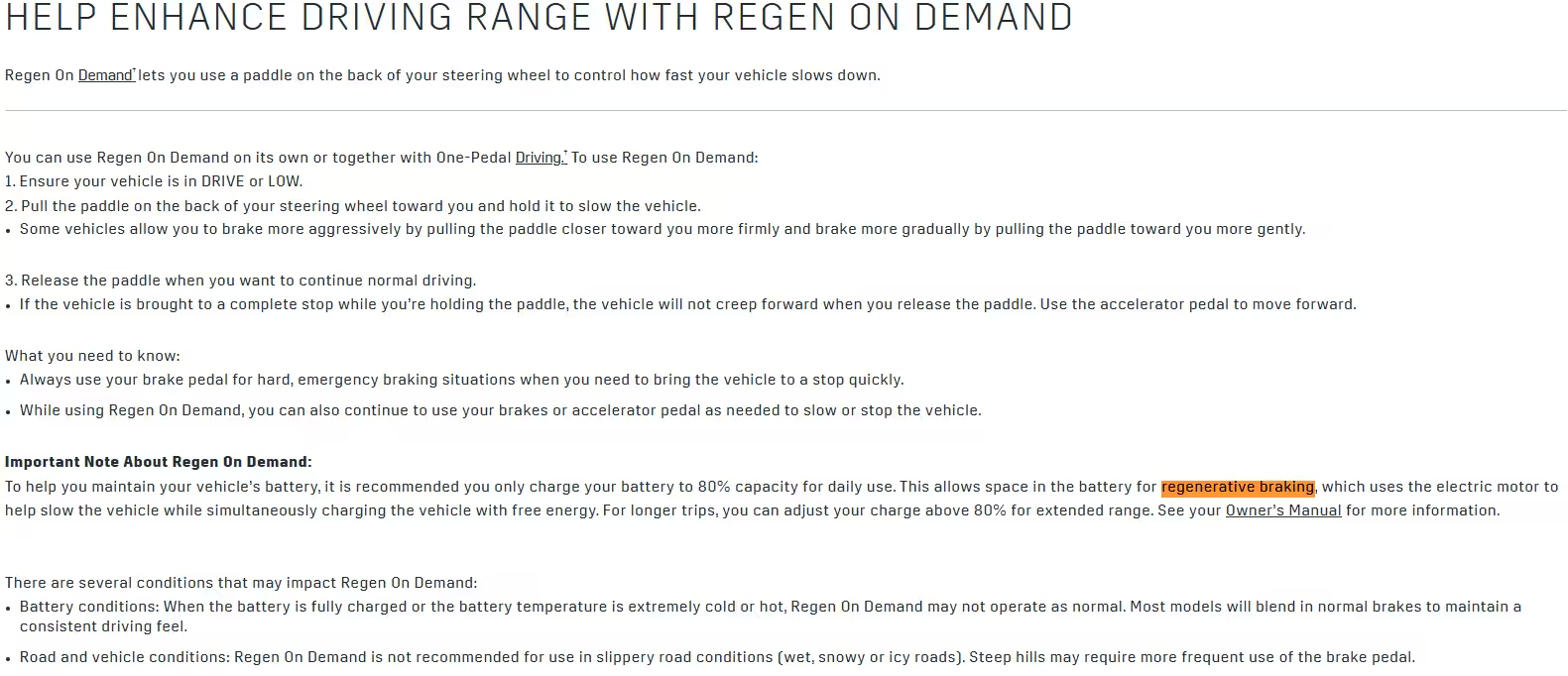
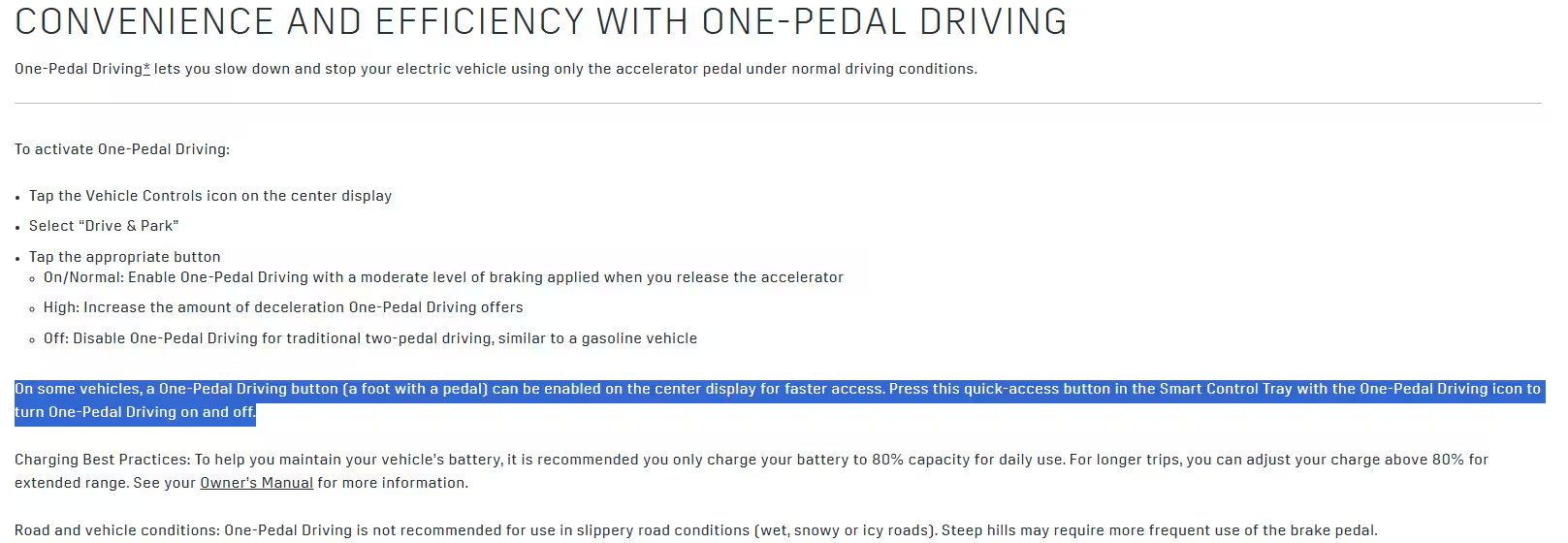
Cadillac LYRIQ regenerative braking features, including Regen on Demand and One-Pedal Driving.
What Factors Reduce Cadillac Lyriq Battery Range More Than Driving Modes?
Our analysis highlights that road conditions and driving behaviour can have a greater practical impact on range than the selected mode alone.
Motorway Speed and Aerodynamic Resistance
At higher speeds, aerodynamic resistance increases substantially.
This matters particularly for larger premium electric SUVs because pushing through the air requires significant energy.
A driver maintaining a moderate motorway speed may achieve better efficiency than someone travelling considerably faster, regardless of whether Tour or Sport is selected.
Cold Weather and Battery Temperature
Cold weather can increase energy demand through cabin heating and battery thermal management.
Winter conditions may also limit regenerative braking temporarily.
Drivers should therefore expect their range estimates to vary between summer and winter journeys.
Preconditioning the cabin while the vehicle is connected to external power can help reduce the amount of stored battery energy used for initial cabin heating.
Tyre Pressure and Vehicle Maintenance
Incorrect tyre pressures can increase rolling resistance and reduce efficiency.
Tyres, brakes and steering must also remain safe and properly maintained.
Drivers can review the wider UK requirements for vehicle maintenance when assessing roadworthiness and ongoing operating responsibilities.
Road Surface, Elevation and Vehicle Load
Climbing hills, transporting heavy cargo and travelling on difficult road surfaces can increase energy consumption.
Descending hills may allow some energy recovery through regenerative braking, but not all energy used during the climb can be recovered.
Additional passengers, luggage and aerodynamic accessories can also affect efficiency.
Factors Affecting Cadillac Lyriq Range
| Factor | Potential effect | Practical recommendation |
| High motorway speed | Increased aerodynamic energy demand | Maintain a consistent, appropriate speed |
| Cold weather | Additional heating and battery-management demand | Precondition when practical |
| Aggressive acceleration | Higher energy consumption | Accelerate progressively |
| Low tyre pressure | Increased rolling resistance | Follow manufacturer pressure guidance |
| Heavy cargo | Greater energy required for acceleration and climbing | Remove unnecessary load |
| Snow and rain | Higher resistance and traction challenges | Prioritise safe driving |
| Repeated braking | Energy losses despite regenerative recovery | Anticipate traffic and slow smoothly |

Cadillac’s official explanation of the factors affecting electric driving range, including speed, terrain, climate settings and temperature.
How Much Can Battery Efficiency Affect Cadillac Lyriq Charging Costs in the UK?
From a financial perspective, the relationship between battery efficiency and electricity expenditure is particularly important.
For a professional using an electric vehicle for business travel, small differences in energy consumption can accumulate over thousands of miles.
Charging expenses depend on the vehicle’s energy usage and the electricity rate paid.
Illustrative UK Charging Cost Comparison
The following calculations assume electricity prices of 25p/kWh for a lower-cost charging scenario and 75p/kWh for a higher-cost public charging scenario.
These are illustrative assumptions, not verified live tariffs or measured LYRIQ consumption figures. They also exclude charging losses.
| Example journey | Electricity used | Cost at 25p/kWh | Cost at 75p/kWh |
| 100 miles at 30 kWh/100 miles | 30 kWh | £7.50 | £22.50 |
| 100 miles at 33 kWh/100 miles | 33 kWh | £8.25 | £24.75 |
| 1,000 miles at 30 kWh/100 miles | 300 kWh | £75 | £225 |
| 1,000 miles at 33 kWh/100 miles | 330 kWh | £82.50 | £247.50 |
The difference across 1,000 miles is £7.50 in the lower-cost scenario and £22.50 in the higher-cost scenario.
For someone travelling 10,000 miles annually, the same 10% increase in energy consumption would mean an additional 300 kWh of electricity.
That would equate to an extra £75 at 25p/kWh or £225 at 75p/kWh, excluding charging losses.
Although these examples do not isolate the effect of a particular driving mode, they demonstrate why improving efficiency can be financially worthwhile.
The same calculation is relevant to commercial drivers, who must consider charging, insurance, maintenance and vehicle acquisition costs when evaluating their operating margins.
For comparison, the economics of professional electric vehicle use are also discussed in our assessment of black cab driver earnings, where charging costs form part of the wider operating-expense calculation.
How Does Business Mileage Change the Financial Picture?
Drivers using their personal LYRIQ for qualifying business journeys may also need to consider mileage reimbursement and tax relief.
The UK’s Approved Mileage Allowance Payments framework applies to eligible business mileage in personally owned cars, including electric cars.
The rules and limitations differ from arrangements involving company-owned vehicles.
Our analysis of the 45p per mile mileage framework explains why business travel expenditure should be assessed separately from household charging costs.
For employers, the important financial distinction is between the electricity cost of a journey and the wider expense of providing or reimbursing a vehicle.
Which Cadillac Lyriq Driving Mode Is Best for Different Situations?
A useful way to compare the driving modes is to assess how well each serves its intended purpose.
The following percentages are editorial suitability ratings, not Cadillac-issued efficiency scores or results from controlled driving tests. They reflect our assessment of the documented features against their main intended uses.
| Driving mode | Rated use case | Editorial suitability rating | Assessment |
| Tour | Everyday commuting and comfort | 95% | Strong everyday balance |
| Sport | Driving responsiveness | 92% | Useful performance-oriented calibration |
| Snow/Ice | Slippery-road driving assistance | 95% | Purpose-built traction response |
| My Mode | Personalisation and flexibility | 90% | Useful adjustable settings |
| LYRIQ-V V-Mode | Performance personalisation | 93% | Specialised performance functionality |
These percentages should not be compared as measured battery efficiency improvements.
Tour’s 95% rating does not mean it delivers 95% battery efficiency, while Sport’s 92% rating does not mean it uses 8% more electricity.
Our judgement is that Tour provides the most balanced default experience, while the other settings offer benefits for particular driving requirements.
How Can Owners Test Battery Usage Across LYRIQ Driving Modes?
A proper comparison requires more than switching between modes and observing the range estimate.
The most useful approach is to conduct a repeatable driving assessment under similar conditions.
Step 1: Select a Consistent Route
Choose a suitable route with a repeatable distance and comparable road conditions.
Ideally, the route should include similar traffic, road gradients and speed limits for each test.
Step 2: Record Battery and Driving Data
Before beginning, note the vehicle’s state of charge, outside temperature, selected mode and available trip-efficiency information.
Record the same information at the end of the journey.
Step 3: Test Tour Mode
Complete the route in Tour Mode using a consistent and safe driving style.
Avoid unnecessary acceleration and record the energy-consumption figures.
Step 4: Repeat in Sport and My Mode
Repeat the same route in another suitable mode.
Where practical, keep climate settings, tyre pressure, vehicle load and driving speeds consistent.
Do not test Snow/Ice mode in inappropriate conditions simply to obtain a comparison.
Step 5: Compare the Results
Use the vehicle’s actual energy-consumption information rather than relying solely on the estimated remaining range.
A comparison might look like this:
| Test measurement | Tour | Sport | My Mode |
| Distance travelled | Record actual | Record actual | Record actual |
| Average speed | Record actual | Record actual | Record actual |
| Outside temperature | Record actual | Record actual | Record actual |
| Energy consumed | Record actual | Record actual | Record actual |
| Consumption per 100 miles | Calculate | Calculate | Calculate |
| Driving conditions | Record actual | Record actual | Record actual |
Repeated tests are more reliable than a single journey because traffic, temperature and driving behaviour can distort individual results.
For business operators, this type of assessment can support a more accurate charging budget and help establish realistic vehicle operating costs.
How Can Cadillac Lyriq Drivers Maximise Their Battery Range?
The strongest efficiency improvements generally come from combining sensible driving habits with appropriate vehicle settings.
- Use Tour Mode for everyday travel: Tour provides predictable responses without encouraging unnecessarily aggressive acceleration.
- Maintain a steady speed: Avoid excessive motorway speed and unnecessary changes in acceleration.
- Use regenerative braking intelligently: Anticipate traffic and allow the vehicle to recover energy when slowing, while prioritising safe braking.
- Check tyre pressures regularly: Use the manufacturer’s recommended tyre-pressure values rather than guessing.
- Precondition the cabin when appropriate: Heating or cooling the vehicle while plugged in can reduce the initial demand on stored battery energy.
- Plan charging stops around real-world range: Do not assume the vehicle will always deliver its maximum official EPA estimate.
- Monitor consumption over multiple journeys: Long-term efficiency averages are generally more useful than interpreting individual range-estimate changes.
- Follow battery charging guidance.: Everyday charging targets and preparation for longer journeys should follow the instructions for the specific vehicle and battery system.
Does the Cadillac Lyriq Offer Better Driving-Mode Flexibility Than Other Luxury EVs?
The LYRIQ competes with premium electric vehicles that offer their own driving-response, traction and efficiency-management features.
The main distinction is not simply the number of modes available, but how those modes interact with the driving experience.
Cadillac provides a combination of configurable accelerator response, steering characteristics, regenerative braking features and specialised traction settings.
This creates a useful balance between everyday comfort and individual preferences.
However, it would be misleading to declare the LYRIQ objectively more efficient than competing SUVs based on its driving-mode system alone.
A meaningful comparison would require equivalent vehicle specifications and controlled testing across similar driving routes, temperatures and speeds.
For buyers assessing total cost of ownership, charging convenience, real-world efficiency, insurance, depreciation and maintenance can be more important than a vehicle’s number of selectable driving modes.
What Are the Most Common Misunderstandings About Cadillac Lyriq Battery Usage?
Several assumptions can cause confusion when comparing the LYRIQ’s available driving modes.
| Common assumption | What drivers should understand |
| Sport Mode always reduces range by 15% | No fixed manufacturer-confirmed percentage applies |
| Tour Mode increases battery capacity | Driving modes do not change physical battery capacity |
| Snow/Ice Mode is the best efficiency setting | It is primarily a traction-related mode |
| V-Mode is available on every LYRIQ | V-Mode is a LYRIQ-V performance feature |
| One-Pedal Driving is a separate main driving mode | It is a regenerative braking feature |
| The dashboard range estimate is guaranteed | It is an estimate that can change with conditions |
| Higher regeneration always means better efficiency | Avoiding unnecessary braking can be more efficient |
| Charging costs are identical for every journey | Energy use and electricity rates can vary substantially |
These distinctions help explain why online claims about fixed range improvements should be treated cautiously.
A driving-mode selection is only one part of the broader energy-management picture.
Conclusion
The Cadillac LYRIQ’s driving modes can influence battery consumption and real-world range, but they do not change the vehicle’s physical battery capacity or create fixed, mode-specific driving ranges.
Tour Mode remains the most practical option for balanced everyday driving, while Sport provides greater responsiveness, Snow/Ice focuses on slippery-road control and My Mode supports personalisation. The separate LYRIQ-V adds specialised performance functionality.
Our analysis indicates that driving habits, motorway speed, weather, vehicle configuration and regenerative braking are often more important than the selected mode alone.
For buyers and business users evaluating charging expenses and total ownership costs, the most reliable approach is to combine official specifications with actual energy-consumption measurements.
Ultimately, the best Cadillac LYRIQ driving mode is the one suited to the road conditions and driving requirements, supported by smooth driving and sensible energy management.
Frequently Asked Questions
Does Sport Mode drain the Cadillac Lyriq battery faster?
It can increase consumption if the driver uses its more responsive accelerator calibration for stronger acceleration. However, Sport Mode does not have a verified fixed battery-drain percentage.
Is Tour Mode the most efficient driving mode in the Cadillac Lyriq?
Tour is generally the most practical default for economical everyday driving. Actual efficiency still depends on driving habits, temperature, speed and road conditions.
Can My Mode increase Cadillac Lyriq driving range?
A relaxed accelerator configuration may help encourage smoother driving. However, Cadillac does not publish a guaranteed range improvement for My Mode.
Does the Cadillac Lyriq have an Eco driving mode?
The standard LYRIQ driving-mode selections are generally Tour, Sport, Snow/Ice and My Mode, depending on model year and equipment. Tour is the closest equivalent to a comfortable everyday efficiency-oriented setting, rather than a separately named Eco driving mode.
How much range does the 2026 Cadillac Lyriq have?
Cadillac publishes an EPA-estimated range of up to 326 miles for the 2026 RWD version, 319 miles for certain AWD configurations and 285 miles for the LYRIQ-V. Actual results vary.
Does regenerative braking work in Sport Mode?
Regenerative braking remains part of the vehicle’s electric braking system. The available controls and behaviour depend on the vehicle configuration and selected settings.
Does driving mode affect Cadillac Lyriq charging speed?
The driving mode itself does not set the vehicle’s maximum charging rate. Charging performance is governed by the charging equipment, battery condition, temperature, state of charge and vehicle capabilities.
Should Snow/Ice Mode be used on ordinary roads to save energy?
No. Snow/Ice Mode is intended to improve control in slippery conditions. It should not be treated as a general battery-saving setting.
Why does the Cadillac Lyriq show fewer miles after charging in winter?
Cold temperatures, heating demand and recent energy consumption can influence the displayed range estimate. The difference does not necessarily indicate permanent battery degradation.
Do the Cadillac Lyriq driving modes affect long-term battery health?
Driving modes are not direct battery-health settings. Long-term battery condition depends on a broader combination of factors, including temperature, charging behaviour, ageing and usage patterns.