


HMRC has made measurable progress towards becoming a digital-first tax authority, although some parts of the transformation programme remain under development.
During 2025 to 2026, 78% of customer interactions with HMRC took place through digital or automated self-service channels, compared with approximately 65% five years earlier. HMRC is targeting at least 90% digital interactions by 2030.
Other notable developments include the introduction of Making Tax Digital for Income Tax in April 2026, growth in HMRC app usage to 7.6 million people and the migration or decommissioning of more than half of HMRC’s services and underlying technology.
However, progress has not been uniform. Wider delivery of the new PAYE expenses service and Child Benefit claim tracking did not meet their original 2025 to 2026 delivery dates. Both are now expected to be introduced incrementally during 2026 to 2027.
HMRC Digital Transformation Progress at a Glance:
| Area | Position as of July 2026 | Future target or next step |
| Digital customer interactions | 78% of interactions were digital or automated in 2025 to 2026 | At least 90% by 2030 |
| HMRC app users | 7.6 million unique users in 2025 to 2026 | 10 million users by March 2027 |
| Personal Tax Account | Used by 19.7 million people during 2025 to 2026 | Further personalised services and clearer tax information |
| Business Tax Account | Used by 10.8 million businesses during 2025 to 2026 | More integrated digital journeys |
| Making Tax Digital for Income Tax | Introduced for qualifying income over £50,000 from 6 April 2026 | Threshold falls to £30,000 in April 2027 and £20,000 in April 2028 |
| MTD sign-ups | More than 350,000 businesses signed up by July 2026 | Around 2.9 million customers expected to enter MTD for Income Tax |
| Ask HMRC digital assistant | More than 6.3 million interactions in 2025 to 2026 | Further AI-powered customer support |
| Cloud and IT modernisation | More than half of services and underlying IT migrated, replaced or decommissioned | Further replacement of legacy systems |
| Postal communications | Transition towards digital-by-default correspondence | Approximately 75% reduction in postal outputs and £50 million annual savings by 2028 to 2029 |
| GOV.UK One Login | New individual customers now use GOV.UK One Login | Existing customers, agents and organisations to transition by 2030 |
The figures above come from HMRC’s original Transformation Roadmap, the official 2026 progress update and HMRC’s accompanying delivery annex.
What Is the HMRC Transformation Roadmap?

HMRC published its Transformation Roadmap on 21 July 2025. It established a five-year programme intended to modernise the administration of tax, customs and valuation services.
The roadmap is built around three principal objectives:
- Improving HMRC’s day-to-day performance and customer experience
- Closing the tax gap through better compliance, automation and data
- Reforming and modernising the UK tax and customs system
By 2030, HMRC expects most straightforward enquiries to be handled digitally or automatically.
Customers and tax agents should be able to complete more tasks online, upload documents securely, track the progress of enquiries and receive information tailored to their circumstances.
The plan does not mean that every HMRC service will become fully automated. HMRC says telephone, postal and adviser-led support will remain available where customers are digitally excluded, vulnerable or dealing with complex tax matters.
What Progress Has HMRC Made With Digital Customer Services?
Digital Interactions Have Continued to Increase
HMRC reported that 78% of customer interactions were completed through digital or automated channels during 2025 to 2026. This was two percentage points higher than the approximately 76% reported when the original roadmap was published.
Digital customer satisfaction averaged around 80%, while use of the HMRC app, Personal Tax Account and Business Tax Account remained high.
The HMRC app recorded:
- 7.6 million unique users during 2025 to 2026
- Approximately three million users in January 2026 alone
- More than 15 million app visits during that month
- £818.8 million of Self Assessment payments in January 2026, compared with £499 million in January 2025
HMRC intends to reach 10 million unique app users by March 2027.
PAYE Services Have Become More Accessible Online
A new online PAYE service has been introduced to give taxpayers greater visibility and control over their tax position. It allows customers to review information such as income, tax codes, allowances, reliefs and deductions.
Further improvements planned for 2026 to 2027 include:
- Clearer explanations of underpayments and overpayments
- Personalised information about changes to take-home pay
- Better explanations of how untaxed interest affects tax
- A consolidated online expenses service
- Digital National Insurance refund applications
- Additional State Pension forecast features
HMRC originally intended to launch its new PAYE expenses service more widely during 2025 to 2026. Instead, it entered private beta testing, with a staged rollout now planned during 2026 to 2027.
PAYE Claim and Repayment Tracking Remains a Priority
Digital tracking is intended to reduce one of the most common reasons people contact HMRC: asking for an update on an existing claim, repayment or application.
Planned services include:
- End-to-end Child Benefit claim tracking
- Digital Child Benefit award notices
- An improved VAT repayment tracker
- Options for tracking Self Assessment submissions and repayments
- Secure online document exchange between HMRC, taxpayers and agents
The original target for Child Benefit tracking was not met. Initial functionality is now expected during 2026 to 2027, followed by incremental improvements.
How Is Making Tax Digital Changing Tax Administration?

Making Tax Digital, commonly abbreviated to MTD, is one of the most significant parts of HMRC’s modernisation programme.
MTD for VAT has operated since 2019. MTD for Income Tax became mandatory for the first group of sole traders and landlords on 6 April 2026.
Under MTD for Income Tax, affected taxpayers must generally use compatible software to:
- Create and maintain digital accounting records
- Record self-employment and property income and expenses
- Submit quarterly updates to HMRC
- Complete the relevant end-of-year tax return process
The first rollout applies to sole traders and landlords whose qualifying income from self-employment and property was more than £50,000 on their 2024 to 2025 tax return.
The planned timetable is:
| Qualifying income shown on the relevant return | MTD for Income Tax start date |
| More than £50,000 | 6 April 2026 |
| More than £30,000 | 6 April 2027 |
| More than £20,000 | 6 April 2028 |
Qualifying income is generally the combined gross income or turnover from self-employment and property before expenses. Eligibility is not based on taxable profit.
More than 350,000 businesses had signed up by July 2026. HMRC estimates that approximately 2.9 million customers will eventually be brought into MTD for Income Tax as the thresholds are reduced.
Businesses and landlords should use the official Making Tax Digital for Income Tax guidance to confirm whether the requirements apply.
Exemptions may be available where it is not reasonable or practical for a person to use digital tools, but an exemption must normally be confirmed by HMRC.
How Is HMRC Using Artificial Intelligence?
Artificial intelligence forms part of HMRC’s plans for customer service, compliance, staff productivity and customs administration.
During 2025 to 2026, HMRC:
- Issued more than 28,000 Microsoft Copilot licences to staff
- Piloted automatic call summarisation
- Used AI-enabled training simulators for customer service staff
- Created testing environments using synthetic data
- Continued developing its Ask HMRC digital assistant
- Built digital prompts and nudges into Making Tax Digital services
Ask HMRC recorded more than 6.3 million customer interactions during 2025 to 2026. HMRC also plans to integrate AI tools into the Online Trade Tariff to help importers and exporters find and understand customs information.
HMRC says its AI use will follow government technology, accessibility and ethical frameworks. For example, the call-summarisation pilot keeps a human adviser involved in reviewing the information produced by the system.
AI is therefore being used primarily to support decisions, automate administrative work and direct customers towards relevant services. It should not be assumed that every compliance or tax decision will be made autonomously.
Is HMRC Replacing Its Older IT Systems?
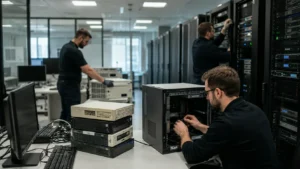
HMRC has a substantial legacy technology estate, including systems that can be expensive to maintain or difficult to integrate with newer services.
By July 2026, more than half of HMRC’s services and underlying technology had either been moved from on-site servers to secure cloud hosting or decommissioned.
Current modernisation work includes:
- A central customer registry connecting information across HMRC systems
- A new enterprise Customer Relationship Management platform
- Contact Centre as a Service technology
- Replacement or improvement of legacy Corporation Tax systems
- A cloud-based Customer Debt Collection Service
- Continued development of the Customs Declaration Service
- Secure digital communication and document exchange
The new Customer Debt Collection Service had already collected more than £1.4 billion in debt by July 2026. It is intended to give HMRC a consolidated view of customer debt and support more targeted communication, automation and case allocation.
What Does Digital Transformation Mean for Tax Advisers?
Tax advisers and software providers are central to HMRC’s future operating model because many taxpayers interact with HMRC through an accountant, agent or commercial accounting platform.
From May 2026, tax advisers who interact with HMRC are required to register. HMRC moved the start date from April to May 2026 so that advisers and taxpayers could focus on the launch of MTD for Income Tax.
HMRC has also published a strategic approach to third-party tax software. Its priorities include:
- Improving digital identity and agent authorisation
- Developing more secure communications between HMRC, customers and advisers
- Establishing clearer standards for tax software
- Improving application programming interfaces
- Supporting responsible use of generative AI in tax products
- Giving agents access to more customer information and tracking tools
A detailed delivery plan covering HMRC’s work with the software industry is expected in April 2027. Formal performance measurement for the software strategy is expected to begin in summer 2027.
Will HMRC Become Digital by Default?
HMRC has introduced a legislative framework that allows customers using digital services to receive correspondence digitally by default unless they opt out or require another form of communication.
The long-term objective is to reduce postal outputs by approximately 75%, generating estimated savings of £50 million a year from 2028 to 2029.
This transition will be gradual. HMRC says paper communications will be retained for critical correspondence and for customers who cannot reasonably use digital services.
Businesses should therefore maintain accurate contact information in their HMRC account and regularly check digital messages.
However, unexpected emails, texts or payment requests should still be treated cautiously because fraudsters may imitate government communications.
Is Government Gateway Being Replaced?

HMRC is moving towards GOV.UK One Login as its standard sign-in and identity-verification service.
All new individual HMRC customers without an existing Government Gateway account now access relevant digital services through GOV.UK One Login. Preparatory work is underway to move existing individual customers, agents and organisations.
The target is to complete the wider transition by 2030. Existing users should not assume that their Government Gateway credentials have already stopped working. They should continue following the sign-in instructions presented on the official GOV.UK service they are using.
What Still Needs to Be Delivered Before 2030?
HMRC has recorded progress, but many of the largest and most technically complex changes remain in development.
Important future milestones include:
- Expanding MTD for Income Tax in April 2027 and April 2028
- Reaching 10 million HMRC app users by March 2027
- Introducing initial Child Benefit and VAT tracking improvements
- Launching a fully digital Inheritance Tax service from 2027 to 2028
- Developing a Digital Disclosure Service for 2027 to 2028
- Moving existing users towards GOV.UK One Login
- Introducing mandatory VAT e-invoicing from April 2029
- Continuing replacement of legacy Corporation Tax technology
- Reaching at least 90% digital customer interactions by 2030
The scale of these projects means the final outcome will depend on successful technology delivery, customer adoption, cybersecurity, accessibility and cooperation with tax agents and software providers.
Some services are also being introduced through private beta testing and phased releases rather than a single national launch.
What Does the Transformation Mean for UK Businesses?

The practical impact will vary according to the type and size of the business.
Sole Traders and Landlords
Those within the MTD thresholds need suitable software, reliable digital records and processes for submitting quarterly updates. They should check qualifying income rather than taxable profit when assessing the start date.
Employers
PAYE services should provide clearer online explanations of tax codes, underpayments and employee tax positions. Employers should still ensure that payroll submissions and employee information are accurate.
Accountants and Tax Advisers
Agents face mandatory registration, stronger identity controls and gradual changes to authorisation and client-management services. Practices may need to review software, staff training and client onboarding.
Importers and Exporters
Businesses involved in international trade should expect further improvements to customs platforms, digital documentation and the Online Trade Tariff. Digital ATA Carnets were introduced on 1 June 2026.
Vat-registered Businesses
Mandatory VAT e-invoicing is planned from April 2029 for business-to-business and business-to-government transactions. More detailed standards, legislation and technical specifications are due before implementation.
Final Takeaway
HMRC’s digital transformation has moved beyond planning and into active delivery.
The launch of Making Tax Digital for Income Tax, increased use of the HMRC app, expanding digital accounts, cloud migration and greater use of automation provide clear evidence of progress.
The programme is not complete, and some commitments have taken longer than originally expected.
Important services such as Child Benefit tracking, digital Inheritance Tax administration, secure document exchange, VAT e-invoicing and the wider GOV.UK One Login transition still need to be delivered.
For businesses, the direction is clear: tax administration will increasingly rely on digital records, compatible software, online communication and integrated data.
Businesses should prepare early while continuing to verify their specific obligations through official HMRC guidance.
Frequently Asked Questions
What is HMRC’s digital transformation programme?
It is a multi-year programme to modernise the UK’s tax, customs and valuation administration. It covers online customer services, Making Tax Digital, artificial intelligence, cloud infrastructure, compliance systems, tax software and digital communications.
Is HMRC on track to reach its 2030 target?
HMRC has made progress, including increasing digital interactions to 78%, expanding app use and launching MTD for Income Tax. However, the 90% target has not yet been reached, and several major services remain under development.
When did Making Tax Digital for Income Tax start?
The first mandatory phase began on 6 April 2026 for qualifying sole traders and landlords with combined gross self-employment and property income above £50,000, subject to the detailed rules and exemptions.
Who will enter MTD for Income Tax next?
Those with qualifying income above £30,000 are scheduled to enter from 6 April 2027. Those above £20,000 are scheduled to enter from 6 April 2028.
Will people still be able to contact HMRC by telephone?
Telephone and adviser-led support will remain available, particularly for complex enquiries, people in vulnerable circumstances and those who cannot use digital services.
Will all HMRC letters become digital?
HMRC plans to make most outbound correspondence digital by default, but paper will remain available for critical communications and customers who require it.
How is HMRC protecting customer data?
HMRC says it is moving services to secure cloud platforms, strengthening identity verification and applying government security and ethical frameworks to AI. Customers must still protect login details and access HMRC services only through GOV.UK or the official app.
What should businesses do to prepare?
Businesses should check whether MTD applies, maintain accurate digital records, review compatible software, keep HMRC contact details updated and monitor official announcements relevant to their tax obligations.
Note: This article has been reviewed against official HM Revenue & Customs and UK Government guidance.