

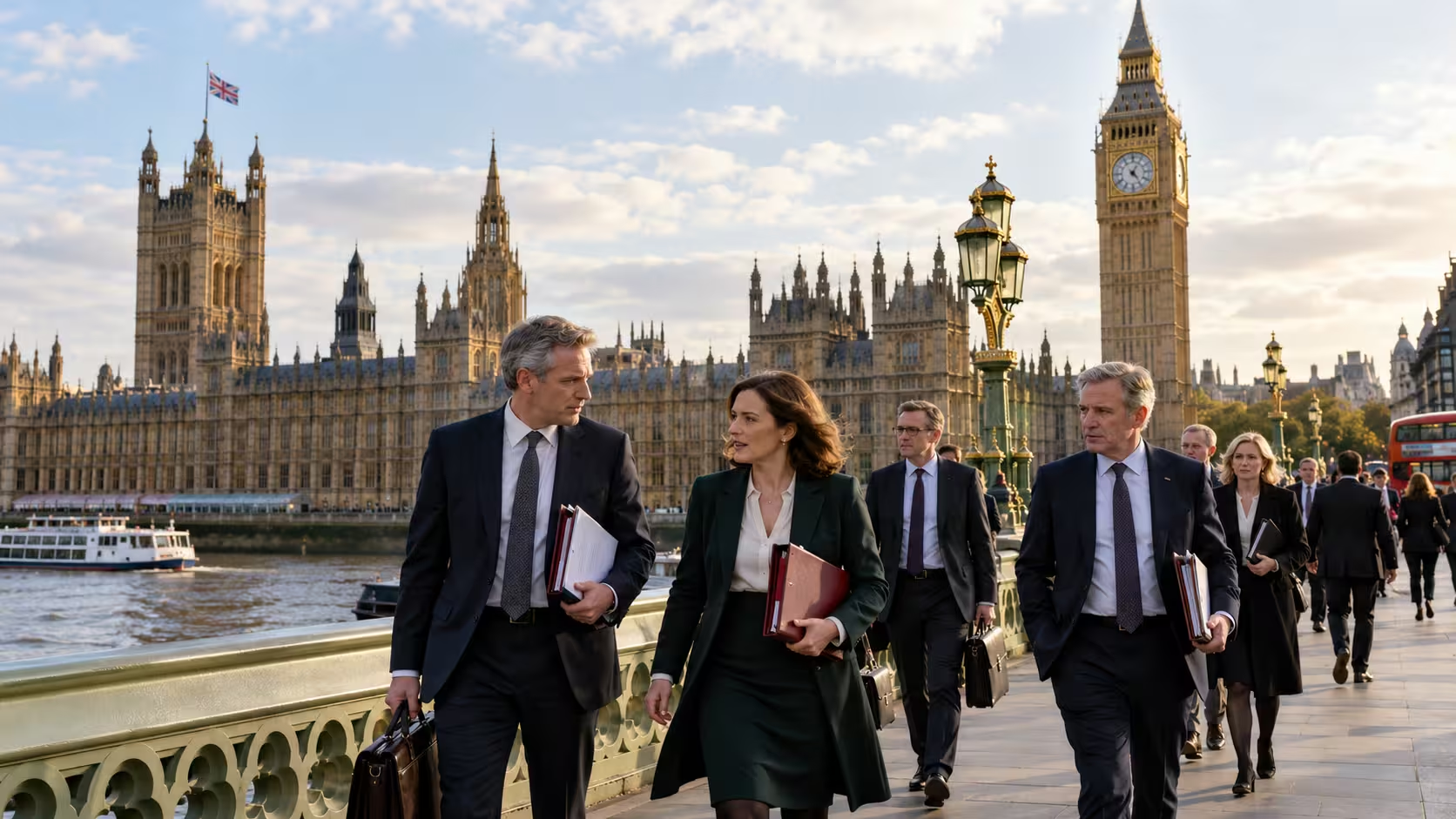
UK Members of Parliament received a 5% pay rise from 1 April 2026, increasing the standard annual MP salary from £93,904 to £98,599 for the 2026/27 financial year.
The Independent Parliamentary Standards Authority (IPSA), which decides MPs’ pay independently of Parliament and the Government, confirmed the increase.
However, the full 5% was not simply a cost-of-living adjustment. It consists of a 3.5% cost-of-living increase and a separate 1.5% benchmarking adjustment.
The percentage increase has also varied considerably in recent years. MPs received 5.5% in 2024/25, 2.8% in 2025/26 and 5% in 2026/27.
Future increases, including the eventual 2027/28 decision, will depend on economic conditions, earnings data, public sector settlements and salary comparisons rather than automatically repeating the current percentage.
What Has Changed With MPs’ Pay From April 2026?
From 1 April 2026, an MP’s standard salary increased by £4,695 a year, taking annual gross pay to £98,599.
That works out at approximately £8,216.58 per month or £1,896.13 per week before Income Tax, National Insurance, pension contributions and any other applicable deductions.
| Pay Detail | 2025/26 | 2026/27 | Change |
| Annual Basic Salary | £93,904 | £98,599 | £4,695 |
| Monthly Gross Salary | £7,825.33 | £8,216.58 | £391.25 |
| Pay Increase | 2.8% | 5% | 2.2 Percentage Points |
The rise applies to MPs’ basic parliamentary salary. Expenses and funding for staffing, constituency offices, accommodation and eligible travel are separate and should not be treated as extra personal salary.
Higher gross pay does not translate directly into the same percentage increase in take-home pay.
Frozen tax thresholds can mean salary increases push more income into higher tax bands, an issue also affecting workers more broadly under the UK’s tax threshold freeze.
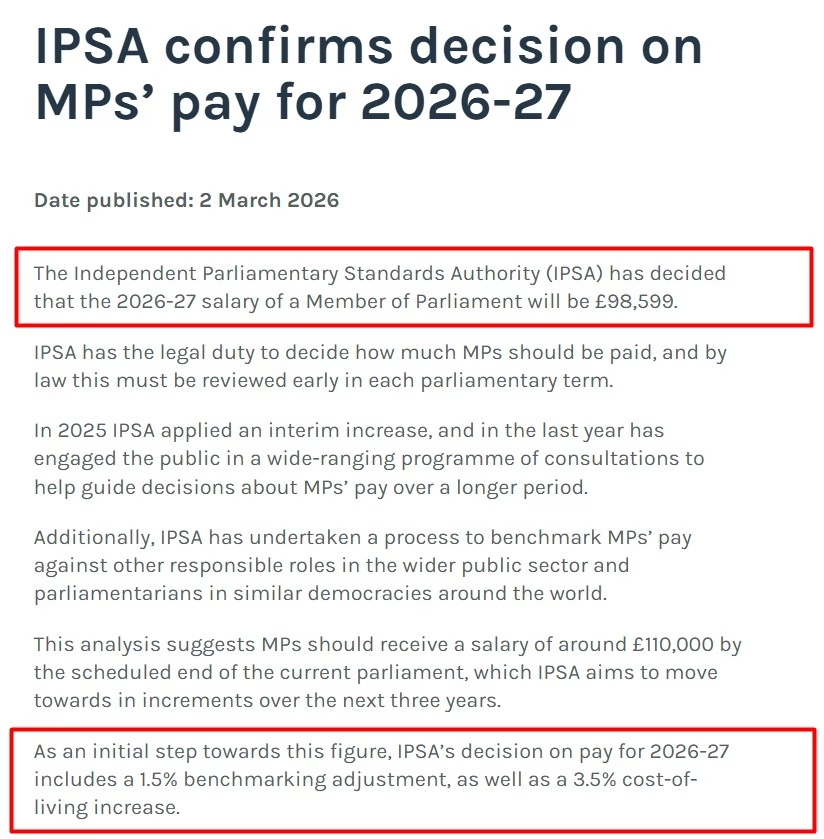
IPSA’s official 2026/27 pay decision confirms the £98,599 MP salary and explains the 3.5% cost-of-living increase plus 1.5% benchmarking adjustment.
Has The MPs’ Pay Rise Percentage Changed Over The Past Three Years?
Yes. MPs have not received the same percentage increase each year.
The last three financial years show substantial variation.
| Financial Year | Previous Salary | New Salary | Cash Increase | Pay Rise |
| 2024/25 | £86,584 | £91,346 | £4,762 | 5.5% |
| 2025/26 | £91,346 | £93,904 | £2,558 | 2.8% |
| 2026/27 | £93,904 | £98,599 | £4,695 | 5% |
In 2024/25, MPs received a 5.5% increase. IPSA said this was in line with the award agreed for the Senior Civil Service.
The approach changed in 2025/26. IPSA applied an interim 2.8% increase while carrying out a broader review of how parliamentary salaries should be determined during the current Parliament. That took basic pay to £93,904.
The 2026/27 increase returned to 5%, but its structure is different again because it combines the 3.5% cost-of-living component with a 1.5% benchmarking adjustment.
The three-year record therefore shows that there is no fixed annual percentage automatically applied to MPs’ salaries.
On What Basis Is The MPs’ Pay Rise Calculated And Decided?
There is no longer a simple rule saying MPs must receive the same percentage increase as one particular group of workers.
IPSA’s current determination requires it to consider a wider collection of economic and salary evidence before deciding whether MPs’ pay should change and by how much.
Factors include
- Economic Forecasts: Forecasts from organisations including the Office for Budget Responsibility and Bank of England
- Inflation: Current inflation measures and forecasts for future price rises
- Average Earnings: Changes in earnings across the wider UK labour market
- Household Income: Trends affecting the financial position of UK households
- Employer Pay Surveys: Evidence showing how salaries are changing across employers
- Public Sector Awards: Settlements and recommendations affecting public sector employees
- Comparable UK Roles: Pay for professionals holding other positions of significant responsibility
- International Comparisons: Salaries received by parliamentarians in comparable democracies
For the 2026/27 decision, IPSA’s benchmarking work led it towards the view that an MP’s salary should move gradually towards approximately £110,000 by the scheduled end of the current Parliament.
The 1.5% benchmarking element of the 2026 rise is the first step in that process, while the remaining 3.5% represents the cost-of-living element.
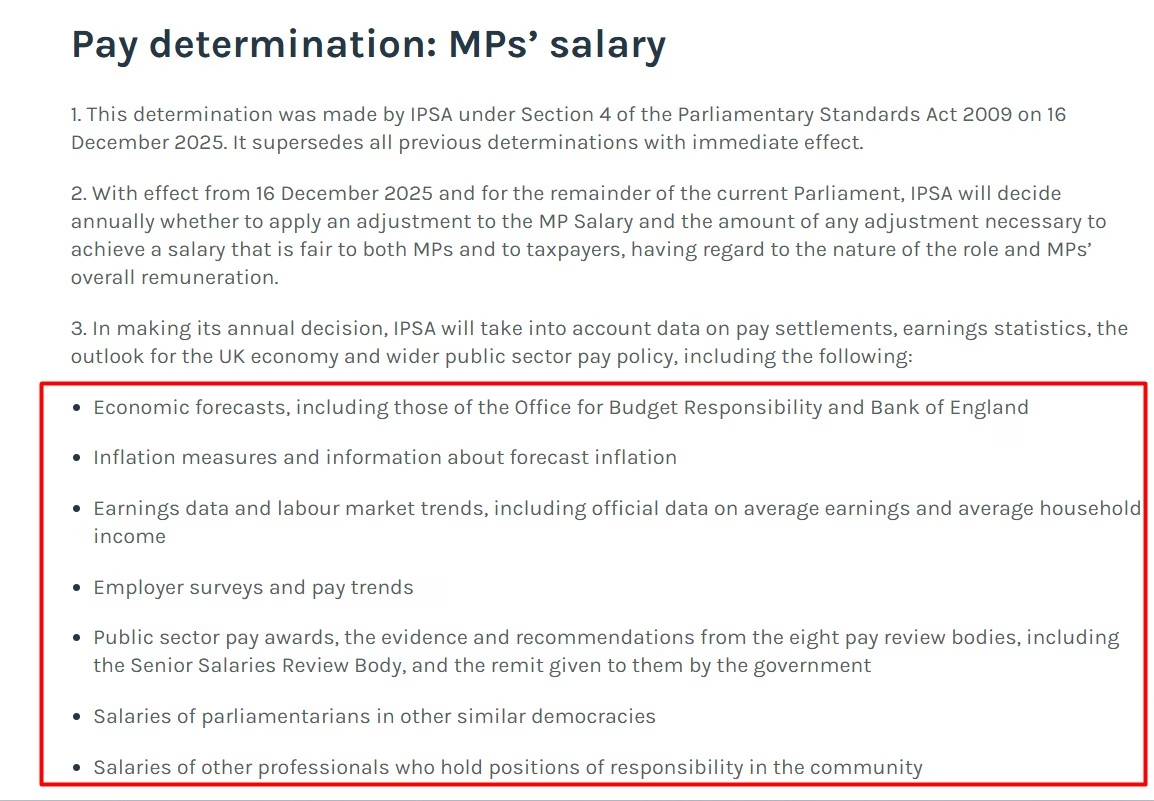
IPSA’s official pay determination lists the economic forecasts, inflation, earnings, public sector awards and salary benchmarks considered when deciding MPs’ annual pay.
Who Decides MPs’ Salaries In The UK?
MPs do not directly vote to set their own basic salary.
The decision belongs to the Independent Parliamentary Standards Authority, which has been responsible for MPs’ pay since 2011.
IPSA operates independently of both Parliament and the Government. It was created following reforms to parliamentary financial oversight and has responsibility for MPs’ pay, pensions and rules governing staffing and parliamentary business costs.
The Parliamentary Standards Act requires IPSA to review its pay determination early in each Parliament. The organisation then decides whether annual adjustments are necessary.
This system is intended to reduce the conflict of interest that could arise if MPs directly determined their own salary increases.
How Does MPs’ Pay Compare With Other Senior UK Roles?
One reason the 2026/27 settlement differs from a standard cost-of-living increase is that IPSA carried out a broader benchmarking exercise.
Its report compared parliamentary pay with senior positions in public services and other areas of responsibility.
| Role | Salary Used In IPSA Benchmarking |
| MP In 2026/27 | £98,599 |
| Police Superintendent | £103,797 To £115,785 |
| NHS Chief Nurse | £105,385 To £128,051 |
| NHS Consultant | £106,424 To £160,951 |
| Army Colonel | £111,854 To £122,849 |
IPSA also examined average salaries for senior managers and directors.
In November 2025 data used in the review, average senior manager salaries ranged from approximately £86,828 in the public sector to £91,720 in the private sector, while director-level averages were above £128,000.
IPSA concluded from its broader analysis that moving MPs’ salaries towards roughly £110,000 during the current Parliament would provide a closer comparison with other positions carrying substantial responsibility.
That does not mean MPs’ salaries are automatically linked to any one of these professions. They are reference points considered alongside economic conditions and taxpayer affordability.
How Does The 2026/27 MPs Pay Rise Compare With Other UK Workers?
The 5% MPs’ increase is higher than several major public sector pay settlements applying during 2026/27.
NHS Agenda for Change employees received a 3.3% consolidated uplift, while the Civil Service Pay Remit Guidance set a maximum 3.5% Increase in Remuneration Cost for departments covered by the framework.
The Civil Service figure represents an overall paybill measure, so it does not mean every employee automatically receives exactly 3.5%.
Other 2026 awards provide further context.
| Workforce | 2026/27 Headline Increase |
| MPs | 5% |
| RAF And Eligible Armed Forces Personnel | 3.6% |
| Prison Officers | At Least 3.5% |
| Civil Service Pay Remit | Maximum 3.5% IRC |
| NHS Agenda For Change Staff | 3.3% |
| NJC School Support Staff | 3.3% |
The differences can be seen across the wider public sector. The confirmed RAF pay rise for 2026 was 3.6%, while the prison officer pay rise provided at least 3.5% for eligible staff.
Eligible NJC school employees ultimately received a 3.3% school support staff pay rise from April 2026.
Local government pay also became the subject of lengthy negotiations after the initial 3.3% proposal prompted the UNISON pay dispute in 2026.
The comparison helps explain why the MPs’ settlement generated attention. However, IPSA argues that the full 5% should not be treated solely as a conventional annual pay award because 1.5 percentage points specifically relate to salary benchmarking.
Why Has The MPs Pay Rise Caused Public Debate?
The controversy largely comes from the size and timing of the increase.
A 5% rise is higher than several major public sector settlements, while many households continue to face pressure from housing, energy, food and other living costs.
Critics therefore question whether elected representatives should receive a larger percentage increase than some nurses, civil servants, council workers and other publicly funded employees.
However, public attitudes towards MPs’ pay are not entirely straightforward.
IPSA’s Citizens’ Forum brought together 23 members of the public for around 18 hours of discussion and evidence sessions.
Before taking part, 65% thought MPs were paid too much. After considering the nature and demands of the job, 67% believed the level of pay was about right.
IPSA has also highlighted increasing constituency casework, greater complexity in MPs’ responsibilities and higher levels of abuse and intimidation towards politicians and their employees.
The debate therefore centres on two competing questions: how much MPs should reasonably receive for the role they perform and whether that amount remains fair to taxpayers and other workers.
How Much Will The MPs Pay Rise Cost UK Taxpayers?
There are 650 seats in the House of Commons.
If the £98,599 basic salary were applied across all 650 seats for a complete year, the simple calculation would be:
£98,599 × 650 = £64,089,350
Using the previous £93,904 salary:
£93,904 × 650 = £61,037,600
The difference is approximately:
£3,051,750 per year
This means the £4,695 individual increase would add roughly £3.05 million to the annual basic salary bill on a simple 650-seat calculation.
| Calculation | Approximate Amount |
| Previous Basic Salary Bill | £61.04 Million |
| New Basic Salary Bill | £64.09 Million |
| Additional Basic Salary Cost | £3.05 Million |
This is an illustrative calculation rather than the final amount recorded in parliamentary accounts.
Actual public expenditure can differ because of vacancies, MPs entering or leaving Parliament during the year, employer National Insurance, pension contributions and additional salaries attached to certain parliamentary positions.
Staffing budgets, office costs, accommodation and eligible parliamentary travel are also separate from MPs’ personal basic salaries.
Do Some MPs Earn More Than The £98,599 Basic Salary?
Yes. £98,599 is the standard basic salary for an MP, but certain MPs can receive additional remuneration because they hold extra responsibilities.
Select Committee Chairs
Eligible Select Committee chairs receive an additional £19,763 a year from April 2026.
When combined with the standard MP salary, this could produce:
£98,599 + £19,763 = £118,362
IPSA determines these additional committee-chair salaries separately.
Government Ministers
MPs who also serve as Government ministers can receive a separate ministerial salary.
As of September 2026, the ministerial salaries actually claimed by Commons ministers included:
| Role | Additional Ministerial Salary | Combined With MP Salary |
| Prime Minister | £75,440 | £174,039 |
| Secretary Of State Or Cabinet Minister | £67,505 | £166,104 |
| Minister Of State | £31,680 | £130,279 |
| Parliamentary Under-Secretary | £22,375 | £120,974 |
These ministerial amounts are separate from the basic MP salary and are administered under different arrangements.
Expenses should not be added to these figures as personal earnings because they are intended to cover costs associated with carrying out parliamentary duties.
Could MPs’ Salaries Reach £110,000 By 2029?
Possibly, but £110,000 is not a guaranteed future salary.
IPSA’s benchmarking exercise suggested that MPs’ basic pay should move towards approximately £110,000 by the scheduled end of the current Parliament.
The organisation said it intends to move towards that level in increments rather than making a single immediate increase. The 1.5% benchmarking adjustment applied in 2026/27 is the first step.
However, IPSA has also made clear that future decisions will continue to consider prevailing economic and fiscal conditions.
This means a predetermined series of 5% annual increases has not been announced.
Moving beyond £100,000 would also have tax implications. Under 2026/27 rules, the standard Personal Allowance begins reducing once adjusted net income exceeds £100,000, falling by £1 for every £2 above that threshold.
A future £110,000 MP salary would therefore not produce the same proportionate increase in take-home pay as the increase in gross salary.
How Will MPs’ Pay Be Decided In 2027 And Beyond?
As of 28 October 2026, IPSA has not announced the final basic salary for MPs for the 2027/28 financial year.
The £98,599 figure therefore remains the confirmed salary for 2026/27.
For the remainder of the current Parliament, IPSA’s determination states that the Board will make an annual decision on whether the salary should be adjusted and by how much.
Instead of relying on one automatic formula, it will examine a collection of indicators.
These include:
- Inflation Trends
- Average UK Earnings
- Average Household Income
- Labour Market Conditions
- OBR Economic Forecasts
- Bank Of England Forecasts
- Public Sector Pay Settlements
- Pay Review Body Recommendations
- Comparable Senior UK Salaries
- Pay For Parliamentarians In Other Democracies
IPSA must balance these indicators against its objective of ensuring MPs receive appropriate remuneration while also considering affordability and fairness to taxpayers.
This makes predicting the exact MPs pay rise for 2027 difficult before IPSA makes its next annual decision.
The 2026 increase should therefore not be presented as evidence that MPs will automatically receive another 5% increase in April 2027.
Conclusion
The MPs pay rise for 2026/2027 increased the basic parliamentary salary by 5%, from £93,904 to £98,599 from 1 April 2026. That gives MPs an additional £4,695 in gross annual salary.
The percentage is not part of a fixed annual formula. MPs received 5.5% in 2024/25, 2.8% in 2025/26 and 5% in 2026/27, showing that the award changes according to the approach and evidence used by IPSA.
For future decisions, IPSA will consider inflation, average earnings, economic forecasts, public sector settlements and comparisons with other responsible roles.
Although it has indicated that parliamentary pay could move towards approximately £110,000 by the end of the current Parliament, the eventual 2027/28 salary and later increases remain subject to annual review.
FAQs About MPs Pay Rise 2026/2027
How Much Are MPs Paid In 2026/27?
The basic annual MP salary is £98,599 from 1 April 2026, before tax, National Insurance and other deductions.
What Percentage Pay Rise Did MPs Receive In 2026?
MPs received a 5% increase, consisting of a 3.5% cost-of-living increase and a 1.5% benchmarking adjustment.
Has The MPs’ Pay Rise Been The Same For The Past Three Years?
No. MPs received 5.5% in 2024/25, 2.8% in 2025/26 and 5% in 2026/27.
How Much Extra Does An MP Receive Each Month In 2026?
The £4,695 annual increase is equivalent to approximately £391.25 extra per month before deductions.
Who Decides Whether MPs Get A Pay Rise?
The Independent Parliamentary Standards Authority decides MPs’ basic salaries independently of Parliament and the Government.
Will MPs Receive Another Pay Rise In 2027?
A 2027/28 increase has not yet been confirmed as of 28 October 2026. IPSA will make an annual decision using economic, earnings and salary-comparison evidence.
Will MPs Definitely Earn £110,000 By 2029?
No. IPSA has identified around £110,000 as a longer-term benchmark to move towards, but future annual increases depend on economic and fiscal conditions.