

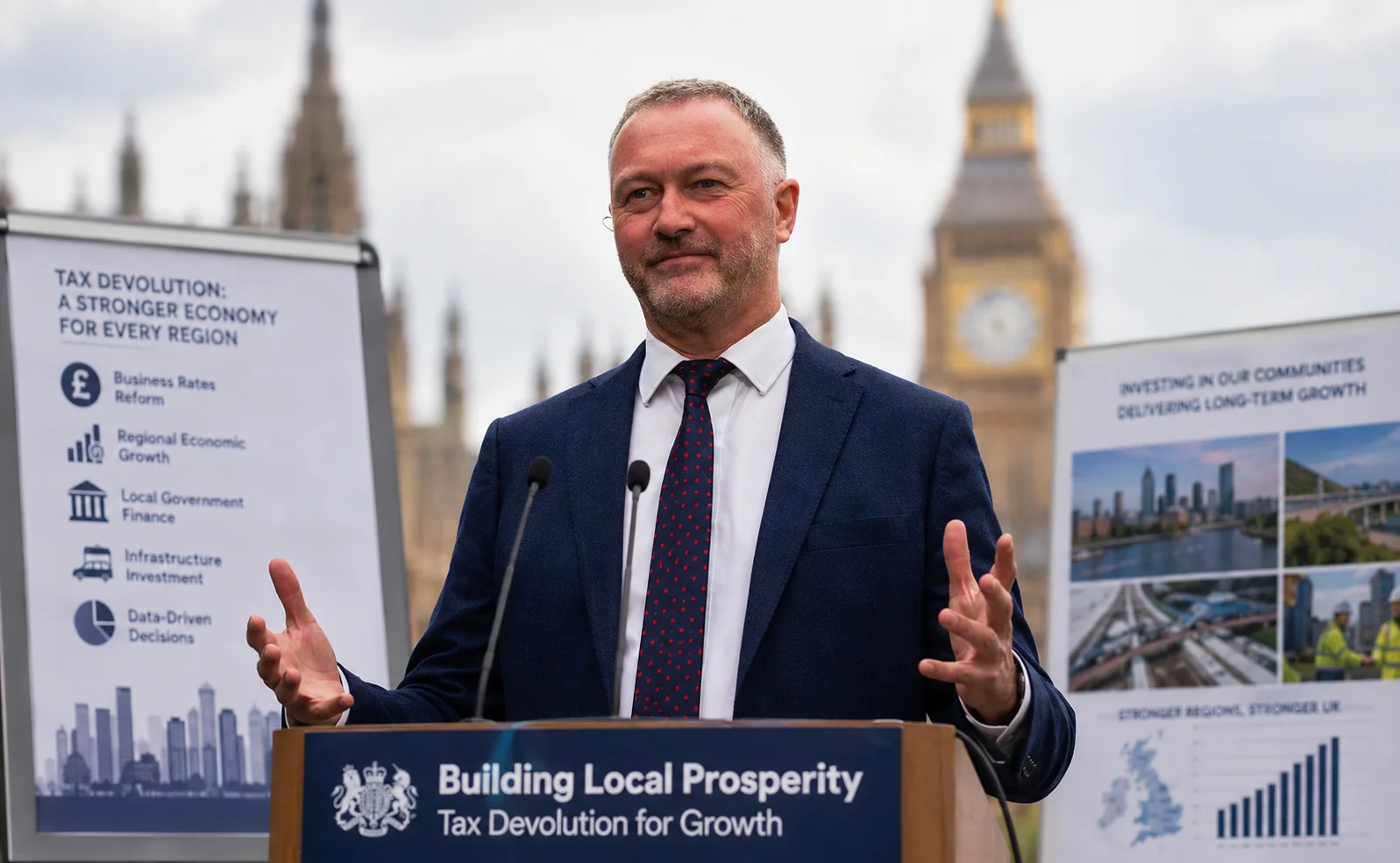
The UK’s devolution agenda is entering a new phase, with Communities Secretary Steve Reed exploring plans that could hand regional leaders greater control over billions of pounds raised through business rates.
The proposed reforms form part of a wider effort to shift power away from Westminster and give local areas more influence over economic development, public services and investment decisions.
While the plans remain under development, they could represent one of the most significant changes to local government finance in decades.
Key takeaways:
- Business rates revenue could be partially devolved to regional mayors.
- An equalisation mechanism would aim to protect less affluent regions.
- Further fiscal devolution could include elements of income tax and VAT.
- New visitor levy powers may provide additional local funding streams.
- More details are expected in the Autumn Budget 2026.
What Are Steve Reed Tax Devolution Plans and Why Do They Matter in 2026?
The proposed Steve Reed tax devolution plans sit at the centre of the government’s broader “devolution revolution”. The objective is straightforward: provide local leaders with greater control over the revenues generated in their regions so they can make investment decisions closer to the communities they serve.
For decades, England has operated one of the most centralised governance systems among developed economies. Most taxation decisions and funding allocations are controlled by central government, leaving local authorities dependent on Westminster funding settlements.
The current proposals seek to change that balance. Rather than relying solely on central grants, regional mayors could receive a share of locally generated tax revenues, particularly from business rates.
“Fiscal devolution can create stronger incentives for regional growth while improving accountability between local leaders and local taxpayers.” — UK Local Government Finance Specialist
The plans align with recent devolution initiatives, including the Right to Request scheme, which allows mayors to seek additional powers and responsibilities directly from government.
How Could Business Rates Devolution Change Local Government Finance?
Business rates currently generate more than £26 billion annually across England. Under the government’s proposals, regional authorities could gain greater influence over how portions of this revenue are allocated and invested.
Business Rates Revenue and Regional Control
Instead of funding flowing primarily through central government, mayoral authorities could receive a direct share of business rates revenue generated within their areas.
Potential outcomes include:
- Greater local investment in infrastructure projects.
- Faster funding decisions for economic development initiatives.
- Improved support for high streets and business districts.
- Enhanced local accountability for economic growth.
Comparison of Current and Proposed Systems
| Area | Current System | Proposed Direction |
| Revenue Collection | Centrally managed | Greater regional involvement |
| Spending Decisions | Primarily Whitehall-led | Increased mayoral influence |
| Growth Incentives | Limited local rewards | Stronger regional incentives |
| Funding Flexibility | Restricted | Greater local discretion |
This shift could fundamentally alter how local growth strategies are funded and delivered.
Equalisation Mechanism to Protect Poorer Areas
One concern surrounding fiscal devolution is the risk of widening regional inequality. Wealthier regions naturally generate more business rates revenue than economically disadvantaged areas. The government has repeatedly stressed that a redistribution framework would remain in place.
Equalisation Principles Under Discussion:
| Objective | Purpose |
| Protect poorer regions | Prevent funding disparities |
| Reward growth | Encourage economic development |
| Maintain public services | Ensure baseline funding levels |
| Support fairness | Balance regional opportunities |
According to Steve Reed, areas will not simply retain all revenues generated locally. Instead, a balancing mechanism would ensure that less prosperous communities continue receiving adequate support. This approach attempts to combine local incentives with national fairness.
Could Regional Mayors Gain More Control Over Tax Revenue?

The discussion extends beyond business rates. Ministers are reportedly examining options for devolving elements of income tax, VAT and other fiscal tools to regional authorities.
Recent developments suggest government willingness to grant mayors broader powers across multiple policy areas, including:
- Transport planning
- Skills and education
- Health partnerships
- Economic development
- Flood resilience projects
- Innovation funding
Examples already emerging include Greater Manchester’s youth justice pilot, Liverpool City Region’s public service technology programmes, and South Yorkshire’s flood resilience initiatives.
“Devolution works best when local leaders have both responsibility and the financial tools needed to deliver outcomes.” — Regional Governance Policy Adviser
However, important questions remain unresolved. The government has not yet clarified whether mayors would gain control over tax rates themselves or simply receive a share of revenues collected nationally.
The Autumn Budget is expected to provide greater detail on these issues.
What Would Tax Devolution Mean for UK Businesses and High Streets?
For businesses, the implications of tax devolution could be significant, particularly if local authorities gain stronger incentives to encourage commercial growth.
Potential Benefits for Local Business Growth
Supporters argue that local leaders understand regional economic priorities better than central government.
Additional funding could support:
- High street regeneration projects.
- Local transport improvements.
- Skills and workforce development.
- Business support programmes.
- Infrastructure investment.
Potential Business Benefits:
| Area | Possible Impact |
| Infrastructure | Improved connectivity |
| Skills | Better workforce development |
| High Streets | Increased regeneration funding |
| Investment | Faster local decision-making |
Greater certainty around funding may also help regions develop longer-term economic strategies.
Risks for Hospitality, Retail and Small Firms
Business groups remain cautious. Recent business rates revaluations have already increased costs for many firms, particularly within hospitality and retail sectors.
Concerns include:
- Potential inconsistencies between regions.
- Increased administrative complexity.
- Uncertainty around future tax structures.
- Pressure on struggling town centres.
Some businesses fear that devolved systems could create uneven competitive conditions across England if policy implementation differs significantly between regions.
Practical Impact on Business Rates Bills
At present, there is no indication that businesses would immediately see major changes to how business rates are calculated. Current discussions focus primarily on revenue allocation rather than rate-setting powers.
However, future reforms could influence how local economic development priorities shape business support programmes and investment decisions. Businesses should therefore monitor future announcements carefully as policy details emerge.
How Does the Overnight Visitor Levy Fit into the Wider Devolution Agenda?

Alongside business rates reform, ministers are considering giving mayors powers to introduce an overnight visitor levy, commonly referred to as a tourist tax.
The proposal would allow strategic authorities to raise additional revenue from overnight accommodation such as:
- Hotels
- Guest houses
- Holiday lets
- Bed and breakfasts
Supporters believe these revenues could help fund tourism infrastructure, transport improvements and destination marketing. York and North Yorkshire research has suggested that a £2 nightly levy could generate substantial annual revenue for local investment.
“Visitor levies can provide sustainable funding for tourism infrastructure when designed with local industry involvement.” — Tourism Economics Consultant
The visitor levy debate centres on ensuring local revenues remain in the communities that generate them while balancing regional autonomy and local accountability.
What Are the Main Risks, Concerns and Unanswered Questions?
Despite growing support for devolution, several uncertainties remain. Many councils have expressed concern about the possibility of funding being redirected away from areas where it is generated. Similar debates are already emerging around the proposed visitor levy.
Other key concerns include governance arrangements, accountability mechanisms and the practical administration of devolved taxation systems.
Questions still awaiting answers include how revenue-sharing formulas will operate, which regions will receive powers first, and whether local authorities will gain any influence over tax rates themselves.
There is also uncertainty regarding how devolved taxation would interact with existing local government funding frameworks and equalisation policies. Until formal proposals are published, much of the discussion remains exploratory rather than finalised policy.
What Should Businesses Watch Ahead of the Autumn Budget?
The Autumn Budget 2026 is expected to provide important clarity on the government’s fiscal devolution agenda, with potential implications for businesses, investors and local authorities across England.
Key Areas to Monitor:
- Business Rates: Revenue-sharing arrangements between local and central government.
- Equalisation Framework: Measures to balance funding across regions with different tax bases.
- Visitor Levy: Plans for implementation and local spending controls.
- Tax Devolution: Proposals involving income tax and VAT powers for local authorities.
- Mayoral Authorities: Timetables for expanding devolved governance structures.
While immediate effects on businesses may be limited, greater local control over funding could shape infrastructure investment, regional growth strategies and long-term economic competitiveness.
Conclusion
The Steve Reed tax devolution plans could significantly reshape local government funding in England by granting regions greater control over revenue streams.
The reforms aim to strengthen local decision-making, support economic growth and improve public services. Although key details are still under consultation, the Autumn Budget is expected to provide further clarity.
Businesses and local authorities should monitor developments closely, as the changes may influence future investment, funding priorities and regional economic strategies.
FAQs About Steve Reed Tax Devolution Plans
Is business rates devolution confirmed by the UK Government?
No. The government is actively exploring the proposal, but detailed policy decisions have not yet been finalised.
Would businesses pay higher rates under devolved tax plans?
Current discussions focus on revenue allocation rather than increasing business rates. No confirmed changes to rate levels have been announced.
Which English regions could receive devolved tax powers first?
Established mayoral combined authorities such as Greater Manchester and Liverpool City Region are widely expected to be among the first.
What is the difference between fiscal devolution and local tax setting?
Fiscal devolution involves local control over tax revenues, while tax setting refers to authority over tax rates themselves.
Could the visitor levy become a tourist tax in England?
Yes. The proposed overnight visitor levy is effectively a form of tourist tax applied to overnight accommodation.
How might equalisation affect wealthier and poorer regions?
Equalisation mechanisms would redistribute funding to help ensure less affluent areas continue receiving adequate financial support.
When will more details about Steve Reed’s tax devolution plans be announced?
The government is expected to provide further details during the Autumn Budget 2026.