


If a person genuinely has nothing that bailiffs can legally take and sell, the bailiff cannot simply seize essential household items or belongings owned by somebody else.
However, the debt does not disappear just because there are no goods to take. The enforcement agent may eventually return the case to the creditor, and the creditor may consider other lawful ways of recovering the money.
In England and Wales, bailiffs are formally known as enforcement agents. They can be used to collect debts such as council tax arrears, parking penalties and unpaid court judgments.
The rules discussed below concern enforcement in England and Wales; Scotland uses a different enforcement process.
What Happens When Bailiffs Find Nothing to Take?
When bailiffs visit, they normally look for money or goods that can legally be taken under the enforcement process.
If the person has no suitable assets, or everything available is legally protected, there may be nothing for the enforcement agent to sell.
Citizens Advice specifically states that where bailiffs decide a person has nothing they can sell, they might return the case to the creditor. This does not mean the outstanding debt has been cancelled.
It means that this particular enforcement attempt has not produced enough money or goods to settle it.
What happens afterwards depends on the type of debt, the creditor and the debtor’s financial circumstances.
What Can Bailiffs Take?

Bailiffs can generally take goods that belong to the debtor, including goods owned jointly with another person, provided those goods are not exempt.
Possible examples include:
- televisions and other non-essential electrical items;
- jewellery;
- games consoles;
- some vehicles;
- other non-essential belongings that have a resale value.
A bailiff may take control of eligible goods and, if the debt is not resolved, those goods can eventually be sold to raise money towards the debt and enforcement costs.
What Are Bailiffs Not Allowed to Take?
Having possessions in a home does not necessarily mean that bailiffs can take them.
Certain belongings are protected because they are considered necessary for basic domestic needs or because they fall within another exemption.
Bailiffs cannot normally take essential items such as:

- clothing;
- beds and bedding needed by household members;
- a cooker or microwave;
- a fridge;
- a washing machine;
- a table and enough chairs for the household;
- necessary medicines and medical equipment;
- items required to care for a child or older person;
- belongings owned by children;
- pets and guide dogs.
They also cannot take another person’s possessions simply because those items happen to be inside the debtor’s home.
Work Tools and Equipment
Goods needed personally for work or study may also be exempt up to a combined value of £1,350.
This can include certain tools, computer equipment and, in some circumstances, a vehicle that is required for work.
If the value exceeds the relevant protection or the item is not genuinely required for work or study, the position may be different. Evidence such as receipts, invoices, proof of employment or course documents can help establish why an item should be protected.
Can Bailiffs Take Someone Else’s Belongings?
No. Bailiffs cannot lawfully take goods belonging entirely to another person to settle the debtor’s liability.
This can be particularly important when a debtor lives with a partner, parents, housemates or other relatives.
The person claiming ownership may need evidence showing that the item belongs to them. Suitable evidence can include purchase receipts, bank or credit-card statements, invoices or finance agreements.
For jointly owned possessions, the position is different because the debtor has an ownership interest in the item.
Keeping evidence of ownership can therefore be valuable where expensive items in the property belong to someone other than the debtor.
Can Bailiffs Take a Car if There Is Nothing Else?
A vehicle is often one of the first assets an enforcement agent may consider because it can potentially be identified and taken without entering the home.
However, not every vehicle can lawfully be seized.
Citizens Advice states that a vehicle should not normally be clamped or removed where the debtor can prove that:
- it displays a valid Blue Badge;
- it is a Motability vehicle;
- it is required for the person’s job and is worth less than £1,350; or
- the vehicle is also the person’s home, such as certain campervans.
Vehicles subject to hire purchase, personal contract plans or conditional-sale agreements can be more complicated because legal ownership may remain with the finance provider until the agreement is completed.
A person facing this situation should not assume that simply moving or concealing an asset resolves the underlying enforcement problem. Instead, they should establish whether the vehicle is legally exempt and obtain debt advice where ownership or exemption is disputed.
Do Bailiffs Have to Be Let Into the House?
Usually, no.
A debtor generally does not have to open the door or voluntarily let a bailiff into a residential property. Bailiffs cannot normally push past somebody or put a foot in the doorway to prevent the door being closed.
They may, however, be able to enter through an unlocked normal means of entry.
There are important exceptions.
Different powers can apply where certain debts are being enforced, including magistrates’ court fines and some unpaid tax debts.
Bailiffs can also have stronger re-entry rights where they have previously entered lawfully, taken control of goods and the debtor later breaks a controlled goods agreement.
That is why a debtor should check exactly which debt is being enforced rather than assuming that every bailiff visit follows identical rules.
Can Bailiffs Keep Coming Back if There Is Nothing to Take?

A failed visit does not automatically end enforcement.
The bailiff may continue attempting to obtain payment or identify goods while the enforcement instruction remains active.
However, if the enforcement company ultimately concludes that there is nothing it can sell, Citizens Advice says the case may be returned to the creditor.
A person should therefore avoid interpreting one unsuccessful visit as confirmation that the matter is over.
Contacting the enforcement company and creditor can clarify whether the case remains active and whether an affordable repayment arrangement is possible.
Does the Debt Get Written Off?
No, not automatically.
Having no possessions that bailiffs can take is different from having the debt legally cancelled or written off.
If a civil judgment remains unpaid, a creditor may potentially consider other enforcement methods.
Depending on the circumstances, these can include:
- an attachment of earnings order, which can require deductions from wages;
- a third-party debt order, which can target money held by a bank or another third party;
- a charging order against land or property;
- further court enforcement action.
The options available depend on the type of debt and whether the creditor has the necessary judgment or legal authority.
Where a debt has already resulted in a default on a person’s credit file, the end of bailiff action does not itself remove that entry.
The separate question of a person’s credit score after default depends on what is recorded on the credit file and the rest of the person’s credit history.
Can Bailiffs Charge Fees Even if They Take Nothing?

Bailiff action can increase the amount owed because statutory enforcement fees can be added at different stages of the process.
For standard enforcement cases that are not being collected by High Court enforcement officers, Citizens Advice currently lists:
| Enforcement stage | Fixed fee |
| Compliance — writing about the debt | £79 |
| Enforcement — visiting | £247 |
| Sale — taking and selling belongings | £116 |
For debts above £1,900, percentage charges can also apply at certain stages. High Court enforcement follows a different fee structure.
These figures reflect the fee structure applicable after the 2026 uplift and should be checked again before publication if the article is updated in future.
Citizens Advice also states that where bailiffs cannot collect a debt—for example, where they conclude there is nothing they can sell and return the case to the creditor—the debtor should not be charged fees that are not lawfully recoverable.
Because fee entitlement can depend on what stage has actually been reached, anyone disputing charges should obtain a written breakdown and have it checked rather than assuming every fee is valid or invalid.
What Should Someone Do if They Have No Money or Assets?
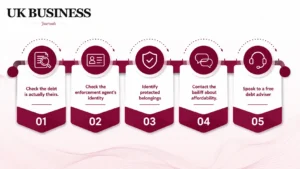
The most useful response is usually to deal with the debt rather than simply waiting for bailiffs to discover that there are no goods available.
A debtor can:
- Check the debt is actually theirs. The notice should identify the debt and amount being enforced.
- Check the enforcement agent’s identity. Bailiffs should be able to provide proof of who they are and their authority.
- Identify protected belongings. Evidence should be gathered for third-party goods, work equipment, financed goods and other exempt property.
- Contact the bailiff about affordability. A debtor who cannot pay everything immediately can propose affordable weekly or monthly payments, although the bailiff does not have to accept the offer.
- Speak to a free debt adviser. Independent advice can help establish whether the person has wider debt solutions available.
For people in England or Wales who are struggling with several debts, a debt adviser may also consider whether the Breathing Space Debt Respite Scheme is appropriate.
An eligible standard Breathing Space can provide up to 60 days of temporary protection from qualifying creditor enforcement while the person obtains debt advice and develops a plan. The debt itself still remains payable.
What if the Person Is Vulnerable?
Enforcement agents must take additional safeguards into account where somebody is considered vulnerable.
Examples can include people who are seriously ill or disabled, have mental health problems, are pregnant, have recently been bereaved or unemployed, have difficulty understanding English, or face other circumstances that make dealing with enforcement particularly difficult.
Citizens Advice advises vulnerable debtors to notify the bailiff company and provide relevant evidence where possible. In some circumstances, they should also be given additional opportunity to obtain advice before particular enforcement fees are charged.
Final Takeaway
If a person has genuinely nothing for bailiffs to take, the bailiff cannot replace those missing assets by taking protected essentials or property that belongs entirely to somebody else.
But that does not make the debt disappear.
The enforcement company may eventually return an unsuccessful case to the creditor, and the creditor may then decide whether another lawful recovery method is appropriate.
The safest approach is therefore to confirm what is owed, identify any exempt belongings, obtain evidence of third-party ownership and seek free debt advice before the situation progresses further.
The exact rules can depend on the debt being enforced and the person’s circumstances, so this information should not be treated as personalised legal or debt advice.
Frequently Asked Questions
What happens if bailiffs cannot find anything valuable?
If there are no non-exempt goods worth taking, bailiffs may be unable to recover the debt through the sale of belongings. Citizens Advice says the case may eventually be returned to the creditor if there is nothing they can sell. The debt itself normally remains outstanding.
Can bailiffs take a sofa or bed?
Bailiffs must leave items required for basic domestic needs. This includes beds and bedding for household members and essential seating and household equipment.
Can bailiffs take a partner’s television or computer?
Not if the item belongs entirely to the partner. The owner may need to provide evidence such as a receipt, invoice or bank statement showing ownership.
Can bailiffs take money instead of belongings?
A bailiff can ask for payment, and creditors may have other enforcement routes depending on the debt. For judgment debts, separate court procedures can include attachment of earnings, third-party debt orders and charging orders.
Does having no assets stop bailiffs permanently?
Not necessarily. An unsuccessful visit does not itself cancel the debt or guarantee that enforcement has finished. The case may continue or eventually return to the creditor.