


If you pay money into a Lifetime ISA (LISA), the 25% government bonus is not normally added immediately. Your LISA provider claims the bonus from HM Revenue & Customs (HMRC) through a monthly reporting system, which means you will commonly wait several weeks after making a contribution.
HMRC’s claim periods run from the 6th of one month to the 5th of the next. Providers normally have until the 20th of the month in which that claim period ends to submit the bonus claim. HMRC says successful claims are then paid to the ISA manager within 14 days after the claim due date.
In practice, that means your LISA bonus can often take roughly four to eight weeks from your contribution date to reach your provider, depending on where your payment falls within the monthly cycle. Your provider may then need additional time to show the bonus in your individual account.
How Does the Lisa Government Bonus Payment Cycle Work?

The government does not send the bonus directly to your bank account.
Instead:
- You contribute money to your Lifetime ISA.
- Your provider records the eligible contribution.
- The provider includes it in the relevant HMRC monthly claim period.
- The provider submits a government bonus claim.
- HMRC checks the claim.
- HMRC pays successful bonus claims to the LISA provider.
- Your provider credits the bonus to your LISA.
HMRC allows LISA managers to submit claims at any time, but the deadline for an ordinary monthly claim is the 20th day of the month following the end of the relevant claim period.
A claim submitted after the reporting deadline can still be processed, but it is treated as late and may not be paid until the following monthly cycle.
You can see the technical rules in HMRC’s guidance on digital reporting for Lifetime ISAs.
Example of When Your Lisa Bonus Could Be Paid
The date on which you contribute can make a significant difference.
| Example contribution | HMRC claim period | Normal claim deadline | HMRC payment timing for a successful claim |
| 4 September 2026 | 6 August–5 September | 20 September | Within 14 days after the claim due date |
| 6 September 2026 | 6 September–5 October | 20 October | Within 14 days after the claim due date |
A contribution made on 4 September falls near the end of one claim period. A payment made just two days later, on 6 September, falls into the next one.
That is why two LISA contributions made only a few days apart could have bonuses appearing several weeks apart.
These are HMRC processing windows rather than guaranteed dates on which the money will appear in your account. Individual LISA providers can have their own processing schedules after receiving the money from HMRC.
How Much Government Bonus Do You Receive on a Lisa?
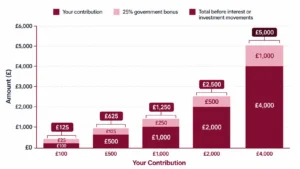
The government adds 25% of your eligible Lifetime ISA contributions.
Under the current rules, you can pay up to £4,000 into a LISA in each tax year, giving you a standard maximum government bonus of £1,000 a year.
For example:
| Your contribution | 25% government bonus | Total before interest or investment movements |
| £100 | £25 | £125 |
| £500 | £125 | £625 |
| £1,000 | £250 | £1,250 |
| £2,000 | £500 | £2,500 |
| £4,000 | £1,000 | £5,000 |
You can contribute until you reach age 50, provided you opened the LISA and made your first payment before turning 40. The £4,000 LISA contribution limit forms part of the overall £20,000 ISA allowance for the 2026/27 tax year.
The government bonus itself is not treated as one of your new ISA subscriptions. HMRC’s guidance specifically excludes government bonus payments from current-year LISA payments.
Does the LISA Government Bonus Earn Interest or Investment Returns?
Once the government bonus is credited, it becomes part of the money held within your Lifetime ISA.
In a cash LISA, the bonus can earn interest at the rate offered by the provider. In a stocks and shares LISA, the bonus may be invested according to your chosen investments or initially held as cash, depending on the provider’s process and your account settings.
Any interest or investment growth generated by the bonus remains within the tax-free ISA wrapper. This growth does not count towards the £4,000 annual contribution limit because it is not a new payment made by you.
Investment returns are not guaranteed, however. The value of a stocks and shares LISA can rise or fall, including the portion originating from government bonuses. Savers should check whether their provider invests each bonus automatically or requires them to place an investment order after the money arrives.
Is the Lisa Bonus Paid Every Month?
HMRC processes LISA bonuses through a monthly claims system, but that does not mean you automatically receive a bonus on the same date every month.
Your provider only claims a bonus when you have made qualifying contributions.
If you make several contributions during the same claim period, your provider may include them within the same monthly submission. If you make no contribution, there is no new contribution bonus to claim.
HMRC pays providers a single payment covering successful bonus requests for that monthly claim period.
What Happens if You Pay £4,000 Into Your Lisa Near the End of the Tax Year?

Your government bonus does not necessarily need to arrive before 5 April for your contribution to relate to that tax year.
HMRC’s own reporting guidance gives an example in which £4,000 was contributed during one tax year, the £1,000 government bonus was claimed in April and HMRC paid the bonus in May.
This distinction is important.
It is the eligible contribution that uses your annual LISA allowance. The bonus can arrive afterwards.
However, you should not assume that sending money to your provider at the last possible moment guarantees it will be accepted for that tax year. Providers can have their own bank-transfer, debit-card or year-end processing cut-offs.
If you want to use the remaining LISA allowance before 5 April, check your provider’s deadline rather than relying on the HMRC bonus payment date.
Why Has Your Lisa Government Bonus Not Arrived?
A missing bonus does not automatically mean something has gone wrong.
Possible reasons include:
- your contribution fell near the beginning of a new HMRC claim period;
- your provider has not yet reached its monthly claim deadline;
- HMRC is still processing the claim;
- the claim was submitted after the normal reporting deadline;
- your provider has received the bonus but has not yet allocated it to your account;
- there is an eligibility or account-data issue that needs correcting;
- your annual LISA payment limit has already been reached.
HMRC allows LISA managers to correct bonus claims where necessary, including retrospective corrections.
If your expected bonus has been outstanding substantially longer than your provider’s published timescale, contact the provider first. Ask:
- which HMRC claim period your contribution was included in;
- whether the bonus claim has been submitted;
- whether HMRC accepted or rejected it;
- whether the provider is waiting to allocate an HMRC payment.
That will usually provide more useful information than simply counting the number of days since you deposited the money.
What Happens to a Pending LISA Bonus When You Transfer Providers?
You can transfer a Lifetime ISA directly to another LISA provider without triggering the standard 25% withdrawal charge. The transfer must be completed through the official ISA transfer process rather than by withdrawing the money yourself.
A pending government bonus should not be lost because of the transfer. If the previous provider has already submitted the claim but receives the bonus after your account has moved, it is responsible for forwarding that payment to the new provider. An outstanding bonus that has not yet been claimed may instead be claimed by the receiving LISA provider.
HMRC’s transfer rules state that current-tax-year LISA payments must normally be transferred in full. Moving money from one LISA to another also does not generate another 25% bonus because transferred LISA funds are not treated as new contributions.
Savers should confirm that the receiving provider accepts LISA transfers before starting the process. Transferring a LISA to an ordinary cash ISA or stocks and shares ISA is different and will normally be treated as a withdrawal, potentially resulting in the 25% charge unless a recognised exemption applies.
Can You Use the Government Bonus Towards Your First Home?

Yes. Buying your first home is one of the principal purposes of a Lifetime ISA.
Under the current rules, you can normally withdraw your LISA savings and government bonus without the standard withdrawal charge when buying a qualifying first home if:
- the property costs £450,000 or less;
- it has been at least 12 months since your first payment into the LISA;
- the property is being bought with a mortgage;
- a solicitor or conveyancer acts for you and receives the LISA funds directly; and
- the property will meet the qualifying first-home purchase rules.
HMRC’s detailed rules also require a qualifying purchase to be expected to complete within 90 days of the LISA withdrawal, subject to the extension provisions available in certain circumstances.
You can check the current conditions through the GOV.UK Lifetime ISA withdrawal rules.
What Happens if You Withdraw Your Lisa for Another Reason?
A 25% withdrawal charge generally applies if you take money out before age 60 without using one of the recognised charge-free routes.
Those charge-free circumstances include:
- buying a qualifying first home;
- withdrawing after reaching age 60; or
- being terminally ill with less than 12 months to live.
The important point is that a 25% withdrawal charge is applied to the amount withdrawn, not simply to the original government bonus.
For example, if you contributed £4,000 and received a £1,000 bonus, your balance would be £5,000 before any interest, investment returns or losses.
A 25% charge on £5,000 would be £1,250.
You would receive £3,750.
So, ignoring investment movements or interest, you would lose the £1,000 bonus and £250 of your original £4,000 contribution.
GOV.UK provides the same mechanism in its official withdrawal examples.
What Happens to Your Lisa Bonus When You Reach 50 or 60?
At 50, you normally stop being able to make new Lifetime ISA contributions and therefore stop earning new 25% government bonuses.
Your existing account can remain open.
At 60, you can normally withdraw money from your LISA without the standard 25% withdrawal charge.
This means the LISA operates differently at the two ages:
Age 50: new contributions and bonuses stop.
Age 60: ordinary charge-free access becomes available.
Are the Lifetime Isa Rules Changing in 2026?

Potentially — but the current LISA rules still apply.
On 23 June 2026, HM Treasury launched a consultation on a new First Time Buyer ISA, which the government intends to offer in place of the Lifetime ISA once the new product becomes available.
As of 7 August 2026, this is still a consultation rather than a replacement product you can open.
Importantly, HM Treasury says that until the new product becomes available, it will remain possible to open a LISA. It also says existing LISA holders will be able to continue saving into their accounts under the existing rules indefinitely.
The proposed First Time Buyer ISA would work differently from a LISA. Under the consultation design, the government bonus would not be added to the account each month while you save.
Instead, it would be calculated and claimed when you withdraw the money to buy your first home. The proposed product would also remove the LISA-style withdrawal charge.
Important details, including the future subscription limit, property price cap and bonus level, have not yet been finalised.
The consultation is open until 18 August 2026. You can read the HM Treasury First Time Buyer ISA consultation for the latest official position.
So, When Should You Expect Your Lisa Bonus?
For an ordinary contribution under today’s Lifetime ISA rules, you should generally think in terms of weeks rather than days.
HMRC uses a monthly cycle running from the 6th to the 5th. Your provider’s normal claim deadline is the 20th, and HMRC says successful claims are paid to the provider within 14 days after the claim due date.
That can produce a practical waiting period of roughly four to eight weeks, depending on when you contribute and how quickly your provider credits the HMRC payment to your individual LISA.
If the bonus has taken considerably longer than your provider’s published timeframe, ask the provider which HMRC claim period contained your contribution and whether the claim has been accepted.
Conclusion
In summary, the LISA government bonus is usually paid several weeks after you contribute, because your provider must claim it through HMRC’s monthly reporting cycle.
The 25% bonus can significantly boost your savings, but payment dates vary depending on when you deposit money and how quickly your provider processes the claim.
If your bonus is delayed beyond your provider’s normal timeframe, contact them for an update. While current LISA rules remain in force, proposed 2026 reforms mean savers should keep an eye on future government announcements before making financial decisions.
Frequently Asked Questions
When is the government bonus paid on a LISA?
Your LISA provider claims the 25% government bonus from HMRC through a monthly reporting cycle. In practice, it can often take around four to eight weeks from your contribution date for the bonus to reach your provider.
Is the LISA bonus paid immediately?
No, the government bonus is not normally added as soon as you make a contribution. Your provider must first include the payment in the relevant HMRC claim period and submit the claim.
How much is the government bonus on a LISA?
The government adds 25% to eligible Lifetime ISA contributions. If you contribute the full £4,000 annual limit, you can normally receive up to £1,000 in government bonus for that tax year.
Why is my LISA bonus taking so long?
Your bonus may be delayed because of the monthly HMRC claim cycle, provider processing times or a late or corrected claim. If it is taking longer than your provider’s published timeframe, contact the provider and ask whether the claim has been submitted and accepted.
Does the LISA bonus count towards the £4,000 annual limit?
No, the government bonus itself does not use part of your £4,000 annual LISA contribution allowance. The limit applies to the money you personally pay into the account.
Can I use the LISA government bonus to buy a house?
Yes, the bonus can form part of your LISA funds when you use the account for a qualifying first-home purchase. You must meet the current LISA conditions, including the property price limit and the 12-month minimum period from your first payment.
What happens if I withdraw my LISA money early?
A 25% withdrawal charge normally applies if you take money out before age 60 for a reason that does not qualify for charge-free access. Because the charge applies to the amount withdrawn, you can lose the government bonus and part of your original contribution.
Can I still receive a LISA bonus after age 50?
You normally cannot make new LISA contributions after you reach age 50, so you cannot earn new government bonuses after that point. Your existing savings can remain in the account and continue to earn interest or investment returns depending on the type of LISA you hold.
What happens to my LISA when I turn 60?
From age 60, you can normally withdraw money from your Lifetime ISA without the standard 25% withdrawal charge. Your account can still remain open if you do not want to withdraw the money immediately.
Are LISA rules changing in 2026?
The government has proposed a new First Time Buyer ISA that could eventually replace the LISA for new savers, but the current LISA rules still apply. Existing LISA holders are expected to be able to continue saving under the current framework unless future legislation changes the position.