If you have noticed Tesco PFS on your bank statement, it usually means your debit or credit card was used at a Tesco Petrol Filling Station in the UK. The payment may relate to petrol, diesel or another purchase made at the petrol station.
The abbreviation can initially appear unfamiliar, especially when a transaction shows a different amount from what you remember spending.
One common explanation is Tesco’s Pay at Pump system, which can temporarily authorise up to £120 before adjusting the transaction to the actual value of fuel purchased.
However, not every Tesco PFS payment involves a £120 authorisation, and an unfamiliar merchant name should not automatically be treated as proof that a payment is genuine.
Understanding the transaction reference, payment status and available balance can help you determine whether the charge is normal or requires investigation.
What Does Tesco PFS Mean on a Bank Statement?
Tesco PFS stands for Tesco Petrol Filling Station. It is a merchant description associated with transactions made at Tesco petrol stations.
Banks often display abbreviated business names instead of the full trading name. Therefore, a petrol purchase made at a Tesco filling station might appear as Tesco PFS rather than simply Tesco.
The reference can be associated with fuel bought through Pay at Pump or a payment processed at a petrol station kiosk.
It does not necessarily identify the precise product purchased. For example, a payment at a forecourt kiosk may include additional items.
How Tesco PFS Appears on a Bank Statement?
The transaction description can vary depending on the bank, location and payment-processing system.
| Bank statement reference | Possible meaning |
| TESCO PFS | Tesco Petrol Filling Station payment |
| TESCO PFS 5251 | Tesco petrol station transaction with a numerical merchant or location reference |
| TESCO PAY AT PUMP | Payment at an automated fuel pump |
| TESCO PETROL | Petrol station purchase |
| TESCO PETROL FILLING S | Abbreviated petrol filling station reference |
| TESCO PFS followed by a town | Payment associated with a specified geographical location |
A numerical code after Tesco PFS may help distinguish a particular merchant location or terminal. However, the number alone should not be treated as conclusive evidence of the exact branch without confirmation.
For example, a bank statement might show:
TESCO PFS 5251 – £48.60
This could represent a £48.60 petrol station purchase. The transaction date, location and receipt would be needed to confirm it.
Why Does Tesco PFS Show a £120 Pending Transaction?
The £120 pending amount is one of the most frequently misunderstood aspects of Tesco petrol station payments.
When a customer uses Pay at Pump, the fuel station does not know how much petrol or diesel the driver will purchase before refuelling begins.
A temporary card authorisation helps establish how much money is available for the transaction.
Under the current UK Pay at Pump arrangements, Tesco can request authorisation for up to £120.
This does not mean every customer will ultimately be charged £120.
How the £120 Pre-authorisation Works?
Consider a driver who visits a Tesco petrol station and purchases £45.50 worth of fuel.
The payment process may operate as follows:
| Transaction stage | Amount | Explanation |
| Initial authorisation | £120.00 | Temporarily reserved against available funds |
| Fuel purchased | £45.50 | Actual value of petrol or diesel |
| Unused authorisation | £74.50 | Released from the temporary reservation |
| Final purchase | £45.50 | Amount the customer owes |
In this example, £74.50 represents unused funds becoming available again, not a separate refund of money that Tesco permanently collected.
The distinction is important because a temporary reservation can reduce the money available to spend even though it is not an additional completed purchase.
Tesco confirms in its official explanation of £120 bank statement transactions that it charges customers only for the fuel they actually purchase.
It also acknowledges that some card issuers may not update account balances immediately.
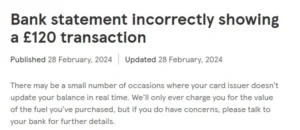
Tesco’s official explanation of why a £120 transaction may temporarily appear on a customer’s bank statement. Capture the heading and relevant explanation from Tesco’s Help Centre.
Why Was the £120 System Introduced?
The larger authorisation was introduced as part of changes to automated fuel-payment arrangements.
Under older systems, some pumps initially authorised a small amount, commonly £1, to verify that a card was valid.
The final cost of fuel could then appear on the customer’s account later.
The newer system is intended to verify sufficient funds before fuel is dispensed and update the transaction more accurately.
This matters to consumers managing limited balances, because unexpected fuel payments appearing days later can disrupt household budgets.
Personal finance journalist Sue Hayward has explained that these pre-authorisation arrangements are linked to payment-card industry requirements rather than a special surcharge invented by an individual supermarket.
The financial distinction is that an authorisation checks available spending capacity, while the final transaction records the actual purchase.
How Long Does a Tesco PFS Pending Payment Take to Clear?
Under the intended Pay at Pump process, the final fuel amount should be communicated promptly to the card issuer once refuelling is complete.
Any unused authorisation should then be released.
However, an updated balance may not always appear immediately in a banking app.
Some customers may see the final amount shortly after purchasing fuel, while others experience a delay because of the issuing bank’s processing or transaction-display systems.
It is important not to assume that a three-day, five-day or seven-day clearance period applies to every bank.
A pending authorisation and a completed charge can be handled differently by different card providers.
What If the Tesco PFS Transaction Is Still Pending?
If the original authorisation has not adjusted to the correct purchase amount, check the transaction’s status.
A pending £120 authorisation with a corresponding final fuel payment may indicate that the original reservation has not yet disappeared from the banking app.
A completed £120 charge that does not match the fuel receipt is a different problem and should be investigated.
Helen Dickinson, chief executive of the British Retail Consortium, raised concerns about how bank applications display Pay at Pump transactions when the industry introduced its changes.
She warned that “Some customers see two transactions, for the estimate and for the actual amount of fuel purchased”, highlighting the confusion this can create.
Her observation identifies an important consumer issue: a banking app can make a single fuel purchase look like two financial transactions even when only one completed payment should ultimately remain.
If the reservation continues to restrict available funds after the final transaction has appeared, contact your card issuer rather than assuming the discrepancy will resolve itself.
What Happens If You Have Less Than £120 in Your Bank Account?
Having less than £120 in your bank account does not automatically mean you cannot purchase petrol at Tesco.
The payment process can support partial authorisation, depending on the card issuer.
For example, suppose a customer’s account has £35 available.
Instead of approving the full £120 authorisation, the card issuer may approve a lower amount. The pump can then display the maximum amount of fuel that may be dispensed.
| Available balance | Illustrative approved amount | Maximum fuel purchase |
| £20 | £20 | £20 |
| £35 | £35 | £35 |
| £60 | £60 | £60 |
| £120 or more | £120 | £120 |
These examples assume the issuer approves the amount shown. They are not guaranteed limits for every card.
If the approved limit is reached, the pump should stop dispensing fuel.
Some card issuers do not support partial authorisations below £120. In those circumstances, the payment can be declined even when the account contains enough money for a smaller fuel purchase.
A different payment card or paying at a kiosk may provide an alternative.
This is particularly relevant to customers who closely manage their weekly budgets and need predictable access to their available funds.
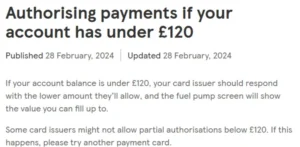
Tesco’s official guidance on fuel-payment authorisations when the available bank balance is below £120. Use the relevant section from Tesco’s Petrol Filling Station FAQs.
Why Does Tesco PFS Sometimes Appear Twice?
Two Tesco PFS entries do not always mean that a customer has paid twice.
Banking applications can display different stages of the same transaction separately.
For example, the initial authorisation might appear as a pending £120 transaction while the actual £52 fuel purchase appears as another entry.
The £120 reservation should be released once the transaction has been correctly processed.
However, it is essential to distinguish this from two completed payments.
| What appears in the banking app | Likely interpretation | Recommended action |
| £120 pending and £52 completed | Possible outstanding pre-authorisation | Check whether the £120 reservation is released |
| £52 pending and £52 completed | Possible authorisation and settlement | Verify whether only one completed charge remains |
| Two separate completed £52 charges | Possible duplicate payment | Contact the card issuer and investigate |
| £120 completed but receipt shows £52 | Possible payment discrepancy | Report the incorrect amount |
| Unrecognised Tesco PFS transaction | Could be an unknown purchase or unauthorised card use | Verify the transaction and contact the bank promptly if unexplained |
A second banking notification should not automatically be counted as a second deduction.
The more reliable test is whether two separate transactions have actually settled and reduced the account balance.
What If Tesco PFS Appears but You Have Not Bought Fuel?
An unfamiliar Tesco PFS payment deserves further investigation, but it does not automatically establish that fraud has occurred.
There are several possible explanations.
A purchase made at the petrol station kiosk
The transaction may relate to something bought at the forecourt rather than fuel alone.
A transaction processed after the purchase date
The banking date can differ from the date the card was originally used. This can make an older purchase harder to recognise.
An authorised additional card user
Another person permitted to use the card or account may have made the purchase.
A shortened merchant description
The name shown on a statement may not match the exact business name the customer remembers.
The same issue can occur with other transactions, including Square Inc on a bank statement, where the payment description may identify a processing service rather than the familiar trading name.
An unauthorised payment
If no legitimate explanation can be found, the card may have been used without permission.
The critical point is to examine the supporting evidence before deciding whether the charge is valid.
How to Identify an Unknown Tesco PFS Transaction
A practical investigation starts with the payment information already available.
Step 1: Check the Transaction Date
Compare the date shown in the banking app with recent journeys and petrol station visits.
Remember that the date of settlement may differ from the date of purchase.
Step 2: Review the Exact Amount
Look for a matching receipt or fuel purchase.
An amount such as £46.83 may be easier to identify than a generic description such as Tesco PFS.
Step 3: Check the Merchant Location
Open the complete transaction details if your bank provides them.
Some banking applications show additional information, including the town, merchant category or reference number.
A location can help establish whether the purchase matches your travel history, although it should not be relied upon as the only evidence.
Step 4: Look for a Fuel Receipt
A receipt can help confirm the station, date, purchase amount and payment.
If the receipt has been lost, Tesco’s petrol station information explains that customers who used a Clubcard can ask at the relevant filling station about obtaining a replacement within 30 days of purchase.
For Pay at Pump purchases, Tesco also describes a receipt-printing option using the pump card machines at the station where the fuel was purchased.
Availability and the relevant instructions should be checked at the station.
Step 5: Contact the Card Issuer
If the information still does not match any purchase, ask the bank to investigate.
The issuer may have access to further payment information that is not visible in the banking application’s standard transaction list.
Where unauthorised use is suspected, report it immediately through an official banking channel.
Is Tesco PFS a Scam or Fraudulent Transaction?
Tesco PFS is a legitimate merchant description associated with Tesco petrol filling stations.
However, the presence of a legitimate merchant name does not prove that the cardholder authorised a particular transaction.
A criminal could potentially use stolen payment-card information to make a purchase at an otherwise legitimate business.
Warning signs include a payment at a location you have never visited, a series of unexplained transactions, or spending that continues after a card has been lost.
In such circumstances, the cardholder should contact their bank immediately.
The bank may need to secure the card, review how the payment was authenticated and investigate the disputed transaction.
The Financial Ombudsman Service’s guidance on unauthorised payments explains the importance of promptly reporting suspicious account activity and preserving relevant information.
This also illustrates why customers should not assume that an unfamiliar transaction is genuine simply because the merchant reference is recognisable.
Can You Get a Refund for a Tesco PFS Charge?
Whether a refund or correction is appropriate depends on the type of transaction.
A temporary authorisation, duplicate settled payment and genuinely unauthorised card purchase are not the same issue.
For example, if a £120 authorisation is still pending after a £40 fuel purchase, the customer generally needs the unused £80 reservation released, rather than a refund for a second completed purchase.
If the bank statement instead shows two separate completed £40 payments for one purchase, that may require a duplicate-payment dispute.
And if the customer never authorised the purchase at all, the matter should be reported as a potentially unauthorised transaction.
The bank can explain the relevant investigation and reimbursement process.
It is also important to distinguish card payments from Direct Debits.
Tesco PFS is ordinarily a card-transaction description, not evidence of a recurring Direct Debit or subscription.
Consumers investigating unfamiliar Direct Debits, such as EMAC Ltd on a bank statement, may face different payment and cancellation arrangements.
If a bank rejects an unauthorised-payment complaint, the customer may be able to escalate the dispute to the Financial Ombudsman Service after following the bank’s complaints process and satisfying the relevant referral requirements.
Can You Avoid the £120 Tesco PFS Authorisation?
Customers who do not want a larger temporary Pay at Pump authorisation can generally choose to pay at a staffed kiosk where that option is available.
This allows the payment terminal to process the known value of the fuel purchase rather than needing a pre-authorisation for an unknown amount.
A normal card-payment authorisation may still occur, but it is different from the up-to-£120 Pay at Pump reservation.
Tesco’s published payment guidance also distinguishes between the available payment methods.
| Payment feature | Tesco Pay at Pump | Tesco kiosk |
| Payment timing | Card authorised before refuelling | Payment made after refuelling |
| £120 Pay at Pump authorisation | Can apply | Does not apply in the same way |
| Maximum fuel purchase | £120 | No equivalent Tesco kiosk fuel-spend cap stated |
| Contactless bank-card payment | Not accepted under Tesco’s published guidance | Accepted subject to Tesco’s stated limits |
| Fuel cards | Acceptance depends on payment system | Selected fuel cards accepted |
Customers should check current payment options at their local filling station, particularly where no staffed kiosk is available.
For those using debit cards with limited available funds, choosing the kiosk can make account-balance management more predictable.
How Tesco PFS Payments Affect Debit and Credit Cards
The temporary authorisation has a similar underlying purpose for debit and credit cards, but the financial impact differs.
With a debit card, the authorised amount can reduce the funds available in the linked bank account.
This can affect other purchases even before the fuel transaction has fully settled.
With a credit card, the authorisation may reduce available credit rather than directly reserving money from a current-account balance.
The final purchase should still reflect the fuel supplied.
For example, a £120 authorisation for a £35 fuel purchase could temporarily affect spending capacity by £85 more than the final purchase amount.
Once the unused authorisation is released, that additional capacity should become available again.
The timing and way these adjustments appear depend on the card issuer.
What Should You Do If Tesco PFS Takes More Money Than Expected?
If the transaction appears incorrect, first establish whether the amount is pending or completed.
A pending authorisation should be approached differently from an incorrect settled charge.
Check the fuel receipt and look for separate authorisation and final-payment entries.
If the amount has settled incorrectly, contact the issuing bank and explain the difference between the receipt and the completed transaction.
It can be helpful to provide the purchase date, amount, station location and transaction reference.
Where the payment is genuinely unauthorised, do not wait for a pending charge to clear before reporting the suspicious activity.
If the bank requires a formal complaint, keep a record of the complaint reference and supporting documents.
Customers should also avoid responding to unsolicited calls, emails or text messages claiming to provide Tesco payment refunds. Use Tesco’s official support channels or the bank’s verified contact details instead.
Frequently Asked Questions About Tesco PFS
Is Tesco PFS a genuine company?
Tesco PFS refers to Tesco Petrol Filling Station, a legitimate Tesco business operation. However, individual transactions should still be checked if they are unfamiliar or appear unauthorised.
Why has Tesco PFS taken £120 from my account?
It may be a temporary Pay at Pump authorisation. Tesco should charge only for the fuel purchased, and the unused reserved amount should become available again.
How long does Tesco PFS take to refund the difference?
Unused authorisation funds should normally be released promptly when the final fuel amount is processed. If the bank does not update the balance correctly, contact the card issuer.
Can Tesco PFS appear when I have not bought petrol?
Yes. The reference may relate to another purchase at a Tesco petrol station kiosk, an earlier transaction or a purchase made by an authorised card user. Unexplained payments should be investigated.
Why is Tesco PFS showing twice?
A banking application may temporarily show both a pre-authorisation and the final purchase. If two separate payments have actually settled, ask the bank to investigate a possible duplicate charge.
Does Tesco PFS mean my bank card has been hacked?
No. The abbreviation itself does not indicate fraud. However, a Tesco PFS payment you did not authorise could require a fraud investigation.
Can I buy Tesco fuel with less than £120 available?
Potentially, yes. Some card issuers allow a partial authorisation that limits the amount of fuel dispensed. Other card issuers may decline the transaction.