

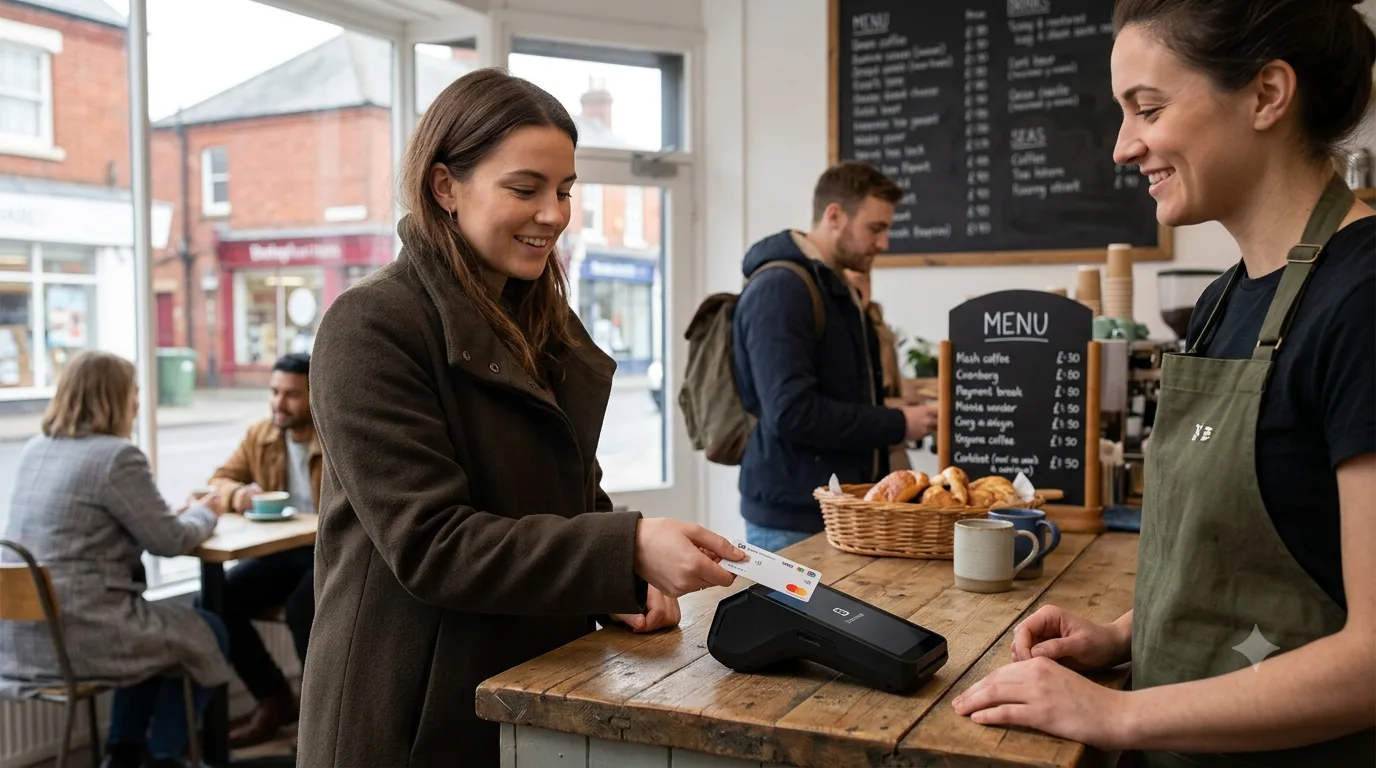
Seeing Square Inc on a bank statement usually means a card payment has been processed through Square, the payment platform used by shops, cafés, restaurants, market traders, tradespeople and other businesses.
The important point is that Square is normally the payment processor rather than the business the customer actually bought from.
A transaction may therefore appear as something similar to:
*SQ COFFEE SHOP LTD
rather than simply showing the name a customer remembers seeing above the shop door.
The wording can vary between banks, card issuers and merchants. Some transactions show a recognisable merchant name after the Square prefix, while others may be shortened, truncated or displayed with limited information.
An unfamiliar Square transaction should therefore be investigated before being treated as fraud.
What Does Square Inc on a Bank Statement Mean?
Square Inc on a bank statement generally indicates that a merchant has used Square to process a debit or credit card transaction.
Square provides card readers, point-of-sale systems, online payments, invoices and other payment services to businesses.
That means someone might buy coffee from an independent café, pay a plumber by card or purchase something from a market stall without ever seeing Square prominently displayed during the transaction.
The customer’s bank can nevertheless receive Square-related information when the card payment is processed.
| Statement wording | What it may mean |
| SQ *BUSINESS NAME | A merchant processed the payment using Square |
| SQ* BUSINESS NAME | Another common presentation of the Square prefix |
| SQ BUSINESS NAME#123 | Square descriptor containing an additional merchant or location identifier |
| SQUARE or SQUARE INC | A Square-related transaction where the merchant information is limited or displayed differently |
| Merchant name only | Some banking apps may emphasise or enrich the merchant name instead of the processor |
| Pending Square transaction | The payment has been authorised but has not necessarily completed settlement |
The exact wording should always be checked alongside the amount, transaction date, location information and any receipts.
Is Square Inc Still the Company’s Name?
Not exactly.
The company previously known as Square, Inc. changed its corporate name to Block, Inc. in December 2021.
Square continues to exist as the payment and seller-services brand.
This distinction explains why people may encounter three different names in discussions about the same wider business group:
| Name | Meaning |
| Square | Payment and commerce brand used by merchants |
| Square, Inc. | Former corporate name |
| Block, Inc. | Current parent corporate name |
A merchant accepting payments through Square does not suddenly become a business called Block.
Likewise, seeing a Block-related name elsewhere on a financial account should not automatically be assumed to represent exactly the same transaction as an ordinary Square merchant payment.
Block also operates other businesses and financial technology services.
For a normal purchase processed by a Square seller, the merchant descriptor remains the more useful clue.
What Does a Square Transaction Normally Look Like?
Square-generated card descriptors commonly begin with:
SQ *
The merchant’s business name normally follows.
For example:
*SQ COFFEE SHOP LTD
A longer entry could contain extra identifying information depending on how the seller and card issuer handle the transaction.
A simplified breakdown might look like this:
| Part of statement line | Possible meaning |
| SQ * | Square payment-processing prefix |
| COFFEE SHOP LTD | Business name configured by the merchant |
| #014 | Optional identifier such as a shop or payment reference |
| Location information | May be added or presented separately by the bank |
| Pending | Authorisation exists but transaction may not yet be settled |
Square has character limits when sending statement information through card networks. Banks and card networks can also shorten what eventually appears to the account holder.
This means a long company name might be cut off.
A business called The Riverside Coffee and Artisan Bakery Limited, for example, could appear in a much shorter form that is not immediately recognisable.
Why Is Square on the Statement When Nothing Was Bought From Square?
This is one of the main reasons Square transactions cause confusion.
The account holder may have bought something from a completely different business.
Square sits between the merchant and the card-payment system.
Examples could include a payment made to an independent:
| Type of merchant | Why Square may appear |
| Café | Card processed through a Square terminal |
| Hairdresser | Mobile Square card reader used |
| Market stall | Portable card terminal |
| Plumber | Payment collected through Square |
| Restaurant | Square point-of-sale system |
| Consultant | Square invoice or remote card payment |
| Small retailer | Square checkout system |
| Online seller | Square-powered online payment |
The account holder should therefore think about where the card was used, not whether anything was deliberately purchased from Square itself.
This problem is common with payment references generally. A customer might recognise a brand but not the legal or processing name displayed by the bank.
Similar confusion can occur with GFM International on a bank statement, where the wording shown by the bank may differ from the name the customer remembers.
Why Is There a £1 or Small Pending Square Transaction?
A small pending Square-related amount can sometimes be an authorisation or pre-authorisation rather than the final purchase amount.
However, a £1 transaction should not be treated as a universal Square verification fee. Square does not use one fixed £1 authorisation rule for every purchase.
The amount and behaviour depend on the type of transaction, merchant setup, card network and issuing bank.
Square supports pre-authorisations in certain payment situations. For example, restaurants or bars can temporarily authorise a card before the final bill is known.
A customer could therefore temporarily see several pending entries before the transaction settles.
For example:
| Stage | Example |
| Initial authorisation | £1.00 or another temporary amount |
| Updated authorisation | £20.00 |
| Final bill | £18.75 |
| Settled transaction | £18.75 |
The example does not mean every Square payment follows this pattern.
The key distinction is between pending and completed transactions.
A pending transaction can change or disappear when settlement occurs.
With some Square pre-authorisations, several pending entries may temporarily be visible before they are consolidated into the completed payment. Settlement of those pre-authorisations can take several working days depending on the card issuer and network.
An account holder should therefore avoid treating a temporary pending amount as a second completed charge without first checking whether it disappears after settlement.
Why Is the Pending Amount Different From the Final Square Charge?
A card authorisation reserves or checks funds before the payment is fully settled.
The final transaction can differ if the merchant subsequently completes the payment at another amount.
This is particularly relevant where the final bill was not known at the moment the card was first authorised.
A restaurant tab is a simple example.
A merchant might initially authorise the card for one amount and later settle the final food and drink bill.
The account could temporarily show the authorisation separately from the completed transaction.
If both amounts eventually become fully completed transactions rather than one disappearing, the account holder should investigate whether a genuine duplicate payment occurred.
Why Does Square Look Different on Debit and Credit Card Statements?
The underlying merchant payment can be identical while its presentation differs between financial institutions.
Traditional bank statements may display a relatively raw merchant descriptor.
App-based banks can sometimes present additional information such as the merchant’s trading name, transaction category, location or other merchant data.
Consequently, one person’s statement might show:
*SQ COFFEE SHOP
while another person’s banking app could emphasise:
Coffee Shop
even though both payments were processed through Square.
Credit-card statements may also apply different character limits or descriptor formatting from current-account debit-card feeds.
The presence or absence of the word Square therefore should not be used as the only method for deciding whether two transactions are related.
The transaction amount, date and underlying merchant information are more useful.
Does SQ on a Bank Statement Mean Square?
Very often, yes.
For Square-processed card payments, the letters SQ followed by an asterisk are commonly used as the payment-facilitator prefix.
An entry such as:
*SQ ABC BARBERS
would therefore normally mean ABC Barbers accepted the card payment through Square.
However, a completely isolated use of the letters SQ without merchant context should not automatically be attributed to Square.
Banks use many shortened references.
The full transaction details should always be examined before reaching a conclusion.
How Can an Account Holder Identify a Square Inc Charge?
The fastest approach is to work from the transaction details rather than searching only for the words Square Inc.
- Check the exact amount and transaction date. Think about card purchases made around that date, remembering that the statement date may not always be identical to the date of purchase.
- Open the full transaction details. The banking app may reveal a merchant, location, category or additional reference that is hidden in the main transaction feed.
- Search email and digital receipts. Square merchants frequently provide electronic receipts, so searching for the amount or merchant may identify the purchase.
- Check Apple Pay, Google Pay and other wallets. A familiar purchase may have been made through a digital wallet while still being processed by Square.
- Ask authorised card users. A partner, employee or family member may recognise the transaction.
- Consider independent businesses. Cafés, contractors, market sellers, salons and small retailers are particularly likely to use portable payment platforms.
- Use Square’s transaction or receipt lookup facilities where appropriate. The payment details may make it possible to identify the merchant.
- Contact the bank if the payment remains unexplained. The bank may have additional card-transaction information that is not displayed in the normal statement view.
This same process is useful when investigating other unfamiliar descriptors such as LVIC on a bank statement: the wording alone is less useful than matching the reference with the payment amount, date and underlying account records.
Is Square Inc on a Bank Statement a Scam?
Not by itself.
Square is a legitimate payment platform, and millions of genuine merchant payments are processed using services such as Square.
What needs to be established is whether the individual transaction was authorised.
A genuine processor name does not make every payment legitimate.
Fraudsters can potentially use legitimate payment platforms, compromised merchant accounts or stolen card details.
Warning signs deserve closer checking when the account holder cannot match the payment with any purchase, recognises neither the merchant nor location, sees several unexpected Square payments, or notices additional unexplained card activity.
An unexplained transaction should therefore be reported rather than ignored simply because Square itself is a genuine company.
What UK Protection Applies to an Unauthorised Square Card Payment?
An ordinary Square merchant payment is generally a card transaction, which matters when considering the applicable UK protections.
The Payment Services Regulations 2017 contain rules covering unauthorised payment transactions.
An account holder who believes a card transaction was unauthorised should notify the card issuer or payment provider without undue delay.
For many claims under the regulations, there is a maximum notification period of 13 months from the debit date.
That should not be treated as a reason to wait.
Suspicious payments are best reported immediately because a compromised card may be used again.
The fact that a transaction was technically authenticated also does not automatically settle the question of whether it was genuinely authorised.
A bank may review evidence such as card-present data, chip usage, PIN authentication, contactless records, 3D Secure information, digital-wallet authentication and account activity when investigating the transaction.
Are Chip-and-PIN or Contactless Square Payments Automatically the Customer’s Responsibility?
No simple rule says that a transaction must have been authorised merely because a chip, PIN or contactless method was recorded.
Authentication evidence is relevant, but the circumstances still matter.
UK payment rules distinguish between proving that a payment was technically authenticated and proving that the account holder actually authorised it.
Banks investigating disputed transactions can therefore examine the wider evidence.
The correct approach is to report a genuinely unrecognised payment accurately and allow the bank to investigate the authentication record.
Is a Square Card Payment the Same as Faster Payments?
No.
This distinction is important because different payment protections can apply.
Square merchant card payment: the customer’s debit or credit card is used through Square’s card-processing system.
Faster Payment: money is sent directly from one bank account to another through the UK Faster Payments system.
An entry beginning with SQ * will normally point towards a merchant card transaction rather than a normal Faster Payment bank transfer.
Consumers should therefore avoid assuming that reimbursement rules designed specifically for bank-transfer scams automatically apply to every Square transaction.
The bank can confirm the payment type if the statement wording is unclear.
What Happens When a Square Payment Is Refunded?
A refund will not necessarily appear immediately after the merchant presses the refund button.
Square’s current UK process can involve several stages.
| Refund stage | Typical timing |
| Refund initiated by merchant | Day merchant processes it |
| Pending refund may become visible | Around 1–3 working days for supported card networks |
| Square processing | Typically 2–7 working days |
| Card issuer processing after Square sends refund | Potentially another 2–7 working days |
| Total possible period | Up to approximately 4–14 working days |
The issuing bank ultimately affects how quickly the credit becomes visible.
The refunded transaction may also be displayed differently from the original debit.
One bank might show a separate incoming credit, while another banking app may associate the refund more closely with the original merchant transaction.
This is why a customer waiting for money back should check both the transaction feed and the original purchase details.
What If the Square Refund Has Not Arrived?
The first step is to confirm that the merchant actually processed the refund rather than simply agreeing verbally to issue one.
The customer should record the refund date and amount.
If the merchant has provided evidence that the refund was processed but the normal processing period has passed, the card issuer can be asked to trace the credit.
An account holder should not assume that the original charge being visible means the refund failed. The original purchase can remain in the statement permanently while a separate credit appears later.
Can a Square Payment Be Charged Back?
Potentially.
Chargeback is a card-scheme process through which a card provider may attempt to recover money from the merchant’s bank.
It can be relevant in circumstances such as goods not arriving, services not being supplied, duplicate payments, incorrect charges or certain fraudulent transactions.
Chargeback is different from Section 75.
It is also subject to card-scheme rules and time limits, so customers should contact their card issuer promptly rather than assuming they have an unlimited period in which to act.
Can Section 75 Apply to a Square Payment?
Section 75 of the Consumer Credit Act 1974 may apply to qualifying purchases made using credit.
For ordinary Section 75 protection, the cash price of the individual goods or services generally needs to be more than £100 and no more than £30,000.
The full price does not necessarily need to have been put on the credit card. In some circumstances, even a deposit paid using eligible credit can bring the purchase within Section 75 when the underlying cash price meets the limits.
However, Section 75 is not simply a rule saying every Square payment above £100 is automatically protected.
Eligibility depends on the payment method and legal relationship between the debtor, creditor and supplier.
The presence of intermediaries can matter in some cases.
Anyone considering a Section 75 claim should therefore ask the card issuer to assess the actual transaction rather than assuming Square’s involvement either guarantees or automatically prevents protection.
Debit-card purchases do not qualify for Section 75, although chargeback or other payment protections may still be available.
What Should a Business Do If Square Inc Appears on Its Own Bank Account?
Business owners can encounter Square references for a different reason.
A company that uses Square itself may see transactions connected with Square transfers, refunds or other account activity.
For example, Square can sometimes need to recover money connected with customer refunds.
The bookkeeping team should therefore determine whether an entry represents:
| Possibility | What to check |
| Customer purchase | Card or expense records |
| Square merchant activity | Square Dashboard |
| Customer refund | Refund and transfer reports |
| Payment-processing adjustment | Transaction reports |
| Business expense | Invoice or receipt |
| Unrecognised transaction | Bank and Square account security |
An unfamiliar Square entry should not automatically be recorded as a generic card-processing fee.
Correct classification requires identifying what the transaction actually represents.
This is particularly important when several employees hold business cards or the business operates multiple Square locations.
Running a Business With Square? | Change What Customers See on Their Statements
This is one of the most important steps Square merchants can take to reduce payment disputes.
Square uses business information configured by the seller when constructing card-statement descriptions.
The business name can appear on customer receipts and payment card statements.
If the name is obscure, outdated or based on a legal company name that customers never see, perfectly genuine payments can look suspicious.
For example, customers may know a café as:
Riverside Coffee
While the Square account is configured as:
RCS Ventures Holdings Ltd
A customer seeing the second name weeks later may assume the card has been compromised.
Use a Recognisable Business Name
Square sellers can review their business information through Square Dashboard.
The current dashboard route for the main business name is generally:
Settings > Account & Settings > My business > About
The seller can then edit the business name.
Businesses operating several locations should also check the information attached to each location.
The statement wording should be recognisable while remaining accurate.
Keep Location Details Current
A seller that has moved premises or changed trading names should review Square’s location information rather than leaving outdated details attached to the account.
Old information can lead customers to question legitimate transactions.
Match Receipts and Statement Descriptors
The branding customers encounter at checkout should broadly correspond with what they later see on their card statement.
Consistency between website branding, receipts, invoices and statement information reduces uncertainty.
Why Clear Descriptors Matter?
A confusing merchant descriptor can generate avoidable customer-service enquiries and payment disputes.
A customer who sees *SQ RIVERSIDE COFFEE is much more likely to remember a purchase than someone who sees an unfamiliar holding-company abbreviation.
Statement descriptions should therefore be treated as part of a business’s payment and customer-service setup rather than as a minor technical detail.
How Can Square Businesses Reduce Chargebacks?
Clear statement information is only one part of dispute prevention.
Businesses should also maintain accurate invoices, digital receipts, order details, customer communications and evidence that goods or services were supplied.
Where card details are stored for future payments, appropriate customer authorisation is particularly important.
Recurring or card-on-file charges can become difficult to defend if the customer was not clearly informed about the payment arrangement.
A business should therefore be able to demonstrate what was purchased, how much the customer agreed to pay and when the payment was authorised.
Why Might a Customer Still See the Wrong Business Name After It Is Changed?
Updating the Square account does not necessarily mean every banking interface will immediately present transactions identically.
Payment descriptions move through several systems, including Square, the card network and the issuing bank.
Character limits and transaction-enrichment systems can affect the final presentation.
Completed historical transactions will also normally retain the information associated with them at the time.
A business that has recently updated its name should therefore check future transactions rather than expecting old statement entries to be rewritten.
Square Inc vs Other Mystery Bank Statement References
Square is slightly different from many unfamiliar banking references because it often identifies the payment processor rather than the final merchant.
Other statement entries can represent an insurer, subscription, payment processor, legal company name, government payment or corporate group.
This is why identifying a transaction requires more than searching the abbreviation.
The most reliable clues are the payment direction, amount, date, payment method and merchant information.
Building those checks into monthly reconciliation is particularly useful for businesses because an unexplained £20 transaction may otherwise be incorrectly allocated to an expense category and remain unnoticed for months.
Should an Unrecognised Square Card Be Frozen?
If there is a genuine concern that card details have been compromised, freezing the card through the banking app can help prevent further transactions while the payment is investigated.
Whether this is necessary depends on the circumstances.
A single vaguely described £8 café purchase that matches the account holder’s activity is very different from several unexplained transactions appearing within hours.
Where fraud is suspected, contacting the bank promptly is more important than spending days attempting to identify every possible Square merchant independently.
Does Cancelling the Card Automatically Refund the Square Transaction?
No.
Card cancellation and payment disputes are separate processes.
Replacing or freezing a card can help prevent further unauthorised use, but it does not automatically reverse a completed transaction.
The account holder normally still needs to report the disputed payment to the bank and follow the appropriate investigation or chargeback process.
Frequently Asked Questions
What is Square Inc on my bank statement?
It normally indicates a card payment processed through Square. Square is often acting as the payment processor for another merchant rather than being the business from which the customer directly bought something.
What does SQ * mean on a bank statement?
SQ * is commonly used as the prefix for a card payment processed through Square. The merchant’s business name usually follows it.
Is Square Inc the same as Block Inc?
Square, Inc. changed its corporate name to Block, Inc. in 2021. Square continues to operate as the payment and commerce brand.
Is Square Inc on a bank statement fraudulent?
Not necessarily. Square processes legitimate payments for many businesses. An individual transaction should still be investigated if the account holder cannot identify the merchant or purchase.
Why is there a £1 Square payment pending?
A small pending amount may relate to a card authorisation or pre-authorisation, but £1 is not a universal Square charge. The amount can depend on the merchant, payment flow and issuing bank.
Will a pending Square payment disappear?
A pending authorisation can disappear or be replaced when the final payment settles. Some pre-authorisation transactions may take several working days to consolidate.
Why is my Square charge higher or lower than the pending amount?
The original transaction may have been a temporary authorisation. The final amount can replace it when the merchant completes the transaction.
How long does a Square refund take in the UK?
Square currently says a card refund typically takes 2–7 working days to process, after which the card-issuing bank can require another 2–7 working days. The total process can therefore take up to around 4–14 working days.