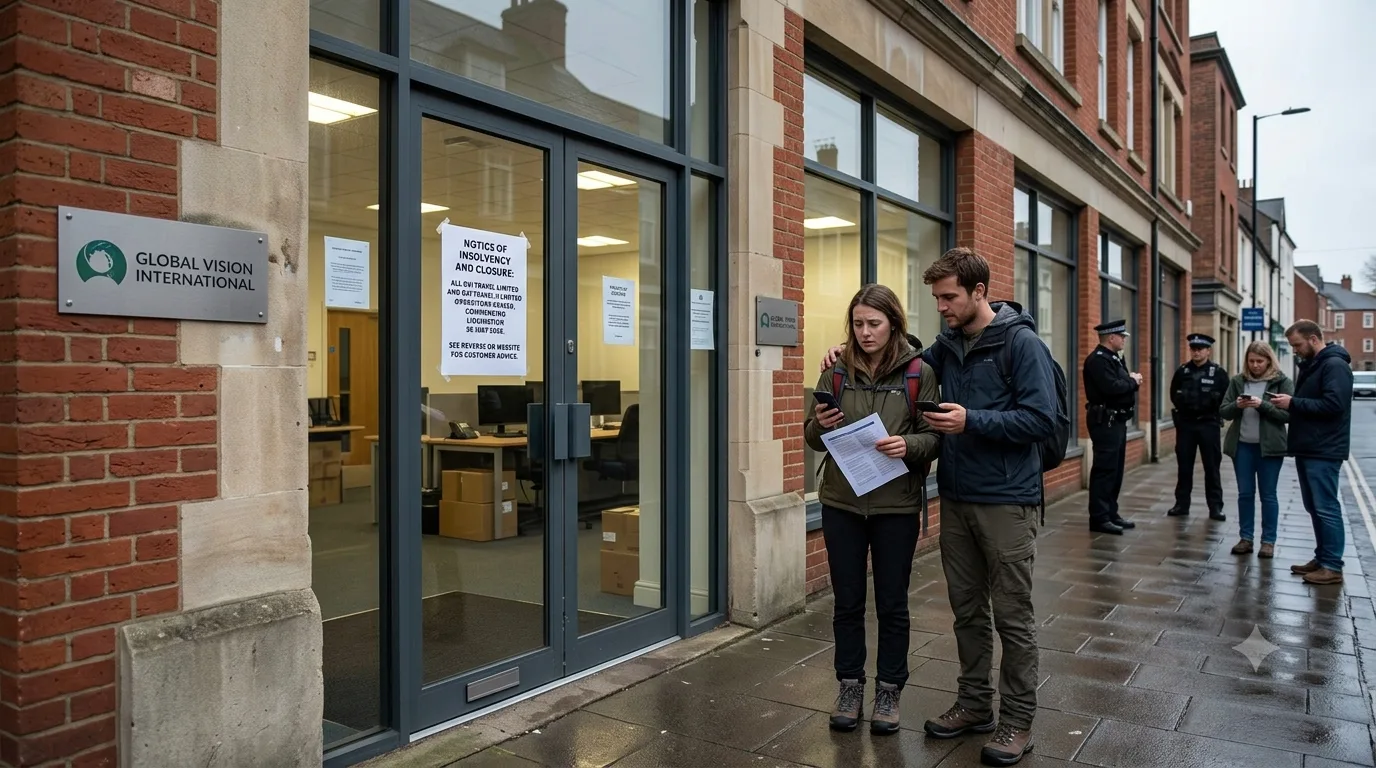
Global Vision International (GVI) has closed after almost three decades in volunteer travel, conservation and community development.
The organisation announced on 2 July 2026 that it was closing, cancelling its current and future programmes and moving towards formal liquidation.
The formal insolvency process followed later that month. Companies House now records both GVI Travel Limited and GVI Travel II Limited as being in creditors’ voluntary liquidation, with the winding-up of both companies commencing on 28 July 2026.
For customers who paid for cancelled programmes, the position is therefore more complicated than simply requesting a normal refund.
Depending on the company named on the booking, payment method and any travel protection attached to the trip, possible routes include lodging a creditor claim, making a Section 75 claim, requesting chargeback, checking travel insurance and, for qualifying flight-inclusive packages, checking ATOL protection.
Is Global Vision International Closed?
Yes. GVI publicly confirmed that it was closing its doors and entering a formal liquidation process.
Its closure announcement said the organisation had reached the end of its journey after operating for nearly three decades.
Reports reproducing the company’s final statement also confirmed that all current and future GVI programmes were cancelled and that participants already at GVI bases were being assisted with departure arrangements.
The closure affected a business associated with international volunteering, conservation, community projects, education and overseas travel experiences.
There is an important distinction between the date GVI announced its closure and the date the UK companies formally entered liquidation.
| Event | Date |
| GVI closure announcement | 2 July 2026 |
| Creditors’ meeting notices published | July 2026 |
| GVI Travel Limited winding-up commenced | 28 July 2026 |
| GVI Travel II Limited winding-up commenced | 28 July 2026 |
| Liquidation filings and statements of affairs filed at Companies House | 11 August 2026 |
Which GVI Companies Are in Liquidation?
Two UK companies carrying the GVI name are currently recorded in liquidation.
GVI Travel Limited
GVI Travel Limited, company number 09660367, is listed by Companies House with the status “Liquidation”. Its creditors’ voluntary liquidation commenced on 28 July 2026.
The appointed practitioners are:
- Michael Goldstein
- Avner Radomsky
Both are associated with RG Insolvency. The official Companies House insolvency record for GVI Travel Limited provides the current case details.
GVI Travel II Limited
GVI Travel II Limited, company number 15772721, also entered creditors’ voluntary liquidation on 28 July 2026.
Its appointed practitioners are:
- Avner Radomsky
- Charlotte Jobling
The current status can be checked through the Companies House insolvency record for GVI Travel II Limited.
Customers should check their original contract, invoice and payment records to establish which legal entity received their money rather than assuming that every GVI booking was contracted with the same company.
Why Did Global Vision International Close?
The evidence confirms that GVI reached the point where it could no longer meet its obligations, but a single definitive underlying cause for the collapse has not been publicly established.
The Guardian reported chief executive Andrew Valentine as saying that GVI had experienced weaker periods of commercial performance and that by 30 June 2026 it had become clear that the business could no longer meet its obligations.
That helps explain the immediate insolvency position, but it does not establish one specific root cause.
It would therefore be premature to state as fact that the Global Vision International closure resulted solely from falling bookings, rising costs, management decisions, conditions in the volunteer-travel market or any other individual factor unless further evidence emerges from the liquidation process.
Companies House confirms that statements of affairs for both companies were filed on 11 August 2026, meaning further financial information forms part of the insolvency record.
What Happened to Existing GVI Programmes?
GVI’s final announcement said that current and future programmes had been cancelled.
Participants who were already overseas were being supported by staff while making arrangements to leave GVI bases, while affected customers were told that they would receive formal information explaining the liquidation process and how claims could be lodged.
Customers should retain:
- Programme booking confirmations
- Contracts and invoices
- Card or bank statements
- Receipts
- Emails from GVI
- Cancellation notices
- Travel insurance documents
- Flight and accommodation bookings
- Any correspondence from the insolvency practitioners
These records may be needed by the liquidator, card issuer, insurer or another protection provider.
What Should Affected GVI Customers Do Now?
The correct route depends largely on which company owes the customer money, how the booking was paid for and what was included in the travel arrangement.
Register a Claim With the Liquidator
A customer who is owed money by an insolvent GVI company should follow the instructions issued by the relevant liquidator.
UK government guidance explains that a person or business owed money by a company in liquidation can register as a creditor by contacting the person handling the insolvency. Registration does not guarantee repayment.
Customers should make sure that any claim is submitted against the correct legal entity shown on their paperwork.
Consider Section 75 for Qualifying Credit-Card Payments
Customers who paid by credit card may have an additional route under Section 75 of the Consumer Credit Act 1974.
MoneyHelper states that Section 75 can apply where the cash price of the purchase is more than £100 and no more than £30,000. The credit-card provider can share liability with the supplier where qualifying goods or services are not provided.
Importantly, the entire purchase does not necessarily have to have been paid on the credit card. A qualifying purchase may still be protected where only a deposit was placed on the card.
Eligibility can become more complicated where an intermediary or third-party payment service was involved, so affected customers should ask the card provider to assess the actual transaction rather than assuming that protection automatically applies.
Ask About Chargeback
Chargeback may be relevant for customers who used a debit card, prepaid card or a card transaction that does not qualify for Section 75.
Unlike Section 75, chargeback is not a statutory legal right. It operates through card-scheme rules.
MoneyHelper says claims are generally subject to a 120-day window, although where the purchase related to a future event or service the timing can run from the date on which that service was expected to take place.
Customers should therefore contact their card issuer promptly rather than waiting for the liquidation process to finish.
Check Travel Insurance
Some travel insurance policies provide cover for the insolvency or failure of a travel supplier, while others exclude it.
The existence and scope of protection depends on the policy wording, when the policy was purchased and the circumstances of the cancellation.
Customers should check for terms such as:
- End-supplier failure
- Supplier insolvency
- Cancellation
- Travel disruption
- Scheduled airline failure
A policy should not be assumed to cover GVI simply because travel insurance was purchased.
Check Whether ATOL Protection Applies
ATOL is relevant mainly where a qualifying booking included a flight as part of a protected travel arrangement.
Government passenger guidance says that customers who purchased a protected flight-inclusive package may be able to claim through the Civil Aviation Authority if the organiser becomes insolvent.
Customers with ATOL protection should normally have received an ATOL Certificate explaining their protection.
Not every GVI programme should therefore be described as ATOL protected. Customers need to check their own booking documents.
What About Flights Booked Separately?

A cancelled GVI programme does not automatically mean that a separately booked airline ticket is also cancelled or refundable.
If the flight is still scheduled to operate, the airline’s normal fare conditions may apply. Customers should check whether the ticket can be changed, credited or cancelled and then review any applicable insurance cover.
Where a flight was purchased separately from the GVI programme, customers should avoid assuming that the flight cost forms part of the same insolvency claim.
Does Making a Creditor Claim Guarantee a GVI Refund?
No.
Government guidance makes clear that registering as a creditor does not guarantee that money will be recovered.
The amount ultimately available depends on factors including the assets realised in the liquidation, costs of the insolvency process and the legal priority of claims.
Card protection or insurance may therefore be particularly important for customers who qualify.
Customers should also avoid submitting inconsistent claims or accepting multiple recoveries for the same loss. Banks, insurers and liquidators should be given accurate information about any amounts already recovered elsewhere.
Should Affected Customers Book With Another Volunteer Organisation?
Customers whose travel plans were disrupted can still consider another provider, but a replacement booking should be treated as a completely new commercial decision.
Before paying another organisation, travellers should consider:
- Which legal company will receive the payment
- How long that company has traded
- Whether recent company accounts and filings are available
- Clear cancellation and refund terms
- What happens if the provider becomes insolvent
- Whether a flight-inclusive package has financial protection
- Whether payment can be made using a method offering consumer protection
- Whether local partners and accommodation arrangements are clearly identified
- Independent reviews rather than testimonials controlled by the provider
- What support exists if a programme ends unexpectedly
The supplied Volunteering Solutions reference recommends alternative volunteer providers, but those commercial recommendations should be evaluated independently rather than treated as evidence about the financial stability of any replacement company.
The GVI failure also sits alongside other recent travel-sector insolvencies, although each case has different facts and consumer protections. UK Business Journals has separately examined the Ski Yodl travel company liquidation and the Ascend Airways liquidation.
What Happens Next in the GVI Liquidation?
The appointed liquidators will continue administering the two companies, dealing with claims, assets and creditors under the insolvency process.
Companies House filing histories already show the winding-up resolutions, liquidator appointments and statements of affairs filed in August 2026. Further documents may provide additional information as the cases progress.
For affected customers, the most important distinction is between waiting passively for the liquidation to conclude and pursuing any other protection that may already be available.
Customers should keep their records, identify the correct GVI entity, follow communications from the insolvency practitioners and promptly investigate any Section 75, chargeback, insurance or ATOL rights that might apply.
The Global Vision International closure is confirmed. What remains uncertain is how much individual creditors will ultimately recover and whether later insolvency reporting will provide a fuller explanation of the financial circumstances that brought almost three decades of GVI operations to an end.
FAQs
Is Global Vision International closed?
Yes. Global Vision International announced its closure in July 2026, and its UK companies subsequently entered creditors’ voluntary liquidation.
When did GVI go into liquidation?
GVI Travel Limited and GVI Travel II Limited both entered creditors’ voluntary liquidation on 28 July 2026.
Can customers get a refund from GVI?
A refund is not guaranteed. Customers may need to lodge a creditor claim and should also check whether Section 75, chargeback, travel insurance or ATOL protection applies.
What happened to existing GVI programmes?
GVI cancelled its current and future programmes following the closure announcement, including programmes that had already been booked.
Why did Global Vision International close?
GVI said it could no longer meet its obligations, but the available evidence does not establish one definitive underlying cause for the collapse.