


The UNISON pay rise 2026/27 has been agreed at 3.3% for eligible council and school employees covered by the National Joint Council (NJC) pay framework in England, Wales and Northern Ireland.
The settlement was accepted by the joint trade unions on 24 August 2026, following months of disagreement over the proposed increase.
The revised pay rates apply retrospectively from 1 April 2026, with eligible workers entitled to backdated salary adjustments where their employers continued paying the previous rates.
However, the agreement represents a compromise rather than the improvement UNISON originally sought. The union had campaigned for at least £3,000 or 10%, whichever was greater, alongside a £15 minimum hourly rate and improvements to working conditions.
Our analysis of official union announcements, employer pay schedules and wider public-sector settlements shows that the agreement provides certainty over salaries but leaves important questions about long-term wage growth, recruitment and affordability.
The distinction is particularly important because UNISON represents workers across several sectors. The NJC settlement does not automatically apply to NHS employees, Scottish council workers or every school employee.
What Is the Latest Update on the UNISON Pay Rise 2026?
The latest confirmed position is that the 2026/27 NJC pay agreement has been settled at 3.3%, covering the period from 1 April 2026 to 31 March 2027.
The agreement applies to eligible pay points and nationally covered allowances.
| Key Detail | Confirmed Position |
| Pay award | 3.3% |
| Agreement reached | 24 August 2026 |
| Effective date | 1 April 2026 |
| Settlement period | 2026/27 |
| NJC pay points | SCP 3–43 |
| Lowest NJC hourly rate | £13.28 |
| Lowest full-time NJC salary | £25,614 |
| Backdated pay | From 1 April 2026 |
| UNISON’s original claim | £3,000 or 10%, whichever greater |
| Proposed minimum hourly rate | £15 |
| Current settlement status | Agreed |
The agreement also includes a 3.3% increase in eligible NJC allowances and applicable salaries above the national spine but below deputy chief officer level.
An important development is that the previous lowest pay point, SCP 2, has been removed. SCP 3 is now the lowest point on the standard NJC spine.
This changes the practical calculation for some of the lowest-paid employees, whose increase may exceed the headline 3.3% because they have moved onto a higher pay point.
How the Agreement Developed?
UNISON initially rejected the employers’ offer because it fell substantially below the unions’ original claim.
The union subsequently conducted targeted industrial action ballots in England and Wales. Although votes returned were overwhelmingly supportive of action, the necessary turnout threshold was not achieved across enough major employers to support an effective escalation.
The union consequently moved towards accepting the settlement alongside the other negotiating unions.
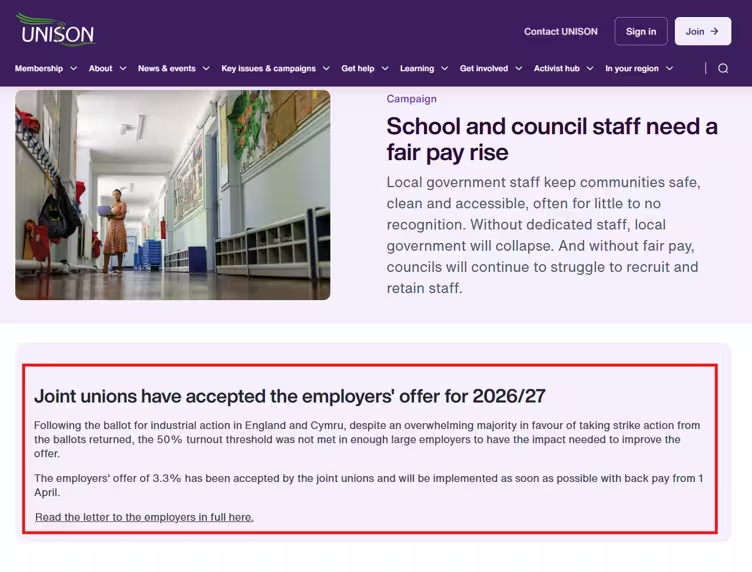
UNISON officially confirms the acceptance of the 3.3% local government and school staff pay offer on 24 August 2026.
Why Did UNISON Initially Reject the 3.3% Pay Offer?
UNISON’s rejection was primarily a response to the difference between the employers’ proposal and the scale of the union’s pay demands.
The original claim sought a substantial improvement in the purchasing power of council and school employees, especially those working in lower-paid occupations.
The union argued that several years of inflation, workforce pressures and comparatively weak salary growth had reduced the attractiveness of local government employment.
UNISON’s Original Pay Demands
| Negotiating Issue | UNISON’s 2026 Claim | Final Agreement |
| Basic salary | £3,000 or 10%, whichever greater | 3.3% |
| Minimum hourly pay | £15 | £13.28 lowest NJC rate |
| Working week | Two-hour reduction | No equivalent national reduction |
| Annual leave | One additional day | No equivalent national increase |
| Term-time leave | One paid day during term time for school support staff | Not included in settlement |
| Teaching assistant structure | Removal of Level 1 TA role | Not agreed as part of the award |
| Settlement duration | One-year claim, with a conditional multiyear option | One year |
The difference between the proposed and accepted headline percentage increases was 6.7 percentage points.
Nevertheless, comparing the figures requires care. UNISON’s claim combined a percentage-based demand with a minimum cash increase, meaning lower-paid workers could have received proportionately larger increases.
For example, someone earning £25,000 would receive £825 from a 3.3% rise. The union’s proposed minimum increase of £3,000 would have represented 12% of that salary.
The employers’ settlement therefore delivered a considerably smaller improvement than the union’s initial objective.
From a workforce-management perspective, the disagreement illustrates the challenge facing public employers. Increasing wages helps recruitment and retention, but councils and schools must also finance additional employment costs within constrained budgets.
How Much Is the UNISON Pay Rise Worth for Different Salaries?
The cash value of a 3.3% increase depends on the employee’s existing salary and contractual working arrangements.
A worker earning £30,000 receives a gross annual increase of £990, while someone earning £40,000 receives £1,320 before deductions.
| Previous Annual Salary | 3.3% Increase | New Annual Salary | Monthly Gross Increase |
| £20,000 | £660 | £20,660 | £55 |
| £24,000 | £792 | £24,792 | £66 |
| £25,000 | £825 | £25,825 | £68.75 |
| £28,000 | £924 | £28,924 | £77 |
| £30,000 | £990 | £30,990 | £82.50 |
| £35,000 | £1,155 | £36,155 | £96.25 |
| £40,000 | £1,320 | £41,320 | £110 |
| £45,000 | £1,485 | £46,485 | £123.75 |
| £50,000 | £1,650 | £51,650 | £137.50 |
These are illustrative percentage calculations, not official NJC grade allocations.
For employees on nationally recognised NJC pay points, the precise salary is determined by the revised pay spine.
What Are the New NJC Pay Scales for 2026/27?
The new pay agreement increased standard national salary points by 3.3%, subject to rounding and the removal of SCP 2.
| NJC Pay Point | 2025/26 Salary | 2026/27 Salary | Annual Increase |
| SCP 2 | £24,413 | Removed | — |
| SCP 3 | £24,796 | £25,614 | £818 |
| SCP 5 | £25,583 | £26,427 | £844 |
| SCP 10 | £27,694 | £28,608 | £914 |
| SCP 15 | £30,024 | £31,015 | £991 |
| SCP 20 | £32,597 | £33,673 | £1,076 |
| SCP 25 | £36,363 | £37,563 | £1,200 |
| SCP 30 | £40,777 | £42,123 | £1,346 |
| SCP 35 | £46,142 | £47,665 | £1,523 |
| SCP 40 | £51,356 | £53,051 | £1,695 |
| SCP 43 | £54,495 | £56,293 | £1,798 |
These are national full-time salary figures. Local grading arrangements, London pay structures and part-time employment can produce different individual salaries.
The removal of SCP 2 means an employee previously receiving £24,413 who moves to SCP 3 at £25,614 would experience an increase of £1,201, approximately 4.9%.
This is a meaningful distinction from the standard 3.3% headline.
It also demonstrates why employees should check their actual spinal column point instead of calculating every pay increase using their previous salary alone.
When Will UNISON Members Receive Their 2026 Back Pay?
The pay rise is backdated to 1 April 2026, but the date employees receive the outstanding money depends on their employer’s payroll arrangements.
For example, Devon County Council confirmed that maintained schools using its payroll service would receive the increase, backdated to April, through the September 2026 payroll.
Oxfordshire also confirmed arrangements for eligible school support staff, with the award implemented in October’s payroll.
These examples demonstrate why there is no single national payment date for every council and school employee.
How Is Back Pay Calculated?
Back pay represents the difference between what an employee received under their previous salary and what they should have received under the revised rate.
Consider a worker previously earning £30,000:
- Previous annual salary: £30,000
- Annual increase: £990
- Monthly gross increase: £82.50
- Six months of salary arrears: £495
If the new rate first applies to October’s normal pay, with April to September arrears outstanding, the employee could receive approximately £495 in gross back pay in addition to the new October salary.
This example assumes unchanged hours, no unpaid leave, no separate allowances and an even monthly salary.
Workers should also consider whether arrears are due on overtime, additional hours or payments linked to their basic hourly rate.
Can Former Employees Claim Backdated Pay?
Employees who left an eligible NJC-covered role after 1 April 2026 may also be entitled to arrears for their period of employment.
National employer guidance recommends that former employees who request outstanding pay should receive money due between 1 April 2026 and their leaving date.
This may apply to workers who resigned, retired, transferred to another employer or otherwise ended their employment after the award’s effective date.
Former employees should contact their previous payroll department rather than assume payments will arrive automatically.
Which Employees Are Covered by the UNISON Pay Rise?
The 3.3% NJC award covers employees whose contracts incorporate the relevant national local government pay arrangements.
This includes many workers employed by councils, maintained schools and certain academy trusts.
Typical occupations include administrative employees, library workers, housing officers, environmental services employees, caretakers, teaching assistants, catering staff and customer service teams.
However, eligibility depends on the contractual pay framework, not simply on being a UNISON member.
An employee who belongs to UNISON but works under a separate national or local agreement may receive a different increase.
Do Teaching Assistants Receive the Same Pay Rise?
Teaching assistants employed on NJC-linked pay structures generally qualify for the 3.3% settlement.
The actual cash increase depends on their grade, working hours and whether they are employed throughout the year or only during school terms.
Further details about school support staff pay explain how contractual hours, academy arrangements and salary scales affect individual entitlements.
A term-time-only employee should not assume that the full-time salary listed on a national NJC table will be their actual annual earnings.
Are Academy and Agency Workers Included?
Academy trusts can operate their own employment arrangements.
Some continue to follow NJC scales, while others use independently determined pay structures.
Agency workers are also not automatically covered by the national agreement because their employment relationship is normally with an agency rather than the council or school where they work.
Employees should review their contract and employer communications to establish whether the award applies.
Is the UNISON Pay Rise Different in Scotland?
Yes. Scottish local government employees are covered by a separate negotiating framework involving COSLA and the Scottish Joint Council.
Scottish council workers agreed a two-year settlement providing:
| Financial Year | Scottish Local Government Increase |
| 2025/26 | 4% |
| 2026/27 | 3.5% |
UNISON reported that 83% of members participating in its Scottish consultation voted to accept the two-year deal in July 2025.
Suzanne Gens, chair of UNISON Scotland’s local government committee, described the agreement as a crucial improvement in efforts to reverse reductions in council staff pay.
The agreement provided a degree of income certainty over two years, unlike the single-year NJC settlement in England, Wales and Northern Ireland.
In Scotland, the locally applicable salary scales and allowances remain important because employees should not simply use an English NJC salary table to calculate their wages.
The separate Scottish settlement also demonstrates that a pay increase negotiated through UNISON is not necessarily a uniform UK-wide award.
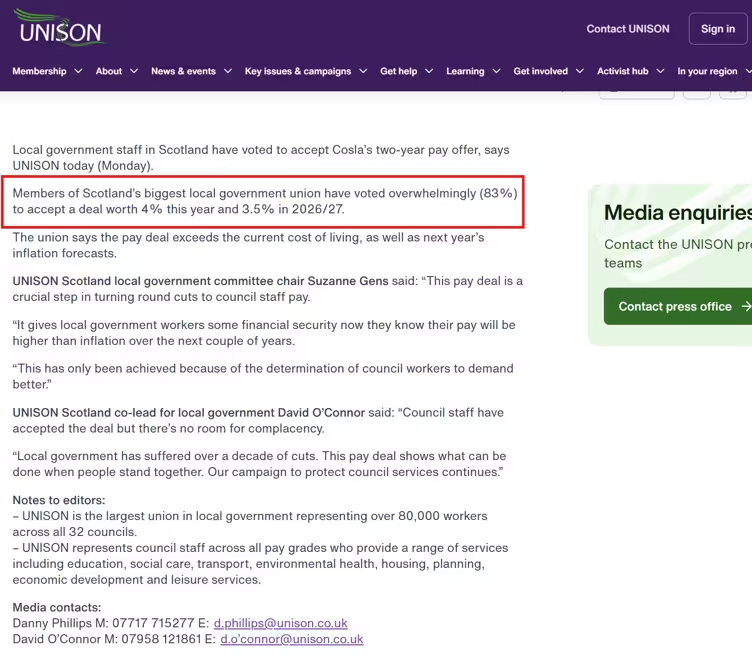
UNISON Scotland confirms that members accepted a two-year local government pay settlement, including a 3.5% increase for 2026/27.
How Does the UNISON Pay Rise Compare With Other Public-Sector Workers?
The 3.3% NJC agreement sits within a wider period of public-sector salary adjustments.
However, comparing the awards requires an understanding of which negotiating system applies to each workforce.
| Workforce | 2026/27 Pay Increase | Pay Framework |
| NJC council and school staff | 3.3% | National Joint Council |
| Scottish council employees | 3.5% | Scottish Joint Council |
| NHS Agenda for Change staff in England | 3.3% | NHS Pay Review Body process |
| Prison staff in England and Wales | At least 3.5% for eligible grades | Prison Service Pay Review Body |
| MPs | 5% | IPSA |
The identical 3.3% figure for NJC workers and NHS Agenda for Change staff does not make the agreements interchangeable.
NHS staff receive pay under a different national salary framework, while Scottish council workers have their own collective bargaining system.
In discussions about the prison officer pay rise, attention has similarly focused on recruitment, retention, workload and the purchasing power of salary increases.
The comparison with the MPs pay rise also illustrates why public-sector wage decisions frequently attract scrutiny. However, MPs’ salaries are independently determined through a different system that includes benchmarking considerations.
Headline percentages alone therefore cannot establish whether one workforce has received fairer treatment than another.
What Has UNISON Said About the NHS Pay Rise in 2026?
NHS Agenda for Change staff in England received a 3.3% pay award effective from 1 April 2026.
UNISON criticised the increase, arguing that it did not adequately compensate employees for the continuing pressure from household costs and workforce shortages.
Helga Pile, UNISON’s head of health, stated in February 2026:
“Hard-pressed NHS staff will be downright angry at another below-inflation pay award.”
The union has also pursued improvements to the NHS pay structure, including concerns about career progression and the differences between salary bands.
In September 2026, fourteen health unions called for renewed progress on negotiations intended to address longstanding problems with Agenda for Change pay.
These discussions are separate from the council and school staff agreement.
For healthcare employees, the relevant issue is therefore not whether the NJC award has been accepted, but how future NHS pay reform could affect salary bands, progression and the overall employment package.
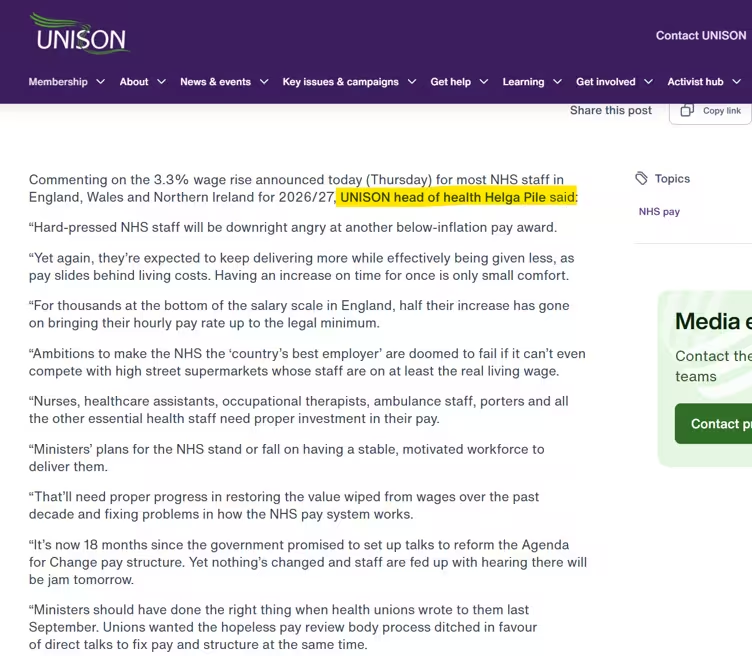
UNISON’s official statement on the 3.3% NHS pay award and its concerns about inflation.
Is the 3.3% UNISON Pay Rise Enough to Beat Inflation?
The value of the pay award must be assessed against the increase in consumer prices.
According to the latest Office for National Statistics inflation release available on 2 November 2026, annual CPI inflation was 3.5% in September 2026, while CPIH inflation was 3.6%.
This creates a challenging comparison for workers receiving a 3.3% increase.
| Indicator | Percentage |
| NJC pay rise 2026/27 | 3.3% |
| September 2026 CPI inflation | 3.5% |
| September 2026 CPIH inflation | 3.6% |
| Gap against CPI | -0.2 percentage points |
| Gap against CPIH | -0.3 percentage points |
At that particular point, annual inflation was slightly higher than the NJC salary increase.
That does not by itself determine the real-terms value of the award across the entire financial year. A full comparison would require inflation over the relevant period.
Nevertheless, the figures help explain why unions remain concerned that nominal pay growth is not always translating into meaningful improvements in household purchasing power.
The situation becomes more complicated for employees facing unusually high housing, childcare, transport or energy costs.
Our assessment of the settlement is that the rise provides a permanent increase in base salary, but the relatively narrow difference between wage growth and inflation limits the immediate improvement in purchasing power.
How Does UNISON Pay Compare With the National Living Wage?
From 1 April 2026, the National Living Wage for eligible workers aged 21 and over increased to £12.71 per hour.
The lowest NJC hourly rate following the pay settlement is £13.28.
That creates a difference of £0.57 per hour, approximately 4.5% above the legal minimum.
| Hourly Pay Benchmark | Rate |
| National Living Wage, April 2026 | £12.71 |
| Lowest NJC hourly rate | £13.28 |
| UNISON’s proposed minimum | £15.00 |
| Gap between NJC minimum and union claim | £1.72 |
The union’s £15 objective was therefore not achieved.
The difference is particularly important for council and school employers competing with private-sector organisations for staff.
For example, the Morrisons pay rise increased the basic hourly rate for eligible customer assistants to £13.11 by October 2026.
Although the roles, working conditions and benefits differ, comparing entry-level wages helps explain why recruitment and retention remain important issues.
Public employers must consider not only gross salaries but also pensions, contracted hours, career development and the overall attractiveness of employment.
How Will the UNISON Pay Rise Affect Income Tax and National Insurance?
A 3.3% salary increase does not produce an identical 3.3% improvement in take-home pay.
Employees may pay additional Income Tax, National Insurance contributions and pension contributions as their gross earnings rise.
For example, a worker receiving an extra £990 annually may retain less than that amount after statutory and contractual deductions.
The precise effect depends on taxable income, tax code, pension arrangement and individual circumstances.
The continued freezing of certain tax thresholds also means that rising wages can bring more earnings into taxation or move employees into higher tax bands.
Our examination of the tax threshold freeze shows why an increase in nominal salary does not necessarily produce an equivalent improvement in disposable income.
The wider debate over the Personal Allowance is relevant because the standard tax-free threshold remains an important factor in workers’ final pay.
Will Back Pay Affect Universal Credit?
A lump-sum arrears payment can affect Universal Credit because the benefit is generally assessed against earnings received within an assessment period.
An employee receiving several months of outstanding pay in one payroll run may experience a temporary reduction in their Universal Credit award.
The consequences vary according to their household circumstances, work allowance and assessment period.
Employees should review their Universal Credit statement and contact the Department for Work and Pensions if they believe their earnings have been recorded incorrectly.
This is particularly important for low-paid and part-time workers because an increase in gross earnings may not be fully reflected in their immediate disposable income.
What Does the Pay Rise Mean for Local Government Employers?
For councils and schools, the financial impact extends beyond employee salaries.
Employers must account for increased pension costs, employer National Insurance liabilities, allowances and potentially higher payments for additional working hours.
Consider an organisation with an annual eligible salary bill of £10 million.
A uniform 3.3% increase represents an additional £330,000 in annual basic salary costs before consequential employment expenses.
The calculation is illustrative, but it demonstrates why apparently modest percentage changes can create substantial budget implications for large employers.
Councils must also consider how higher salary expenditure interacts with funding settlements, service demand and recruitment.
In sectors such as adult social care, education support, housing and environmental services, workforce shortages can increase reliance on temporary staffing.
Pay increases may help employers retain experienced employees, but the effect depends on how salaries compare with competing jobs and whether working conditions improve.
The importance of accurate implementation should not be underestimated.
Our review of HMRC payroll checks highlights why employers need reliable salary records, correctly calculated deductions and accurate reporting.
A delayed national pay settlement creates additional payroll work because employers must update salary scales and reconcile retrospective payments.
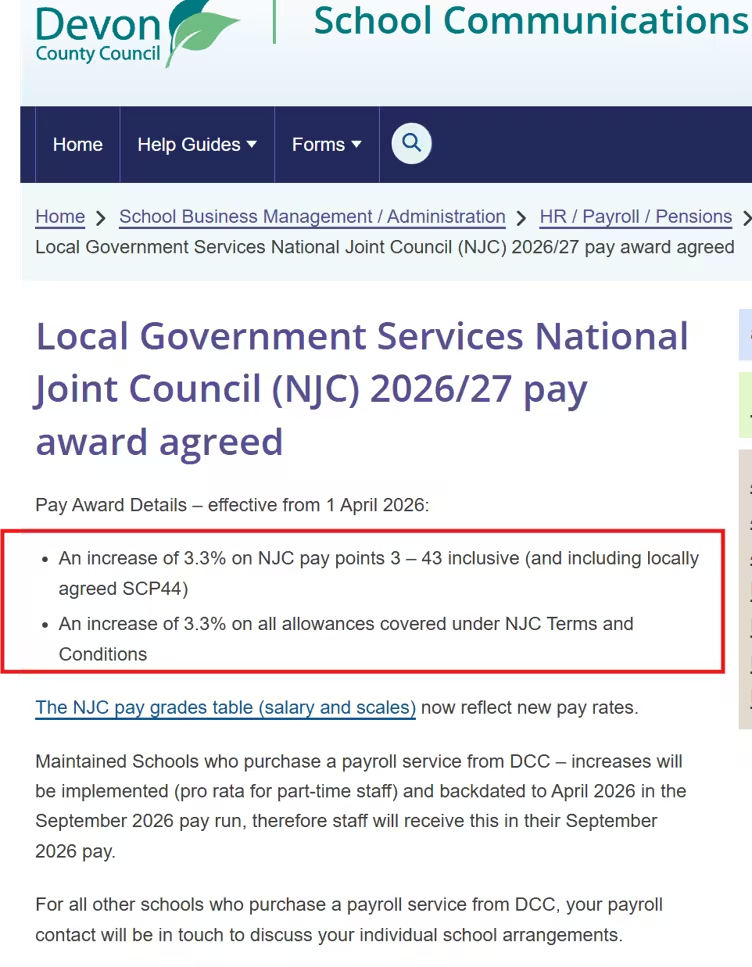
Local authority guidance showing how the agreed 3.3% NJC increase is implemented and backdated.
What Has Changed in UNISON Pay Over the Last Three Years?
The NJC pay framework has experienced different types of settlements in recent years.
| Financial Year | NJC Pay Settlement | Structure |
| 2024/25 | £1,290 | Fixed annual cash increase on relevant pay points |
| 2025/26 | 3.2% | Percentage increase |
| 2026/27 | 3.3% | Percentage increase |
The distinction matters because a flat cash increase delivers a larger percentage benefit to lower-paid workers than to higher-paid employees.
For example, £1,290 represents a more substantial percentage of a £25,000 salary than a £50,000 salary.
The subsequent movement towards uniform percentage increases provides more predictable proportional growth, but larger salaries receive larger cash gains.
For an employee remaining on the same pay point through the 2025/26 and 2026/27 awards, the two percentage increases compound to approximately 6.61%, before considering any other contractual or grading adjustments.
This explains why UNISON has repeatedly advocated measures targeted at the lowest-paid workers rather than relying solely on standard percentage increases.
What Will Happen to the UNISON Pay Rise in 2027?
The 2026/27 NJC settlement runs to 31 March 2027.
UNISON has already indicated that its attention is turning towards the next pay round.
The union’s priorities are likely to continue reflecting concerns about salary erosion, affordability, recruitment and retention.
However, a new NJC increase for 2027/28 should not be presented as confirmed until employers and the negotiating unions reach an agreement.
The Next NJC Pay Claim
Following the acceptance of the 2026 settlement, UNISON branches began preparing for the next negotiating period.
The union has indicated that member consultation will be an important part of determining future pay demands.
For employers, early negotiations would provide greater budget certainty and potentially reduce the need for large retrospective salary adjustments.
For workers, earlier agreements could reduce the period between an annual pay award’s effective date and its appearance in monthly wages.
What Is the School Support Staff Negotiating Body?
Another important development is the planned School Support Staff Negotiating Body (SSSNB) in England.
The government has outlined a dedicated negotiating structure covering pay, employment conditions, training and career development for eligible school support employees.
The Department for Education has stated that existing arrangements continue during 2026/27, with the first improvements arising from the SSSNB expected from 2027/28 at the earliest.
This means the SSSNB should not be confused with an additional confirmed 2026 pay award.
It represents a potential structural change to future negotiations.
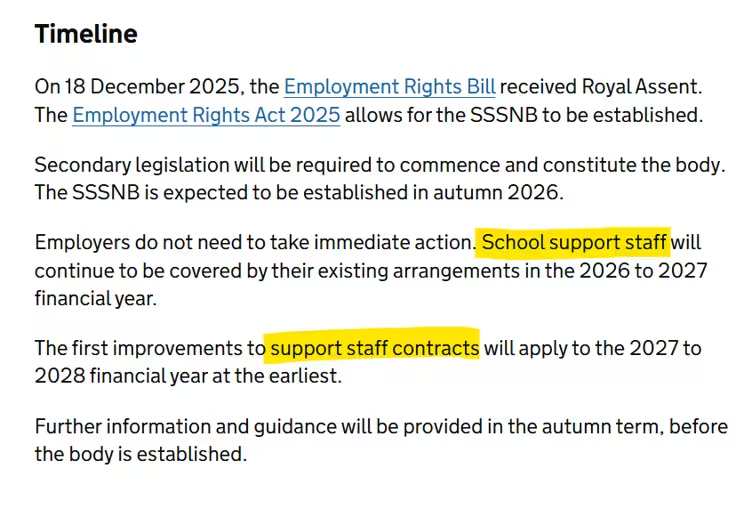
Department for Education guidance confirming the proposed timetable for the School Support Staff Negotiating Body.
What Should UNISON Members Check After the Pay Settlement?
Following implementation of the 3.3% agreement, employees should review their updated payslips carefully.
The most important details include their revised pay point, contractual hours, hourly rate, backdated salary and eligible allowances.
Workers should also check whether their payroll includes adjustments for overtime and any payments linked to the revised basic rate.
For part-time or term-time-only employees, the annual increase may differ from the headline figures in national full-time salary tables.
Employees who have changed jobs since April 2026 should check whether their previous employer owes them arrears.
Where a payslip appears incorrect, employees should contact their payroll department or UNISON branch with details of their previous salary and the expected revised rate.
Accurate implementation matters because the pay award is intended to be a permanent consolidated salary increase, not simply a one-off payment.
Conclusion
The UNISON pay rise for 2026/27 has been settled at 3.3% for eligible NJC council and school workers, with revised rates effective from 1 April 2026.
Although the agreement was initially rejected, the joint unions accepted the employers’ proposal on 24 August 2026 after industrial action ballots failed to secure the necessary turnout across enough major employers.
The settlement raises the lowest standard NJC salary to £25,614 and provides backdated pay where eligible workers continued receiving older rates.
Nevertheless, inflation, taxation, recruitment pressures and different regional pay arrangements mean the financial impact varies across the workforce.
The next major issue is the 2027 pay round, alongside potential changes to school support staff negotiations. For employees and employers, the priority is ensuring the agreed award has been implemented correctly while preparing for future salary decisions.
FAQs About the UNISON Pay Rise 2026
Has UNISON accepted the 2026 pay rise?
Yes. The joint unions accepted the 3.3% NJC pay settlement on 24 August 2026.
How much is the UNISON pay rise for 2026/27?
The agreed NJC increase is 3.3% on eligible salary points and allowances, effective from 1 April 2026.
When will UNISON members get their back pay?
Back pay is calculated from 1 April 2026, but actual payment dates depend on the employer and payroll provider.
What is the lowest NJC salary in 2026?
The standard national pay spine begins at SCP 3, with an annual full-time salary of £25,614 and an hourly rate of £13.28.
Did UNISON members vote for strike action?
Returned ballots showed strong support for action, but the required turnout threshold was not achieved across enough major employers to support the intended industrial action.
Do Scottish council employees get the same pay rise?
No. Scottish local government employees have a separate settlement providing a 3.5% increase for 2026/27.
Do NHS workers receive the UNISON NJC increase?
No. NHS Agenda for Change staff have separate national pay arrangements, although eligible staff in England also received a 3.3% award for 2026/27.
Will employees who left their jobs receive back pay?
Former eligible employees may be due arrears for employment after 1 April 2026 and should contact their previous employer if payment has not been arranged.
Is there another confirmed UNISON pay rise for 2027?
The next NJC pay round is being prepared, but no additional 2027/28 NJC settlement has been established in this review.
Will the School Support Staff Negotiating Body increase wages in 2027?
It could influence future pay and conditions, but no specific additional increase is guaranteed. The first negotiated improvements are expected from 2027/28 at the earliest.